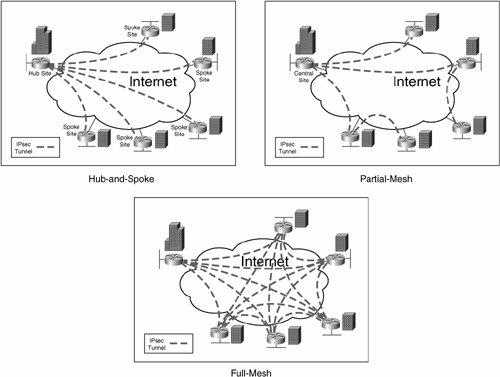
Advantages and Disadvantages of IPsec Site-to-Site VPNsBefore deciding whether to deploy an IPsec site-to-site VPN, it is important to take a look at their advantages and disadvantages:
Having examined some of the main advantages and disadvantages of IPsec site-to-site VPNs, it is now time to discuss their underlying operation. |
IPsec: A Security Architecture for IP
IPsec protects IPv4 and IPv6 traffic as it transits a network between end
Note
In this book, the
The terms IPsec peer and IPsec device refer to IPsec-enabled end hosts or security gateways. IPsec consists of a number of elements, including the following:
These elements together provide the following security services to IP:
Cryptographic Algorithms
IPsec relies on a number of cryptographic algorithms to authenticate and encrypt
The sections that follow discuss these algorithm types in greater detail. Authentication AlgorithmsIn IPsec, a number of hash algorithms provide connectionless integrity and data origin authentication (authentication). These algorithms are discussed in this section. Hash Algorithms
A hash algorithm is a type of cryptographic algorithm that takes a message of an
arbitrary length
as its input and produces a
fixed-length
output value that is characteristic of the message input and no other message. The output value produced by a hash algorithm is variously called a hash value, a
Two common hash algorithms are Message Digest 5 (MD5) and the Secure Hash Algorithm (SHA-1). MD5 produces a 128-bit hash, and SHA-1 produces a 160-bit hash. As an example of the operation of a hash algorithm, the message "Comparing, Designing, and Deploying Virtual Private Networks by Mark Lewis" produces the output hash value (in hexadecimal) of 0x164727408b1e20f1c97b6952b1cb425c4ffa8864 using SHA-1, and the message "Troubleshooting Virtual Private Networks by Mark Lewis" produces the output hash value 0xecaae55ceff1d90ebff79def877796e033538f4a using SHA-1. Cryptographic hash algorithms have two important characteristics:
Note See the following URL if you would like to try out the MD5 and SHA-1 hash algorithms yourself: http://block111.servehttp.com/hash http://pajhome.org.uk/crypt/md5/ Now, because a hash algorithm provides a fingerprint of a message, you might think that if a host or security gateway simply sends a hash value along with a message this would be enough to ensure that an attacker would not be able to tamper with that message. But this is not the case. Figure 6-2 illustrates transmission of a message with its corresponding hash value. Figure 6-2. "Authenticating" a Message with a Hash Value
To keep the following example as simple to follow as possible, hash values for the messages "Comparing, Designing, and Deploying Virtual Private Networks by Mark Lewis" and "Troubleshooting Virtual Private Networks by Mark Lewis" have been truncated to 16 bits (4 hexadecimal numerals). In Figure 6-2, the London gateway transmits a message ("Comparing, Designing, and Deploying Virtual Private Networks by Mark Lewis") along with its corresponding (truncated) SHA-1 hash value, 0x1647. If an attacker modifies the message to be "Troubleshooting Virtual Private Networks," the Paris gateway will detect this when it receives the message, as shown in Figure 6-3. Figure 6-3. An Attacker Modifies the Message
In Figure 6-3, the London gateway calculates a hash value for "Comparing, Designing, and Deploying Virtual Private Networks by Mark Lewis" (truncated to 0x1647) and attaches this hash value to the message before sending the message to the Paris gateway.
An attacker alters the message to "Troubleshooting Virtual Private Networks by Mark Lewis" as it transits the Internet to the Paris gateway. The Paris gateway then receives the message (now "Troubleshooting Virtual Private Networks by Mark Lewis") and calculates a hash value (truncated to 0xecaa). The locally calculated hash value (0xecaa) does not match the attached hash value (0x1647, which corresponds to the message "Comparing, Designing, and Deploying Virtual Private Networks by Mark Lewis"), and so the Paris gateway
At this point, it might appear that a hash algorithm can prevent an attacker altering a message; however,
Figure 6-4. An Attacker Modifies the Message and the Hash Value
In Figure 6-4, the London gateway calculates a hash value for "Comparing, Designing, and Deploying Virtual Private Networks by Mark Lewis" (truncated to 0x1647), and attaches this hash value to the message. The London gateway then sends the message to the Paris gateway. The attacker intercepts and alters the message (to "Troubleshooting Virtual Private Networks by Mark Lewis") and adds the new hash value 0xecaa (which corresponds to the message "Troubleshooting Virtual Private Networks by Mark Lewis"). Finally, the Paris gateway receives the message ("Troubleshooting Virtual Private Networks by Mark Lewis") and calculates a hash value (truncated to 0xecaa). The locally calculated hash value (0xecaa) matches the attached hash value (0xecaa), and so the Paris gateway accepts the message. So, if the attacker alters the attached hash value at the same time as altering the message itself, the message will be accepted by the receiving gateway. Clearly, a simple hash value is not enough to protect a message from tampering. Message Authentication Code (MAC) and Hashed Message Authentication Code (HMAC) AlgorithmsAs stated in the previous section, a simple hash value is not enough to ensure that a message is not tampered with in transit between IPsec-enabled hosts or security gateways.
What is needed is to add something else (apart from the message itself) as an input to the hash algorithm such that only the sending and receiving hosts or security gateways can correctly calculate and verify the hash value. This something is a
shared key
. If the attacker does not know the shared key, any attempt to modify the message or the hash or both will result in the receiving gateway
Figure 6-5. An Attacker Modifies the Message and the Hash
Notice in Figure 6-5 that the hash value calculated by the London gateway (0xa45e) no longer corresponds to the output of the regular SHA-1 hash algorithm. The output of regular SHA-1 for the "Comparing, Designing, and Deploying Virtual Private Networks by Mark Lewis" message is (when truncated to 16 bits) 0x1647. This difference in hash values (0xa45e and 0x1647) is due to the addition of a shared key as an input to the SHA-1 hash algorithm. A hash algorithm that uses the message and a shared key as inputs is known as a Message Authentication Code (MAC) algorithm. One further characteristic of a MAC (apart from ensuring that a message cannot been tampered with) is that a receiver can use it for data origin authentication (to verify that a specific sender did, indeed, send the message). The MAC can be used for data origin authentication because only the sender and receiver know the shared key and can correctly calculate MACs. If an attacker attempts to modify a MAC, the receiver will detect this attempt because the attacker does not possess the shared key.
However, that is not quite the end of the story. Regular MD5 and SHA-1 have been shown to be vulnerable to attack, and so IPsec uses a
Figure 6-6. HMAC Algorithm
Two HMACs algorithms that are often used with IPsec are MD5-HMAC-96 and SHA-HMAC-96. Whereas regular MD5 produces a 128-bit output and SHA-1 produces a 160-bit output, MD5-HMAC-96 and SHA-HMAC-96 both produce a truncated output of 96 bits. One advantage of this
Note MAC and HMAC algorithms are often referred to simply as hash algorithms . Encryption Algorithms
Encryption is a process by which data is rendered incomprehensible to
The process of encryption changes a plaintext to a ciphertext; the process of changing the ciphertext back to its unencrypted plaintext form is known as decryption . IPsec uses symmetric encryption algorithms for bulk encryption of data. Symmetric encryption algorithms use a key as an input (along with a plaintext) to produce a ciphertext. The same key is used as an input (with the ciphertext) to reproduce the plaintext. So, when one IPsec VPN gateway encrypts data with a certain key, another gateway will require that same key to decrypt the data. Figure 6-7 illustrates encryption and decryption using a symmetric encryption algorithm. Figure 6-7. Encryption and Decryption Using a Symmetric Encryption Algorithm
The main characteristics of symmetric encryption algorithms are as
There are two types of symmetric encryption algorithms:
The sections the follow describe each symmetric encryption algorithm in more detail. Block Ciphers
Block ciphers encrypt and decrypt a block of plaintext or ciphertext at one time and can
In ECB mode, each block of plaintext is encrypted independently. One
In ECB mode, an attacker might then be able to analyze patterns of identical blocks of ciphertext within the complete ciphertext. In addition, a ciphertext produced using ECB mode might be vulnerable to cut-and-paste attacks (the substitution of blocks of ciphertext). The CBC, CFB, and OFB modes of operation introduce an element of feedback into the encryption of any given block of plaintext. In CBC mode, prior to encryption, each block of plaintext is first XOR'd (exclusive OR'd) with the ciphertext corresponding to the previous block of data. Because there is no previous block of data, the first block of plaintext is first XOR'd with a special random value called an initialization vector (IV) prior to encryption.
Figure 6-8 illustrates encryption using CBC mode (with, in this example, an eight-character block
Figure 6-8. Encryption Using CBC Mode
In Figure 6-8, the first block of eight
The
The process of encrypting each block is
Two examples of block ciphers are the Data Encryption Standard (DES) and the Advanced Encryption Standard (AES). The U.S. National Institute of Standards and Technology has published both of these algorithms as Federal Information Processing Standards (FIPS), and each can operate in CBC mode. DES encrypts/decrypts 64-bit blocks of plaintext/ciphertext at a time and uses a 64-bit key. For parity, 8 bits of the key are used, and so the effective key length is 56 bits. Triple DES (3DES) is a derivation of the DES algorithm that uses different keys to (typically) encrypt, then decrypt, and finally encrypt each block of plaintext. 3DES has an effective key length of 168 bits (3 * 56 bits).
DES has in recent
Although 3DES currently remains secure, it is slow, and so in 1997, NIST initiated a competition to find a replacement for DES. In October 2000, the Rijndael algorithm was selected as the winner of the competition and in 2001 was published as a FIPS. AES encrypts/decrypts 128-bit blocks of plaintext/ciphertext in one go, and can use key lengths of 128 bits, 192 bits, or 256 bits.
Note If you would like to see a block cipher (AES) in action, you might like to download the following Flash animation: http://www.esat.kuleuven.ac.be/~rijmen/rijndael/Rijndael_Anim_exe.zip Stream CiphersStream ciphers, in contrast to block ciphers, operate on the plaintext (usually) a single bit at a time. Stream ciphers are fastusually faster than block ciphers. Examples of stream ciphers are RC4 and the Software Encryption Algorithm (SEAL). RC4 was designed by Ron Rivest, and SEAL was designed by Phil Rogaway and Don Coppersmith and is optimized for 32-bit processors. Public Key Cryptographic Algorithms
In the previous two sections, symmetric cryptographic algorithms (that require the sender and receiver of a message to be in possession of the same key) were discussed. Public key (asymmetric) cryptographic algorithms
Public key algorithms have a number of characteristics, including the following:
Some popular public key algorithms are the Diffie-Hellman; Rivest, Shamir, and Addlemen (RSA); the Digital Signature Algorithm (DSA); and ElGamal. Diffie-Hellman is used for key exchange, RSA and ElGamal can be used for encryption or digital signatures, and DSA can, as the
Encryption Using Public Key AlgorithmsAs previously discussed, symmetric encryption algorithms use the same key for both encryption and decryption, but public key algorithms use one key for encryption and another for decryption. Public key algorithms require a public key and a mathematically associated private key. Any data encrypted using the public key must be decrypted using the corresponding private key. Similarly, any data encrypted with the private key must be decrypted using the corresponding public key.
Any data encrypted using the public key cannot be decrypted using the public key, and any data encrypted using the private key cannot be decrypted using the private key. Figures 6-9 and 6-10
Figure 6-9. Encryption with the Private Key, and Decryption with the Corresponding Public Key
Figure 6-10. Encryption with the Public Key, and Decryption with the Corresponding Private Key
Digital Signatures
Digital signatures are
encrypted hash values
and can be used to
Figure 6-11. Using a Digital Signature
In Figure 6-11, Host A calculates a hash value on the message "Comparing, Designing, and Deploying Virtual Private Networks by Mark Lewis" and then encrypts this hash using its private key , giving a digital signature. Host A attaches this digital signature to the message (signs the message) and sends it to the Host B. Host B now calculates its own hash value on the message. It then decrypts the hash value from Host A using Host A's public key . If Host B's and Host A's hash values match, Host B accepts the message.
If the hash values match, the Host B gateway
Key Exchange with Diffie-Hellman
Diffie-Hellman is a public key algorithm that allows two peers to establish a secret key that only they know while communicating over an
Figure 6-12. Diffie-Hellman Exchange
In Figure 6-12, the following events occur:
Security Protocols: AH and ESPIPsec uses two security protocols, the Authentication Header (AH) and the Encapsulating Security Payload (ESP). The following two sections discuss AH and ESP. Authentication Header (AH)AH is a packet header that provides the following security services:
AH is IP protocol 51. Figure 6-13 shows the AH header format. Figure 6-13. AH Header Format
AH fields have the following functions:
AH can operate in two modes:
In transport mode, the AH header is inserted between the original IP header and header of the next protocol (such as TCP, UDP, or ICMP) of the user packet being protected. Figure 6-14 shows AH transport mode. Figure 6-14. AH Transport Mode
In AH transport mode, the whole packet is authenticated except any mutable fields in the original IP header (fields that may change during transit between IPsec-enabled hosts or security gateways). Mutable fields include Time-To-Live (TTL), Type of Service (ToS), and Header Checksum. Typically, AH transport mode is used to protect user packets as they transit a network between IPsec-enabled end hosts or devices. It is also possible, however, for security gateways to use AH transport mode to protect tunneling protocols such as GRE, and Layer Two Tunneling Protocol (L2TP). In tunnel mode, the AH header along with a new IP header are prepended to the user packet being protected. Figure 6-15 shows AH tunnel mode. Figure 6-15. AH Tunnel Mode
In AH tunnel mode, the whole packet is authenticated except mutable fields in the new IP header. AH tunnel mode can be used to protect user packets as they transit a network between end hosts, but it is typically used to protect user packets as they transit a network between security gateways. So, that is the theory. However, it is definitely worth taking a look at what happens in practice. Figure 6-16 shows a sample IPsec VPN. Figure 6-16. Sample IPsec VPN
In Figure 6-16, Host A (10.1.1.2) sends a user packet to Host B (10.2.2.2). When the user packet arrives at the London gateway (192.168.1.1), it is encapsulated in IPsec (AH). The IPsec packet then transits the Internet to the Paris gateway (192.168.2.2). The Paris gateway decapsulates the user packet (by authenticating it and removing the AH header) and sends it onward to Host B. Figure 6-17 shows the packet capture of the packet sent from Host A to Host B. The packet was captured at a point between the London and Paris IPsec VPN gateways. Highlighted line 2 in Figure 6-17 shows that this is an AH packet. Figure 6-17. AH Packet Capture
If you take look at the line directly above highlighted line 2, you can see that the new (outer) IP header. This new IP header includes source and destination IP addresses 192.168.1.1 (the London gateway) and 192.168.2.2 (the Paris gateway). If you look below highlighted line 2, you can see another IP header (source address 10.1.1.2 [Host A], destination address 10.2.2.2 [Host B]). This is the original IP header of the encapsulated user packet. Below the original IP header, you can see an Internet Control Message Protocol (ICMP) header. In fact, this is the ICMP header of a ping packet from Host A to Host B. So, there are two IP headersa new IP header and an original IP header. This is an AH tunnel mode packet (see Figure 6-15). Directly below highlighted line 2, you can see the fields in the AH header:
Encapsulating Security Payload (ESP)ESP is a packet header that provides the following:
Notice that ESP provides all the same security services as AH, as well as data and limited traffic flow confidentiality. For this reason, AH is now rarely used. ESP is IP protocol 50. Figure 6-18 shows the ESP header (and
Figure 6-18. ESP Header Format
Many of the fields in the ESP header have the same function as those in the AH. Fields not already described have the following functions:
ESP also operates in two modes:
In ESP transport mode, the ESP header is inserted between the original IP header of the user packet and the header of the next layer protocol of the user packet being protected. In addition, a variable-length ESP trailer (consisting of the Padding, Pad Length, and Next Header fields), and
Figure 6-19. ESP Transport Mode
As you can see in Figure 6-19, if ESP authentication is configured, the initial ESP header (including the SPI and Sequence Number fields), TCP/UDP/Other Header, Payload, and ESP Trailer fields are all authenticated. Notice that the original header is not authenticated, unlike when using AH (see Figure 6-14). If ESP encryption is configured, the TCP/UDP/Other Header, Payload, and ESP Trailer fields are all encrypted. ESP transport mode is usually used to protect user traffic between IPsec-enabled end hosts or other devices, although it may also be used to protect GRE, L2TP, or other tunnels between security gateways. Figure 6-20 illustrates ESP tunnel mode. In ESP tunnel mode, a new IP header and ESP header are prepended to the user packet, and an ESP trailer and (if ESP authentication is configured) an ESP ICV are appended to the user packet. If ESP authentication is configured, the ESP header, the entire user packet, and the ESP trailer are authenticated. Figure 6-20. ESP Tunnel Mode
If ESP encryption is configured, the ESP header, entire user packet, and the ESP trailer are encrypted. Now it is time to see how ESP works in practice. Figure 6-21 shows an ESP tunnel mode packet captured in transit between the London and Paris gateways shown in Figure 6-16. Again, Host A sends a user packet to Host B, and this user packet is encapsulated in ESP by the London gateway and transmitted to the Paris gateway. Figure 6-21. ESP Packet Capture
If you look just above highlighted line 2, you can see the new (outer) IP header, with source address 192.168.1.1 (London) and destination address 192.168.2.2 (Paris). In highlighted line 2, you can see the ESP header. Looking just below highlighted line 2, you can see the fields in the (initial) ESP header:
After the SPI and Sequence Number fields, Figure 6-21 shows 124 bytes of data.
If you are wondering what
AH and ESP TogetherIt is possible to configure both AH and ESP protection for a single-user traffic flow. In this case, AH and ESP headers are included, as shown in Figure 6-22. Figure 6-22. AH/ESP Transport and Tunnel Modes
If you look closely at Figure 6-22 and compare it with Figures 6-19 and 6-20, you might notice the absence of the ESP ICV field at the end of each of the packets shown. The field is absent because it is included only if ESP authentication is enabled. If you are using AH authentication, there is no point also using ESP authentication (although it is possible to configure both AH and ESP authentication for a single traffic flow). Figure 6-23 shows an AH/ESP tunnel mode packet captured between the London and Paris gateways shown in Figure 6-16. Figure 6-23. AH/ESP Tunnel Mode Packet Capture
Highlighted line 2 shows the AH header. Directly below that are the AH header fields. Note, in particular, the Next Header fieldthis indicates the protocol in the following header (in this case, ESP).
After the AH header fields is the ESP header. One thing to note here is the SPI (0x73b348ee); if you compare this to the SPI in the AH header (0x0ca310ad), you can see that they differ. The SPIs differ because they
Security AssociationsAn IPsec SA is unidirectional in nature and defines how traffic for a particular traffic flow is to be protected by IPsec. An IPsec SA is identified by an SPI and includes information such as security protocol, security protocol mode, cryptographic algorithms, and SA lifetime. A particular traffic flow may be protected by one or more SAs. For example, if AH is specified for authentication and ESP is specified for encryption, traffic protection will involve two SAs. Because IPsec SAs are unidirectional, a minimum of two IPsec SAs are required to protect user traffic in both directions between a pair of IPsec VPN gateways. IPsec Databases
IPsec defines three databases to ensure that IP traffic is correctly
SA and Key Management Techniques
IPsec allows two
IKEv1IKEv1 is made up of elements of a number of protocols:
IKEv1 negotiation is divided into two phases and three modes. In phase 1, IPsec peers establish an IKE SA. This IKE SA is used to protect phase 2 negotiations, which are then used to negotiate IPsec SAs.
IKEv1 phase 1 can be negotiated using main mode or
IKE Phase 1 Main Mode NegotiationSo, the purpose of IKEv1 phase 1 is to establish an IKE SA between two IPsec peers. But, how exactly is this accomplished? During IKE phase 1, the two IPsec peers exchange three pairs of messages, giving a total of six messages. The function of these messages is as follows:
Phase 1 is now complete, and an IKE SA has been established between the IPsec peers. Figure 6-24 illustrates IKE main mode negotiation between IPsec VPN gateways. Figure 6-24. IKE Main Mode Negotiation
Before finishing this section, it is worth taking a look at the three methods that IPsec peers can use to authenticate each other during IKE negotiation:
IKE Phase 1 Aggressive Mode NegotiationAn alternative to main mode negotiation is aggressive mode negotiation. Aggressive mode negotiation consists of three messages rather than the six messages used in main mode. Aggressive mode negotiation is quicker but is less secure than main mode. It is less secure than main mode because the IPsec identities are exchanged unencrypted. As previously discussed, in main mode negotiation, identities are sent during the third exchange of messages (messages five and six), which are encrypted using session key SKEYID_e. The three messages exchanged during aggressive mode negotiation can be described as follows:
Figure 6-26 illustrates IKE aggressive mode negotiation. Figure 6-26. IKE Aggressive Mode Negotiation
IKE Phase 2 Quick Mode Negotiation
When IKE phase 1 negotiation is complete, phase 2 can begin. The purpose of IKE phase 2 negotiation is, as previously described, to established IPsec SAs. These IPsec SAs are then used to protect user traffic as it transits the
IKE phase 2 negotiation consists of three messages:
Messages 1 and 2 also contain additional keying material (nonces) to be used for the IPsec SAs. Keying material can be used for the authentication key of an AH SA or for the authentication key and/or encryption key for an ESP SA. It is also worth noting that if Perfect Forward Secrecy (PFS) is enabled using the set pfs command, extra Diffie-Hellman public values are also exchanged in messages 1 and 2. Usually, keying material used for IPsec SAs is (partially) derived from the Diffie-Hellman public values exchanged during IKE phase 1. If you want more security, however, you can enable PFS and thereby ensure that IPsec keying material is based on Diffie-Hellman values exchanged during phase 2.
If the IPsec peers are gateways negotiating SAs on
All IKE phase 2 messages are protected using the session keys SKEYID_e and SKEYID_a, which are generated during phase 1. Figure 6-27 illustrates IKE phase 2 (quick mode) negotiation. Figure 6-27. IKE Phase 2 (Quick Mode) Negotiation
IKEv2The IKEv2 base specification includes all the functionality of IKEv1 as well as additional functionality that was tacked on to IKEv1, such as NAT traversal and legacy authentication. IKEv2 also includes improvements in overall efficiency and security.
IKEv2
Figure 6-28 illustrates a typical IKEv2 phase 1 negotiation sequence. In Figure 6-28, the initiator and responder exchange two pairs of IKEv2 Request and Response messages. The purpose of the first pair of messages (Request 1/Response 1) is used to negotiate cryptographic algorithms such as encryption algorithm and Diffie-Hellman
Figure 6-28. IKEv2 Phase 1 Negotiation
In IKEv2, phase 2 is responsible for negotiating any further child IPsec SAs that may be required. These additional child IPsec SAs are negotiated using additional pairs of IKE Request and Response messages. Additional IKEv2 Request and Response messages can also be used for sending informational messages. These informational messages can be for purposes such as informing an IPsec peer of the deletion of an IPsec SA. Putting It All Together: IPsec Packet Processing
Now that you have seen all of the
Outbound ProcessingFigure 6-29 illustrates outbound processing of user packets from the inside interface to the outside interface of an IPsec VPN gateway. In Figure 6-29, the IPsec VPN gateway receives a user packet on its inside interface. The gateway checks the packet against the SPD to determine whether the packet should be discarded, should bypass IPsec and be forwarded, or should be protected by IPsec. Figure 6-29. Outbound Processing of User Packets
The user packet is discarded if the SPD indicates that this should be the case. If the SPD indicates that the user packet should bypass IPsec, the packet is forwarded out of the outside interface. If the SPD indicates that the user packet should be protected by IPsec, the SAD is consulted for an IPsec SA. If no corresponding IPsec SA exists in the SAD, IKE negotiation is initiated with the remote IPsec peer (assuming that automated SA and key management is enabled and that IKE negotiation is authorized by the PAD). If IKE negotiation is successful, one or more IPsec SAs are installed into the SAD. The user packet is then encapsulated (protected) according to the SA in the SAD (using AH or ESP). If only one SA (AH or ESP only ) corresponds to the user packet, the packet is forwarded on the outside interface. If more than one SA corresponds to the user packet (for example, AH in addition to ESP), the SAD is again consulted, and the packet is again encapsulated (protected) according to the additional SA (or SAs). After all IPsec SAs corresponding to the user packet have been processed, the packet is forwarded out of the outside interface to the peer IPsec gateway. Inbound ProcessingFigure 6-30 shows IPsec processing of packets received on the outside interface of an IPsec VPN gateway. As shown in Figure 6-30, the IPsec VPN gateway receives a packet on the outside interface. Figure 6-30. Inbound Processing of Packets
If the packet is not IPsec protected, the packet is processed according to the SPD. If the SPD specifies that the packet should bypass IPsec, the packet is forwarded out of the inside interface. If the packet is an ICMP packet addressed to the gateway (for example, as ping packet), it is passed to the ICMP process. If the SPD does not specify that the packet should bypass IPsec, and the packet is not an ICMP packet, it is discarded. If the packet received on the outside interface is an IPsec packet, IPsec protection (AH or ESP header) is removed by referencing the correct SA in the SAD using the SPI in the AH/ESP header. If the packet is protected by more than one IPsec header (for example, ESP in addition to AH), the SAD is again consulted and the IPsec protection is removed. After all IPsec protection has been removed, the user packet is forwarded out of the inside interface. |