Cryptography: Theory and Practice:Other Public-key Cryptosystems
 | Cryptography: Theory and Practice by Douglas Stinson CRC Press, CRC Press LLC ISBN: 0849385210 Pub Date: 03/17/95 |
| Previous | Table of Contents | Next |
The parameters of the Goppa codes have the form n = 2m, d = 2t + 1 and k = n - mt. For a practical implementation of the public-key cryptosystem, McEliece suggested taking m = 10 and t = 50. This gives rise to a Goppa code that is a [1024, 524, 101] code. Each plaintext is a binary 524-tuple, and each ciphertext is a binary 1024-tuple. The public key is a 524 × 1024 binary matrix.
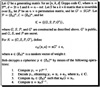
Figure 5.14 McEliece Cryptosystem
A description of the McEliece Cryptosystem is given in Figure 5.14.
We present a ridiculously small example to illustrate the encoding and decoding procedures.
Example 5.11
The matrix
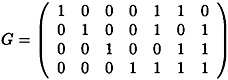
is a generating matrix for a [7, 4, 3] code, known as a Hamming code. Suppose Bob chooses the matrices
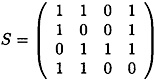
and
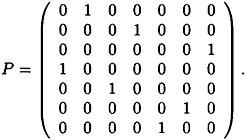
Then, the public generating matrix is
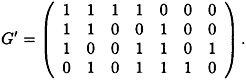
Now, suppose Alice encrypts the plaintext x = (1, 1, 0, 1) using as the random error vector of weight 1 the vector e = (0, 0, 0, 0, 1, 0, 0). The ciphertext is computed to be
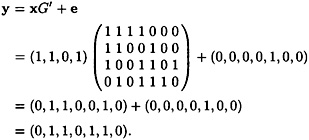
When Bob receives the ciphertext y, he first computes
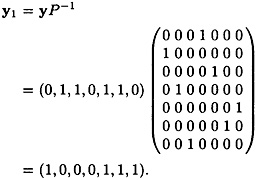
Next, he decrypts y1 to get x1 = (1, 0, 0, 0, 1, 1, 0) (note that e1 ≠ e due to the multiplication by P-1).
Next, Bob forms x0 = (1, 0, 0, 0) (the first four components of x1).
Finally, Bob calculates
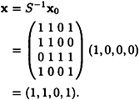
This is indeed the plaintext that Alice encrypted.
5.5 Notes and References
The ElGamal Cryptosystem was presented in [EL85]. The Pohlig-Hellman algorithm was published in [PH78], and the material concerning individual bits of the Discrete Logarithm problem is based on Peralta [PE86]. For further information on the Discrete Logarithm problem, we recommend the articles by LaMacchia and Odlyzko [LO91] and McCurley [MC90].
The main reference book for finite fields is Lidl and Niederreiter [LN83]. McEliece [MC87] is a good textbook on the subject, and a research monograph on applications of finite fields was published by Menezes et al. [MBGMVY93]. A recent article on the Discrete Logarithm problem in GF(2n) is Gordon and McCurley [GM93].
The idea of using elliptic curves for public-key cryptosystems is due to Koblitz [KO87] and Miller [MI86]. Menezes [ME93] is a monograph on elliptic curve cryptosystems. See also Menezes and Vanstone [MV93] and Koblitz [KO94]. For an elementary treatment of elliptic curves, see Silverman and Tate [ST92]. The Menezes-Okamoto-Vanstone reduction of discrete logarithms from elliptic curves to finite fields is given in [MOV94] (see also [ME93]).
The Merkle-Hellman Cryptosystem was presented in [MH78]. This system was broken by Shamir [SH84], and the “iterated” version of the system was broken by Brickell [BR85]. A different knapsack-type system, due to Chor and Rivest [CR88], has not been broken. For more information, see the survey article by Brickell and Odlyzko [BO92].
The most important reference book for coding theory is MacWilliams and Sloane [MS77] There are many good textbooks on coding theory, e.g., Hoffman et al. [HLLPRW91] and Vanstone and van Oorschot [VV89]. The McEliece Cryptosystem was first described in [MC78]. A recent article discussing the security of this cryptosystem is by Chabaud [CH95].
Exercises
- 5.1 Implement Shanks’ algorithm for finding discrete logarithms in
 , where p is prime and α is a primitive element. Use your program to find log106 12375 in
  and log6 248388 in
  .
.- 5.2 Implement the Pohlig-Hellman algorithm for finding discrete logarithms in
 , where p is prime and α is a primitive element. Use your program to find log5 8563 in
  and log10 12611 in
  .
.- 5.3 Find log5 896 in
 using the algorithm presented in Figure 5.6, given that L2(β) = 1 for β = 25, 219 and 841, and L2(β) = 0 for β = 163, 532, 625 and 656.
 - 5.4 Decrypt the ElGamal ciphertext presented in Table 5.3. The parameters of the system arc p = 31847, α = 5, a = 7899 and β = 18074. Each element of
 represents three alphabetic characters as in Exercise 4.6.
The plaintext was taken from “The English Patient,” by Michael Ondaatje, Alfred A. Knopf, Inc., New York, 1992.
- 5.5 Determine which of the following polynomials are irreducible over
 .
.- 5.6 The field GF(25) can be constructed as
 . Perform the following computations in this field.
- (a) Compute (x4 + x2) × (x3 + x + 1).
- (b) Using the extended Euclidean algorithm, compute (x3 + x2)-1
- (c) Using the square-and-multiply algorithm, compute x25.
- (b) Using the extended Euclidean algorithm, compute (x3 + x2)-1
- 5.7 We give an example of the ElGamal Cryptosystem implemented in GF(33). The polynomial x3+2x2+1 is irreducible over
 and hence
  is the field GF(33). We can associate the 26 letters of the alphabet with the 26 nonzero field elements, and thus encrypt ordinary text in a convenient way. We will use a lexicographic ordering of the (nonzero) polynomials to set up the correspondence. This correspondence is as follows: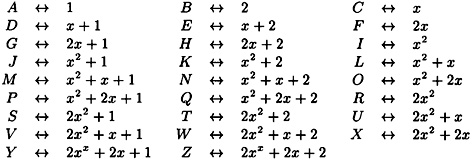
Suppose Bob uses α = x and a = 11 in an ElGamal system; then β = x + 2. Show how Bob will decrypt the following string of ciphertext:
(K, H) (P X) (N, K) (H,R) (T,F) (V, Y) (E, H) (F, A) (T, W) (J, D)(U, J)
- 5.2 Implement the Pohlig-Hellman algorithm for finding discrete logarithms in
| (3781, 14409) | (31552, 3930) | (27214, 15442) | (5809, 30274) |
| (54000, 31486) | (19936, 721) | (27765, 29284) | (29820, 7710) |
| (31590, 26470) | (3781, 14409) | (15898, 30844) | (19048, 12914) |
| (16160, 3129) | (301, 17252) | (24689, 7776) | (28856, 15720) |
| (30555, 24611) | (20501, 2922) | (13659, 5015) | (5740, 31233) |
| (1616, 14170) | (4294, 2307) | (2320, 29174) | (3036, 20132) |
| (14130, 22010) | (25910, 19663) | (19557, 10145) | (18899, 27609) |
| (26004, 25056) | (5400, 31486) | (9526, 3019) | (12962, 15189) |
| (29538, 5408) | (3149, 7400) | (9396, 3058) | (27149, 20535) |
| (1777, 8737) | (26117, 14251) | (7129, 18195) | (25302, 10248) |
| (23258, 3468) | (26052, 20545) | (21958, 5713) | (346, 31194) |
| (8836, 25898) | (8794, 17358) | (1777, 8737) | (25038, 12483) |
| (10422, 5552) | (1777, 8737) | (3780, 16360) | (11685, 133) |
| (25115, 10840) | (14130, 22010) | (16081, 16414) | (28580, 20845) |
| (23418, 22058) | (24139, 9580) | (173, 17075) | (2016, 18131) |
| (198886, 22344) | (21600, 25505) | (27119, 19921) | (23312, 16906) |
| (21563, 7891) | (28250, 21321) | (28327, 19237) | (15313, 28649) |
| (24271, 8480) | (26592, 25457) | (9660, 7939) | (10267, 20623) |
| (30499, 14423) | (5839, 24179) | (12846, 6598) | (9284, 27858) |
| (24875, 17641) | (1777, 8737) | (18825, 19671) | (31306, 11929) |
| (3576, 4630) | (26664, 27572) | (27011, 29164) | (22763, 8992) |
| (3149, 7400) | (8951, 29435) | (2059, 3977) | (16258, 30341) |
| (21541, 19004) | (5865, 29526) | (10536, 6941) | (1777, 8737) |
| (17561, 11884) | (2209, 6107) | (10422, 5552) | (19371, 21005) |
| (26521, 5803) | (14884, 14280) | (4328, 8635) | (28250, 21321) |
| (28327, 19237) | (15313, 28649) |
- 5.8 Let E be the elliptic curve y2 = x3 + x + 28 defined over
 .
.- (a) Determine the number of points on E.
- (b) Show that E is not a cyclic group.
- (c) What is the maximum order of an element in E? Find an element having this order.
- (b) Show that E is not a cyclic group.
- 5.9 Let E be the elliptic curve y2 = x3 + x + 13 defined over
 . It can be shown that #E = 34 and (9, 10) is an element of order 34 in E. The Menezes-Vanstone Cryptosystem defined on E will have as its plaintext space
  . Suppose Bob’s secret exponent is a = 25.
 - (a) Compute β = aα.
- (b) Decrypt the following string of ciphertext:
- ((4, 9), 28, 7), ((19, 28), 9, 13), ((5,22), 20, 17), ((25, 16), 12, 27).
- (c) Assuming that each plaintext represents two alphabetic characters, convert the plaintext into an English word. (Here we will use the correspondence A ↔ 1, . . . , Z ↔ 26, since 0 is not allowed in a (plaintext) ordered pair.)
- (b) Decrypt the following string of ciphertext:
- 5.10 Suppose the Merkle-Hellman Cryptosystem has as its public list of sizes the vector

Suppose Oscar discovers that p = 2503.
- (a) By trial and error, determine the value a such that the list a-1t mod p is a permutation of a superincreasing list.
- (b) Show how the ciphertext 5746 would be decrypted.
- 5.11 It can be shown that the matrix H shown below is a parity-check matrix for a [15, 7, 5] code called a BCH code.
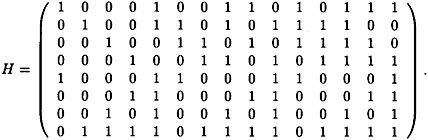
Decode, it possible, each of the following received vectors r using the syndrome decoding method.
- (a) r = (1, 1, 0, 0, 0, 0, 0, 0, 0, 0, 0, 0, 0, 0, 0).
- (b) r = (1, 1, 0, 1, 1, 1, 1, 0, 1, 0, 1, 1, 0, 0, 0).
- (c) r = (1, 0, 1, 0, 1, 0, 0, 1, 0, 1, 1, 0, 0, 0, 0).
- (b) r = (1, 1, 0, 1, 1, 1, 1, 0, 1, 0, 1, 1, 0, 0, 0).
- (a) Determine the number of points on E.
| Previous | Table of Contents | Next |
Copyright © CRC Press LLC

EAN: 2147483647
Pages: 133