Hack 16. How Big Is the World?


If you wanted to make your own Google Maps server, how much hard drive space would you need?
Google Maps renders maps by stitching small images together. We seek to discover the storage capacity of such an image repository. By capturing and examining screenshots of Google Maps in action, we can estimate the map scale at each zoom level, which will give us an idea of how much space is necessary to store all the tiles for that zoom level. Finally, we can add the storage requirements for each zoom level and apply some simple rules of thumb to arrive at an idea of how much hard drive space is necessary to support a web mapping service such as Google Maps.
2.8.1. Economies of Scale
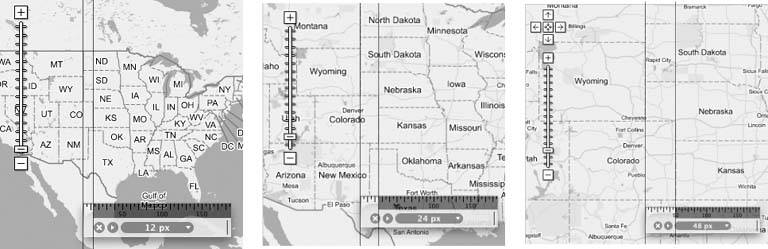
First, we need to discover the scaling factors used at each of the fifteen zoom steps. To accomplish this analysis, we use a tool called Art Director's Toolkit, which comes bundled with Mac OS X and which offers an overlay desktop ruler image for measuring pixel distances onscreen. In zoom levels 0 to 6, we measure the pixel length between the northeast corner of Colorado and the southeast corner of Wyoming. This distance is clearly marked on the map as a horizontal line, which makes measuring it easy. Figure 2-16 depicts zoom levels 0, 1, and 2, where the distances in question are 12, 24, and 48 pixels, respectively.
Figure 2-16. Zoom levels 0 through 2
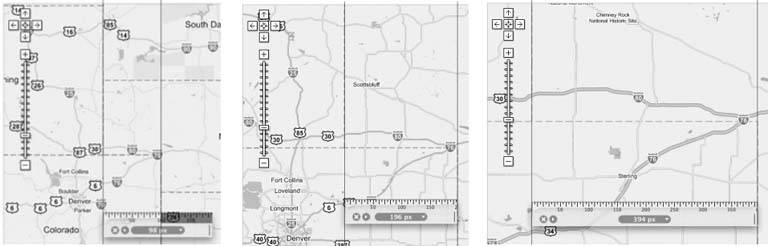
In Figure 2-17, we see that, for zoom levels 3, 4, and 5, the same distances are 98, 196, and 394 pixels.
For zoom level 6, the distance between the northeast corner of Colorado and the southeast corner of Wyoming measures out at 790 pixels. Zoom level 7 was skipped because there was nothing to measure for itsmaller things were too small, and bigger things were too big. (Skipping it did not negatively impact the analysis.)
Figure 2-17. Zoom levels 3 through 5
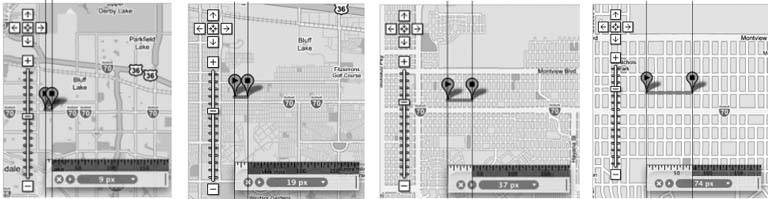
In zoom levels 8 through 14, we measure the pixel length of the path from the intersection of Trenton Street and East 16th Avenue to the intersection of Verbena Street and East 16th Avenue in Denver, Colorado, which is within the metropolitan area closest to our previous locations. For zoom level 8, the distance is 9 pixels. For zoom levels 9, 10, and 11, the distances are 19, 37, and 74 pixels. The results are shown in Figure 2-18.
Figure 2-18. Zoom levels 8 through 11
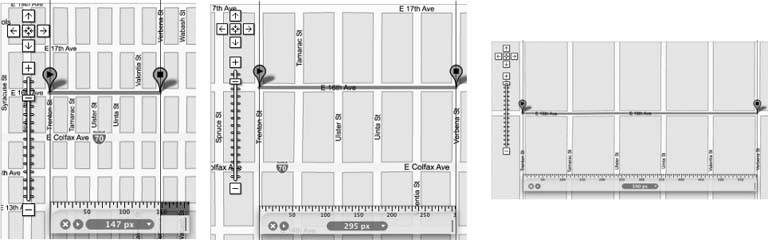
For zoom levels 12, 13, and 14, the distances are 147, 295, and 590 pixels. Figure 2-19 depicts this measurement.
Figure 2-19. Zoom levels 12 through 14
Now we can take the information from these measurements, and attempt to establish the numeric scale ratio between one zoom level and the previous one. Figure 2-20 presents the same relationships in three nicely formatted line graphs and Table 2-1 summarizes the data we collected.
Figure 2-20. Length ratios visualized in a series of line graphs
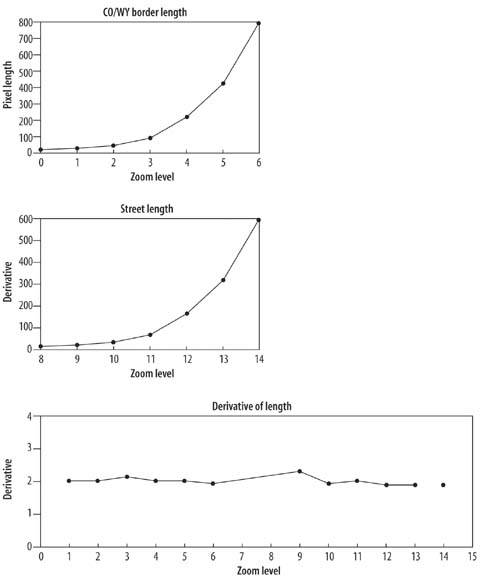
The conclusion we draw is that we can be fairly certain that the scale doubles with every increment of the zoom bar.
|
Zoom |
State border length |
Ratio |
Zoom |
Street length |
Ratio |
|---|---|---|---|---|---|
|
0 |
12 |
n/a |
8 |
8 |
n/a |
|
1 |
24 |
2 |
9 |
19 |
2.38 |
|
2 |
48 |
2 |
10 |
37 |
1.95 |
|
3 |
98 |
2.04 |
11 |
74 |
2 |
|
4 |
196 |
2 |
12 |
147 |
1.99 |
|
5 |
394 |
2 |
13 |
295 |
2.01 |
|
6 |
790 |
2.01 |
14 |
590 |
2 |
2.8.2. So, How Much?
By zooming almost all the way out in Google Maps, we see that North America fits nicely in a 600 x 800pixel rectangular region, amounting to 480,000 pixels. Armed with this approximation, we proceed to estimate the pixel-area of this body at each zoom level. Table 2-2 depicts these relationships.
|
Zoom |
Scale |
Width |
Height |
Area in pixels |
|---|---|---|---|---|
|
0 |
1 |
800 |
600 |
480,000 |
|
1 |
2 |
1,600 |
1,200 |
1,920,000 |
|
2 |
4 |
3,200 |
2,400 |
7,680,000 |
|
3 |
8 |
6,400 |
4,800 |
30,720,000 |
|
4 |
16 |
12,800 |
9,600 |
122,880,000 |
|
5 |
32 |
25,600 |
19,200 |
491,520,000 |
|
6 |
64 |
51,200 |
38,400 |
1,966,080,000 |
|
7 |
128 |
102,400 |
76,800 |
7,864,320,000 |
|
8 |
256 |
204,800 |
153,600 |
31,457,280,000 |
|
9 |
512 |
409,600 |
307,200 |
125,829,120,000 |
|
10 |
1,024 |
819,200 |
614,400 |
503,316,480,000 |
|
11 |
2,048 |
1,638,400 |
1,228,800 |
2,013,265,920,000 |
|
12 |
4,096 |
3,276,800 |
2,457,600 |
8,053,063,680,000 |
|
13 |
8,192 |
6,553,600 |
4,915,200 |
32,212,254,720,000 |
|
14 |
16,384 |
13,107,200 |
9,830,400 |
128,849,018,880,000 |
If we add up the areas, we find that 171,798,691,680,000 (171 trillion) pixels are needed to store all the bitmap information. Since all maps are made up of 256 x 256 tiles, one can venture to guess that there are 171,798,691,680,000 ÷ (256 x 256) = 2,621,439,997 (2.6 billion) potential tile files.
The color histogram of the maps in Figure 2-19 shows that about 60 percent of it is water. Assuming that Google observes such statistics, we guess that a single tile is used for all water regions. There are also lots of regions (such as tundra, deserts, and forests) where uniformly colored tiles can be used. Computing this accurately is difficult, but we will say it amounts to 10 percentof the data. So, only 30 to 40 percent of the tiles have unique data on them. This reduces the amount of data to 50 to 70 trillion raw data pixels stored in 750 million to 1 billion image files. Assuming a modest 1 byte per 6 pixels compression ratio (for LZW-encoded GIF format images), the storage required might be 50 to 70 trillion pixels * (1 byte/6 pixels) = 8 to 11 terabytes. If we consider that Google supports three map types at present (Map, Satellite, and Hybrid), this suggests that 24 to 33 terabytes are needed to store all the image data.
2.8.3. What About the Rest of the World?
Since we did our original analysis, Google Maps UK, Google Maps Japan, and Google Earth were introduced, providing further evidence of a lofty goal to create a world atlas. So this puny analysis (as compared to the world's topology and architectural landmark data necessary for Google Earth), makes an attempt at covering the whole earth with tiles. To do this, we must learn more about the world. The CIA World Factbook provides just what we need.
To wrap the world requires 510 million km2 of surface. Of this, only 29.2%, or 147 million square kilometers, is land. North America's surface area is about 21.4 million square kilometers (9.9 for Canada, 9.6 for the United States, and 1.9 for Mexico) or 13.6% of the world's total land surface area.
We concluded from our analysis that covering North America requires somewhere between 750,000 and 1 billion distinct tiles to be fully described. Now we know that this is only 13.6% of the tiles necessary to describe the world's land tiles. So, anywhere from 5.5 to 7 billion distinct tiles ought to cover the world's surface area. Assuming the compression ratio described above, the world's tiles amount to 61 to 81 terabytes just for the rendered vector maps, and 182 to 243 terabytes for all three map types. That's a lot of databut then storing and retrieving huge amounts of data is Google's stock in trade!
|

In some ways, it seems a bit comical to attempt such a calculation where every step of the way requires an approximation. That's why in the end we have such a wide chasm of error. And, of course, this rough analysis does not cover area distortion introduced by mapping the globe's points onto a two dimensional surface. However, even with this rough estimate, we think we've managed to get a decent sense of just what it takes to map the entire world in the style that Google Maps has pioneered.
Michal Guerquin and Zach Frazier
You Are Here: Introducing Google Maps
- Hacks 19: Introduction
- Hack 1. Get Around http://maps.google.com
- Hack 2. Find Yourself (and Others) on Google Maps
- Hack 3. Navigate the World in Your Web Browser
- Hack 4. Get the Birds-Eye View
- Hack 5. Driven to a Better User Interface
- Hack 6. Share Google Maps
- Hack 7. Inside Google Maps URLs
- Hack 8. Generate Links to Google Maps in a Spreadsheet
- Hack 9. Use del.icio.us to Keep Up with Google Maps
Introducing the Google Maps API
- Hacks 1016: Introduction
- Hack 10. Add a Google Map to Your Web Site
- Hack 11. Where Did the User Click?
- Hack 12. How Far Is That? Go Beyond Driving Directions
- Hack 13. Create a Route with a Click (or Two)
- Hack 14. Create Custom Map Markers
- Hack 15. Map a Slideshow of Your Travels
- Hack 16. How Big Is the World?
Mashing Up Google Maps
- Hacks 1728: Introduction
- Hack 17. Map the News
- Hack 18. Examine Patterns of Criminal Activity
- Hack 19. Map Local Weather Conditions
- Hack 20. Track Official Storm Reporting
- Hack 21. Track the International Space Station
- Hack 22. Witness the Effects of a Nuclear Explosion
- Hack 23. Find a Place to Live
- Hack 24. Search for Events by Location
- Hack 25. Track Your UPS Packages
- Hack 26. Follow Your Packets Across the Internet
- Hack 27. Add Google Maps to Any Web Site
- Hack 28. How Big Is That, Exactly?
On the Road with Google Maps
- Hacks 2941: Introduction
- Hack 29. Find the Best Gasoline Prices
- Hack 30. Stay Out of Traffic Jams
- Hack 31. Navigate Public Transportation
- Hack 32. Locate a Phone Number
- Hack 33. Why Your Cell Phone Doesnt Work There
- Hack 34. Publish Your Own Hiking Trail Maps
- Hack 35. Load Driving Directions into Your GPS
- Hack 36. Get Driving Directions for More Than Two Locations
- Hack 37. View Your GPS Tracklogs in Google Maps
- Hack 38. Map Your Wardriving Expeditions
- Hack 39. Track Your Every Move with Google Earth
- Hack 40. The Ghost in Google Ride Finder
- Hack 41. How Google Maps Got Me Out of a Traffic Ticket
Google Maps in Words and Pictures
- Hacks 4250: Introduction
- Hack 42. Get More out of What You Read
- Hack 43. Dont Believe Everything You Read on a Map
- Hack 44. You Got Your A9 Local in My Google Maps!
- Hack 45. Share Pictures with Your Community
- Hack 46. Browse Photography by Shooting Location
- Hack 47. Geotag Your Own Photos on Flickr
- Hack 48. Tell Your Communitys Story
- Hack 49. Generate Geocoded RSS from Any Google Map
- Hack 50. Geoblog with Google Maps in Thingster
API Tips and Tricks
- Hacks 5161: Introduction
- Hack 51. Make a Fullscreen Map the Right Way
- Hack 52. Put a Map and HTML into Your Info Windows
- Hack 53. Add Flash Applets to Your Google Maps
- Hack 54. Add a Nicer Info Window to Your Map with TLabel
- Hack 55. Put Photographs on Your Google Maps
- Hack 56. Pin Your Own Maps to Google Maps with TPhoto
- Hack 57. Do a Local Zoom with GxMagnifier
- Hack 58. Find the Right Zoom Level
- Hack 59. Show Lots of StuffQuickly
- Hack 60. Make Things Happen When the Map Moves
- Hack 61. Use the Right Developers Key Automatically
Extreme Google Maps Hacks
- Hacks 6270: Introduction
- Hack 62. Find the Latitude and Longitude of a Street Address
- Hack 63. Read and Write Markers from a MySQL Database
- Hack 64. Build Custom Icons on the Fly
- Hack 65. Add More Imagery with a WMS Interface
- Hack 66. Add Your Own Custom Map
- Hack 67. Serve Custom Map Imagery
- Hack 68. Automatically Cut and Name Custom Map Tiles
- Hack 69. Cluster Markers at High Zoom Levels
- Hack 70. Will the Kids Barf? (and Other Cool Ways to Use Google Maps)

EAN: 2147483647
Pages: 131
