| < Day Day Up > |
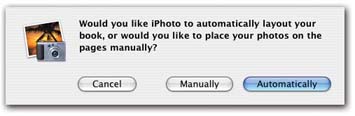
10.3. Phase 3: Initial LayoutiPhoto is nearly ready to lead you into Book Layout Land, where you'll see, for the first time, your pictures inserted into Apple's page designs. First, though, you're asked the important question shown in Figure 10-2: Do you want to place the photos on the pages yourself (Manually), or would you like iPhoto to do the job for you (Automatically)?
|
| < Day Day Up > |
| < Day Day Up > |
10.4. Phase 4: Design the PagesWhen you click Automatically or Manually, two more things happen. First, a new icon appears in your Source list, representing the book layout you're about to create. You can work with it as you would other kinds of Source-list icons. For example, you can delete it by dragging it to the iPhoto Trash, rename it by double-clicking, file it in a folder by dragging it there, and so on. Note: If you're used to previous iPhoto versions, this is a happy bit of news. It means that a book is no longer tied to an album. Therefore, rearranging or
Second, you now see something like Figure 10-3. The page you're working on always appears at nearly full
Once you've selected an album and a theme, the most
10.4.1.
|
|
The lower icon
In any case, the first step in building your book is to click a page to work on. Most people start with the Cover pagethe first thumbnail in the row. When it's selected, the cover photo appears in the main picture area. This is the picture that will appear, centered, on the linen or glossy cover of the actual book. You can't do much with the cover except to change the title or
After you're finished working with the cover, open the
Whether you
If you approve of the photos-per-page proposal, great. You can go to work choosing which photos to put on each page, as described in the following pages.
Sooner or later, though, there will come a time when you want three
|
|
FREQUENTLY ASKED QUESTION
Doubling the Cover Photo |
|
I want to use my cover photo as one of the pages in the book, just like they do in real coffee-table photo books. How do I do it?
Find the photo in its album, or in your Library; click the photo and then choose Photos
Now you have two copies of the photo. Use one as the cover, and then drag the other onto the desired interior page layout. |
You control how many pictures appear on a page by choosing from the Page Type pop-up menu. Your choices are:
Cover. The first thumbnail in your book must have the Cover design.
(You can choose Cover from the pop-up menu for
Introduction.
In most themes, this special page design has no photos at all. It's just a big set of text boxes that you can type (or paste) into. Here's where you can let the audience know about the trip, the company, or the family; tell the story behind the book; praise the book's lucky recipient; scare off intellectual-property
One, Two, Three, Four These commands let you specify how many photos appear on the selected page. iPhoto automatically arranges them according to its own internal sense of symmetry. (Most themes offer up to six or seven photos per page.)
Use these options to create a pleasing overall layout for the book and give it variety. Follow a page with one big photo with a page of four smaller ones, for example.
You can also use these commands to fit the number of photos you have to the length of your book. If you have lots of pictures and don't want to go over the $30 10-page limit, then choose higher picture counts for most pages. Conversely, if iPhoto warns you that you have blank pages at the end of your book, spread your photos out by choosing just one or two photos for some pages.
One with Text, Title Page, Text Page, About Page, Contact Page. Some themes, especially the Folio theme, offer their own private page designs. In general, they're designed to hold specialized blobs of text that are unique to that book design.
Blank. Here's another way to separate sections of your book: Use an empty page. Well, empty of pictures, anyway; most of the new iPhoto 5 themes still offer a choice of "look" for a blank page, such as a choice of color or simulated page texture.
End. The Story Book theme offers a bonus page design called End. Use it for the last page of the book.
The End page is designed to hold three pictures, and you'd be well advised to fiddle with your album until the last page does, in fact, have three photos on it. Otherwise, you'll wind up with a
Once you've chosen how many photos you want on a page, the Page Design pop-up menu becomes available to you. As shown at right in Figure 10-4, it contains tiny thumbnail representations of the various photo layouts available. If you chose Three as the number of photos, for example, the Page Design pop-up menu may offer you a choice of page background (for a three-photo layout) or a couple of different arrangements of those three photosbig one on top, two down the side, or whatever.
In some themes, especially the older ones, you're not
The key to understanding iPhoto 5's book-layout mode is
In fact, between dragging photos and using a handful of menu commands, you can perform every conceivable kind of photo- and page-manipulation trick there is.
Here are all the different ways to move photos around in your book (see Figure 10-5 for a summary):
Swap two photos on the same page (or two-page spread) by dragging one directly on top of the other. When the existing picture sprouts a colored border, let go of the mouse button; the two pictures swap places.
|
FREQUENTLY ASKED QUESTION
The Save Command |
|
Yo where's the Save command? There isn't one. iPhoto automatically saves your work as you go. If you want to make a safety copy along the waythat is, a fallback versionControl-click the book's icon in the Source list and then, from the shortcut menu, choose Duplicate. This process takes virtually no extra memory or disk space, but it's good insurance. If you change the layout or theme of a book, iPhoto vaporizes all the text you've entered (and often a lot of the layout work). If that ever happens, you'll be glad you had a backup. |
Move a photo to a different page of the book by dragging it onto a different page in the photo browser.
Remove a photo from a page
by clicking its icon and then pressing your Delete key. Its icon moves up into the unplaced-photos area (Figure 10-5). (You can also drag the photo directly into the unplaced-photo browser, if it's visible.) There it will
|
Remove a photo from the book altogether by (a) moving it to the unplaced-photo area as described above (or just dragging it off the page), then (b) clicking it again (in its current photo-browser location) and, finally, (c) pressing Delete again.
Note that removing a photo also changes the resulting page type from a four-photo page layout (for example) to a three-page layout. In other words, the three remaining pictures snap into a different arrangement to fill up the new space. (And if you delete the last photo on a page, you wind up with a big gray placeholder.)
Shove one overlapping photo "under" another by Control-clicking it and, from the shortcut menu, choosing Send to Back. Figure 10-6 reveals all.
|
Add an unplaced photo to a page
by dragging it out of the unplaced-photos browser (Figure 10-3) onto a
blank
spot of the page. iPhoto automatically
Swap in an unplaced photo
by dragging it out of the unplaced-photos browser
onto
a photo that's already on a page of your book. iPhoto swaps the two,
Add new photos to the unplaced-photo area by dragging them onto the book's Source-list icon. For example, you can click any album, smart album, slideshow, or Library icon to see what photos are insideand then drag the good ones onto your book icon.
Once these photos have arrived in the unplaced-photo area, you can drag them onto individual pages as described above.
Fill in an empty gray placeholder frame by dragging a photo onto it from the unplaced-photos area.
|
Fill in all the gray placeholders with photos by clicking the Autoflow button at the bottom of the window. (Those gray placeholders appear when you choose the Manual layout option described on page 258, or whenever your book has more pages than photos you've put on them.)
Either way, clicking Autoflow "pours" all of the unplaced photos into the gray placeholders of your book, front to back. When they
If the results aren't quite what you expected, you can always use the Edit
Undo command to backtrack.
Enlarge or crop a picture, right there on the page, by double-clicking it. A tiny zoom slider appears above the photo, which you can use to magnify the picture or shift it inside its boundary "frame" (see Figure 10-7). For now, it's worth remembering that this trick is helpful when you want to call attention to one part of the photo, or to "crop" a photo for book-layout purposes without actually editing the original.
Edit a photo by Control-clicking it and, from the shortcut menu, choosing Edit Photo. In a flash, book-layout mode disappears, and you find yourself in the editing mode described in Chapter 6. (Either the picture appears in its own window, or the Edit tools fill the bottom toolbar, depending on your iPhoto preference settings.)
When you're finished editing, click the Done button (or, if you're editing in a separate window, close it). You return to the layout mode, with the changes intact.
Photos aren't the only ones having all the fun. You can drag and manipulate the pages
Move pages around within the book by dragging their thumbnails horizontally in the photo browser.
Remove a page from the book
by clicking its photo-browser icon and then either pressing Delete or choosing Edit
Remove Page. (If you use the Delete-key method, iPhoto asks if youre sure you know what you're doing.)
Note that removing a page never
Insert a new page into the book
by clicking the Add Page button at the bottom of the window, or by choosing Edit
Add Page.
Before you go nuts with it, though, note that iPhoto
If you have some leftover pictures in the unplaced photos area, iPhoto uses them to fill the new page; if not, you just get empty gray placeholders. (iPhoto takes it upon itself to decide how many photos appear on the new page.) In any case, now you know how to change the number of photos on that page, or at least how to replace the pictures that iPhoto put there.
Sometimes chronological order is the natural sequence for your photos, especially for memento books of trips, parties, weddings, and so on. Of course, there's nothing to stop you from cheating a bitrearranging certain scenesfor greater impact and variety.
As you drag your pictures into order, consider these effects:
Intersperse group shots with solo portraits,
On multiple-photo pages, exploit the direction your subjects face (Figure 10-8). On a three-picture page, for example, you could arrange the people in the photos so that they're all looking roughly toward the center of the page, for a feeling of inclusion. You might put a father looking upward to a shot of his son diving on a photo higher on the page, or a brother and sister back-to-back
Group similar shots together on a page.
|
iPhoto's design templates
|
In most cases, that's what you already have, since those are the standard proportions of standard digital photos. If all your pictures are in 4:3 (or 3:4) proportion, they'll fit neatly and beautifully into the page-layout slots iPhoto provides for them.
But not all photos have a 4:3 ratio. You may have cropped a photo into some other shape. Or you may have a camera that can take pictures in the more traditional 3:2 film dimension (1800 x 1200 pixels, for example), which work better as 4 x 6 prints.
When these photos land in one of iPhoto's page designs, the program
Unfortunately, this solution isn't always ideal. Sometimes, in the process of enlarging a nonstandard photo to fill its 4:3 space, iPhoto winds up lopping off an important part of the picturesomebody's forehead, say.
Here, you have two alternatives. First, you can use the Fit Photo to Frame Size command described in Figure 10-9.
Second, you can crop your non-4:3 photos using the Constrain pop-up menu (page 150) set to "4 x 3 (Book)." This way,
you
get to decide which
The book can have
Of course, if you really have more than 100 pages'worth of pictures, there's nothing to stop you from creating multiple books. ("Our Trip to New Jersey, Vol. XI,"
Don't be alarmed if iPhoto puts page numbers on the corners of your book pagesthat's
Even so, if it turns out that your theme does put numbers on your pages, and you feel that they're intruding on the mood your book creates, you can eliminate them. Click the Settings button at the bottom of the window. In the resulting dialog box, you'll see a "Show page numbers" checkbox that you can turn off.
| < Day Day Up > |