Flylib.com

Books Software


Quick Image Fixes in Studio

 < Day Day Up > 

Quick Image Fixes in Studio

Image editors like PhotoImpact and Photoshop Elements provide the perfect environment for perfecting your images, but sometimes it's faster to perform quick fixes in Studio. Here are the two corrections you can make quickly and easily within Studio.

To rotate your image

1.

Start with the Movie window in Timeline view and the Album window open to the Still Images tab.

2.

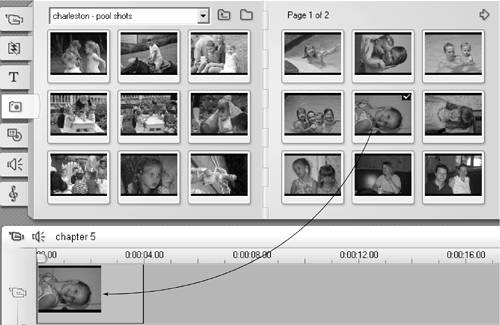
Drag the image into the Timeline ( Figure 5.21 ).

Figure 5.21. To get an image into the Timeline, just click and drag.


3.

Double-click the image.

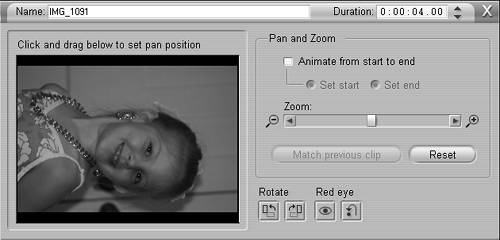
Studio opens the Clip Properties tool ( Figure 5.22 ). Here's Whatley looking natural for the camera.

Figure 5.22. This image needs to be rotated to the left.


4.

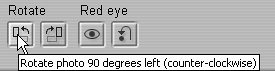
Click the Rotate icons as required to rotate the photo into the desired position ( Figure 5.23 ).

Figure 5.23. Rotate the image by clicking these controls.


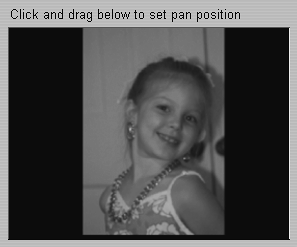
Studio rotates the image to the desired position ( Figure 5.24 ).

Figure 5.24. The corrected image.


Tips

  • To understand why there are black bars around the image in Figure 5.24, see "How Studio works with images," earlier in this chapter.

  • To remove the black bars, zoom into the image until they disappear, as described in "To insert a pan and zoom effect," later in this chapter.


To remove red eye in an image

1.

Start with the Movie window in Timeline view and the Album window open to the Still Images tab.

2.

Drag the image into the Timeline.

3.

Double-click the image.

Studio opens the Clip Properties tool (Figure 5.22).

4.

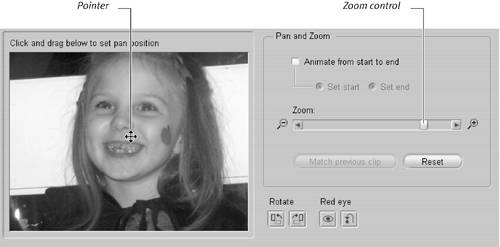
Do one or both of the following to zoom into the region of the image containing the red eye:

  • Use the zoom slider to zoom into the image ( Figure 5.25 ).

    Figure 5.25. Use the Zoom slider to zoom into the image and grab the image directly to move it around the frame.


  • Click and drag the image to the desired position.

5.

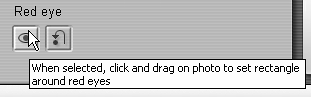
Click the Red Eye icon ( Figure 5.26 ).

Figure 5.26. Click here to remove red eye.


6.

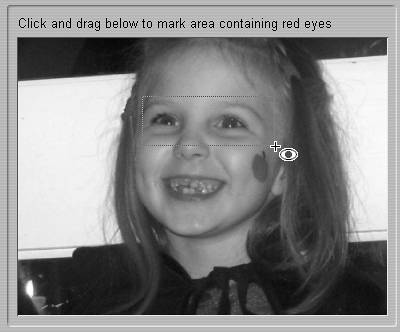
Click and drag a rectangle around the eye or eyes containing the red eye ( Figure 5.27 ).

Figure 5.27. Then drag the rectangle around both eyes.


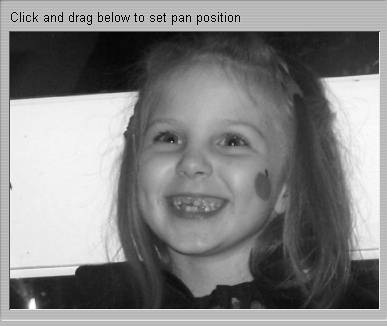
Studio removes the red eye ( Figure 5.28 ).

Figure 5.28. Works like Visine (though it's not apparent here in the grayscale image).


Tips

  • Studio worked best for me when I eliminated the red eye from both eyes at once.

  • If two or more subjects in the picture have red eye, fix them sequentially, using the pan cursor to move around the image as necessary.


 < Day Day Up > 
 < Day Day Up > 

Inserting Pan and Zoom Effects

At a high level, Studio's workflow for panning and zooming within an image has two simple steps. First you pick a starting position for the pan and zoom effect, then you choose the end position. When rendering the effect, Studio builds a movie from the starting point of the image to the ending point.

This start-to-finish approach works well with some pictures, but sometimes you'll want to make more complicated passes through an image. For example, in the image shown in Figure 5.29 , shot outside of historic Dollywood, I want to move to three different locations within the image, from daughter to mother to daughter .

Figure 5.29. Now let's pan and zoom around this image; daughter to mother to daughter.


To facilitate this, Pinnacle added a button called Match Previous Clip to Studio to simplify multi-point panning within an image. This section demonstrates both single-point and multiple-point pan and zoom effects.

To insert a pan and zoom effect

1.

Start with the Movie window in Timeline view and the Album window open to the Still Images tab.

2.

Drag the image into the Timeline.

3.

Double-click the image.

Studio opens the Clip Properties tool (Figure 5.29).

4.

Click the Animate from Start to End checkbox.

The Set Start button is automatically selected.

5.

Do one or both of the following to set the start position:

  • Use the Zoom slider to zoom into or away from the image.

  • Click and drag the image to the desired position ( Figure 5.30 ).

    Figure 5.30. The zoom slider sets magnification levels, and you grab the image in the window to move it to the desired position.


6.

Click the Set End checkbox ( Figure 5.31 ).

Figure 5.31. Select the Set end radio button, then use the pan and zoom controls to move to the end position.


Studio resets the image to its original position.

7.

Do one or both of the following to set the end position:

  • Use the Zoom slider to zoom into or away from the image.

  • Click and drag the image to the desired position.

Tip

  • At this point, if you exit the Clip Properties window by clicking X in the upper-right corner or closing the Video Toolbox, the pan and zoom effect is set. But I've only zoomed into two of the three faces in the picture. To zoom seamlessly into a third image, see below.


To insert multi-point pan and zoom effects

1.

After inserting the first point of the multi-point pan and zoom effect, click the Open/Close Video Toolbox icon (Figure 5.4) to close the Video Toolbox.

Studio returns to the Album window open to the Still Images tab.

2.

Drag the same image to the Timeline ( Figure 5.32 ).

Figure 5.32. To get to the second daughter, you have to drag the same video to the Timeline.


3.

Double-click the image.

Studio opens the Clip Properties tool ( Figure 5.33 ).

Figure 5.33. Click the Match Previous Clip button and Studio aligns the starting point of the second clip to the ending point of the first clip.


4.

Click the Animate from Start to End checkbox.

The Set Start button is automatically selected.

5.

Click the Match Previous Clip button.

Studio matches the Set Start pan and zoom location to the end point of the previous image.

6.

Click the Set End checkbox.

7.

Do one or both of the following to set the end position:

  • Use the Zoom slider to zoom into or away from the image.

  • Click and drag the image to the desired position ( Figure 5.34 ).

    Figure 5.34. Then pan and zoom over to the second daughter.


{% if main.adsdop %}{% include 'adsenceinline.tpl' %}{% endif %}

Tip

  • At this point, if you exit the Clip Properties window by clicking X in the upper right corner or closing the Video Toolbox, the pan and zoom effect is set.


 < Day Day Up >