Flylib.com

Books Software


Monitoring DB2 Utilities

 <  Day Day Up  >  

Monitoring DB2 Utilities

Online DB2 utilities can be monitored and controlled using DB2 commands. The DISPLAY and TERM commands can be used for this purpose. For example, the DISPLAY command can be entered as


-DISPLAY UTILITY (UID)

or


-DISPLAY UTILITY (*)

NOTE

The -DISPLAY command can be abbreviated to -DIS for simplicity.


The TERM command also can be entered by specifying a wildcard or a UID . The recommendation is to specify a UID when terminating utilities, because an asterisk indicates that every utility known to DB2 should be terminated . Enter the TERM command as


-TERM UTILITY (UID)

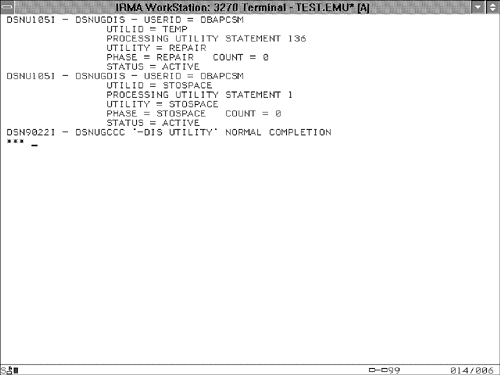
The -DISPLAY UTILITY command provides information about the execution status of the utility named by the utility ID. When this command is issued, it returns a screen similar to the one shown in Figure 30.5. This screen lists the following information:

Figure 30.5. Output from the -DISPLAY UTILITY (*) command.
graphics/30fig05.gif

USERID

The user ID of the job performing the utility.

UTILID

The utility ID assigned in the UID parameter on the EXEC card. If the UID parameter is not provided, UTILID is the same name as the jobname.

STATEMENT

The number of the control card containing the utility statement that is being processed (if more than one utility control card is supplied as input to the utility step).

UTILITY

The type of utility that is being executed. For example, if a reorganization is run, UTILITY contains REORG .

PHASE

The phase of the utility being executed. The phases for each utility are discussed in Part VI.

COUNT

A count of the number of records (pages or rows, depending on the utility and phase being monitored) processed by the phase. Count also may be the number of index entries being processed. Count isn't always kept by every utility phase, however.

STATUS

The status of the utility. ACTIVE indicates that the utility is currently active and should not be terminated. If terminated, the utility will abend. STOPPED means that the utility is currently stopped and should be restarted or terminated, depending on the state of the job and the procedures in place for restarting or rerunning.


The TERM command terminates the execution of a DB2 utility. Think carefully before terminating a utility. After a utility is terminated, it cannot be restarted. Instead, it must be rerun, which involves reprocessing.

Five types of online DB2 utilities are provided:

  • Data consistency utilities

  • Backup and recovery utilities

  • Data movement and organization utilities

  • Catalog manipulation utilities

  • Miscellaneous utilities

 <  Day Day Up  >  
 <  Day Day Up  >  

Version 7 and the State of IBM DB2 Utilities

graphics/v7_icon.gif

As of DB2 Version 7, IBM decoupled the core utility functionality from the base DB2 engine and is charging their customers extra if they choose to use IBM's utilities. In all past releases of DB2, core utility functionality came free with the DB2 base product. This is causing confusion and angst for mainframe DB2 users.


This decision was made because IBM wants to use the DB2 utilities as an entry into the database tools market. IBM just recently entered the market for database tools in a big way. By leveraging their installed base for DB2 utilities (which is 100% ”remember, they were free), IBM is trying to market additional tools and products like performance monitors , administration tools, and so on.

IBM has competition in the database utility field from companies such as BMC Software, CDB Software, and Computer Associates. These companies thrive by selling more functional, faster utilities than IBM ”and they do so by selling products that IBM was giving away for free. Now many organizations are faced with a decision ”"Do I buy the IBM utilities or third-party utilities for DB2?"

This is a more difficult question than it appears to be on the surface. First of all, IBM does not sell individual utilities, but suites of utilities. The third-party vendors all sell individual utilities (as well as suites and solutions that include utilities). Additionally, the functionality of the IBM and third-party utilities is not 100% exact. Many of the third-party offerings still provide more functionality at higher speeds than the IBM offerings. But the IBM utilities are still cheaper (though no longer free) than the third-party utilities. Furthermore, only IBM offers certain functionality in certain utilities.

To add to the discomfort, consider that many organizations bought third-party utilities with the comfort level of having the IBM utilities as a backup in case problems were encountered with the third-party products. Additionally, most shops bought only a few of the third-party utilities. Now those shops might have to purchase both the IBM utility suites and the third-party utilities to get the same functionality they had before. So, in essence, IBM is forcing them to buy utility functions twice.

To be fair to IBM, their DB2 utilities are better than they used to be. IBM finally seems to be putting the appropriate development effort into their utilities. Even so, the third-party utilities still provide unique features not available in IBM's utilities. And in many cases, organizations are relying on those features to run their business.

To be critical of IBM, they have been claiming that their DB2 utilities are improved to the point that the IBM stuff is all their customers need since Version 3. This was not true for V3, V4, V5, or V6, and it still is not true for V7 and V8. Many organizations that deal with a lot of data, require 24x7 availability, and/or need to contend with shrinking batch windows need the speed of third-party utilities. Given IBM's utility history, customers have every right to be skeptical about IBM's speed and functionality claims with regard to DB2 utilities.

IBM Utility Packages

graphics/v7_icon.gif

An additional complexity to contend with when trying to understand DB2 utilities is the way that IBM packages their utilities. Prior to V7, all utilities came free with DB2. As of V7, IBM packages the DB2 utilities into four suites, or packages:


  • Base utilities CATMAINT , DIAGNOSE , LISTDEF , OPTIONS , QUIESCE , REPAIR , REPORT , TEMPLATE , and DSNUTILS

  • Operational utilities COPY , LOAD , REBUILD , RECOVER , REORG , RUNSTATS , STOSPACE , and UNLOAD

  • Recover and diagnostics utilities CHECK , COPY , COPYTOCOPY , MERGE , MODIFY , REBUILD , and RECOVER

  • Utilities suite ” Includes all utilities in both the Operational utilities suite and the Recover and diagnostics utilities suite.

Only the first package, the base utilities, is provided free of charge by IBM. Any of the others must be purchased and licensed before the utilities can be used. This is so, with one exception. IBM permits customers to use any utility to manage DB2 system catalog objects.

Also, to further complicate matters, some utilities are in both suites. For example, COPY is in both the operational utilities suite and the recover and diagnostic utilities suite.

Keep in mind, too, that IBM will not sell just one utility. Instead of allowing customers to purchase individual utilities, IBM sells utilities in the listed packages. If you want to purchase only one specific IBM utility, you are instead forced to purchase an entire suite of utilities ”some of which you may not want, or need.

NOTE

In late 2003 IBM decided to stop marketing and selling the Operational Utilities suite and Recover and Diagnostics suite. This means that the only option for IBM utilities at this time is the full Utilities suite. Of course, you still can opt to purchase competitive utilities from another vendor such as BMC Software or Computer Associates.

Additionally, keep in mind that IBM may change its packaging for the utilities at their discretion. Further changes to packaging may have occurred subsequent to the publishing of this book.


So, when a DB2 customer migrates to Version 7, there are some decisions that need to be made. Should you buy IBM utilities or can you go with a third party? And if you go with a third party, can they offer everything that IBM offers? And furthermore, if you need third-party functionality and speed, will you have to buy something from IBM that you do not want or need?

CAUTION

It is my recommendation that all DB2 users purchase the entire DB2 utilities suite from IBM. Then, as needed, you should evaluate which third-party utilities you need to augment the IBM utilities. This is the only reasonable approach. It basically duplicates the "DB2 environment" the way it was before IBM started to charge for their utilities.

Some third-party vendors are selling their utilities as replacements for the IBM utilities. Before you go down that route, make sure that the vendor can supply you with answers to the following questions:

  • Is there any functionality the vendor cannot provide that IBM can (for example, does the MODIFY utility clean up SYSLGRNX records)?

  • Will the vendor guarantee a response time for support calls if theirs are the only utilities you own?

  • How will the vendor work with IBM in case of problem situations? IBM has hinted that they will not provide support if the support call requires utility functionality and the customer does not have the IBM utility.


It is confusing, but you must be able to understand all of the options and then make an informed decision about the functionality you need to run your DB2 business.

 <  Day Day Up  >