| < Day Day Up > |
Flat Lighting—The Reality of LightingOpen any book or article on lighting and you'll see a chapter or section on three-point lighting, usually identifying this technique as optimal, if not the be-all and end-all of professional lighting. However, there's one dark secret about three-point lighting that few sources reveal: most television programs don't use it.
Why? The reasons are plentiful. Three-point lighting usually requires high-
Plus; with today's high-resolution, large-screen television sets, depth is more apparent, lessening the importance of three-point lighting. Finally, some
So, while you may see three-point lighting in use in dramatic interviews on
60 Minutes
, you typically won't on broadcasts from ESPN, CNN, the
Tonight Show with Jay Leno
, the Golf Channel, and on most local news
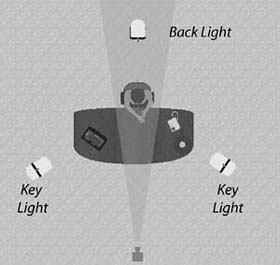
Producing flat lighting is very simple, as shown in
Figure 3.3
. Rather than using key and fill lights with different intensities, you use two key lights of identical intensity. And, rather than using hard lights that produce shadows, you use soft lights that produce less
Figure 3.3. Flat lighting using two equally powered key lights.
Flat lighting produces the image shown on the left in
Figure 3.4
, which has even lighting throughout the face and the characteristic shadow
Figure 3.4. Flat lighting: on the right used with a matte reflecting light under my chin to reduce shadow. Note to self: try some face powder to get rid of the
|
| < Day Day Up > |
| < Day Day Up > |
Lighting Fundamentals
As you've seen, the mechanics of three-point lighting are
Your Camera Doesn't "See" As Well As Your EyesJust because your eyes can perceive details in a shot, doesn't mean that your camera can. Video is definitely not a What You See Is What You Get affair. This reality causes problems primarily in scenes with "high-contrast" lighting— in other words the very significant differences between the brightest area in the shot and the darkest. Typically, you get excessive contrast when you're shooting a subject with extremely bright lights in the background, whether produced by the sun or a spotlight.
When you're looking at the scene with your eyes, you can see good detail at both extremes because your eyes have a contrast range of around 1,000:1. This
Without getting too technical, this means that while your eyes will be able to perceive detail at both the darkest and lightest extremes, your video camera will not. This is why the left side of my face lost detail in the key light-only image in Figure 3.2. Simply stated, the contrast range between the darkest and lightest
If too much lighting contrast exists in your scene, you have no good choices. If your exposure favors the darker area, the more lighted areas become washed-out blobs with no detail. If you adjust exposure to favor the lighter areas,
Interestingly, the "spotlight" or "backlight" control found on most camcorders doesn't really fix the problem. Rather, it simply
Application
All Lights Have a Different Color TemperatureLet's start with two fairly common situations to explain what this means: Situation 1: You're shooting indoors, using sunlight streaming in from a window as your key light, and a lamp in the room as a fill light. Situation 2: You're shooting indoors, lighting the scene primarily with fluorescent lights in the office ceiling, using an incandescent lamp to reduce facial shadows. Now, as they say in law school, what result and why? Situation 1 is hopeless, and your subject's face will be either blue or orange. Same result in Situation 2 (unless you're very lucky), except that the face will be either overly green or orange. Now, the why.
Simply stated, white is not "white" under all types of light. As shown in
Figure 3.5
, different lights produce slightly different coloring on the Kelvin scale, named after renowned Scottish
Figure 3.5. Color temperature and Color Rendering Index for common lighting types.
The mere existence of this scale may surprise many readers. After all, our eyes see "white" irrespective of the color of the light. As it turns out, however, this is a case where our brain overrules our eyes. We see white paper, poster board, or other objects that we know are white, and our brain tells us they are white. Unfortunately, video cameras aren't that smart; you have to tell them what is white; and you do this when you set the camera's white balance.
Most video cameras have at least two white balance settings: one for outdoors, which assumes that the prevailing light is slightly bluish, and one for indoors, which assumes that the light is
In addition, most
Now, back to our scenarios. In the first scenario, you're mixing sunlight (5,600K) with an incandescent lamp (3,000K). If the white balance is set to indoors, the portion of the face lighted by the sun through the window will be blue. If it's set to outdoors, the portion of the face lighted by the indoor lamp will appear slightly orange. The second scenario is more interesting. First, recognize that today's fluorescent bulbs have much more range color-wise, so just because you're using fluorescent lighting doesn't doom your subjects to a sickly green coloring. Second, while you can buy "cool white" fluorescents that produce light in the 4,000K range, you can also buy warmer lights that output close to the 2,700 to 3,000K produced by incandescent bulbs. If the color output of your incandescent and fluorescent bulbs match, you've eliminated the white balance issue, and picture quality should be good. While color temperature values are seldom listed on a bulb's packaging, stores such as Lowe's often provide this information at the point of sale, and it's generally available on the manufacturer's Web site. I'll describe how to avoid problems in both scenarios in the Problem Solving section. Application
The Color Rendering Index (CRI)
In addition to the color temperature of common lighting types, Figure 3.5 also shows the Color Rendering Index (CRI) of these lights.
The difference is too subtle to detect on the grayscale pages of this book, but General Electric has comparison shots posted at www.gelighting.com/na/institute/quality.html . If you browse around the web site, you'll find it's a solid resource for additional information on lighting temperature and CRI. Scan the lighting racks at Lowe's or Web sites such as www.bulbs.com and you'll see that lights with higher CRIs cost a bit more. But in my experience they're well worth it. Hard Versus Soft Lighting
Hard light is light transmitted from a lighting source in sharp, parallel rays that produce hard edges and dark, clearly defined shadows. Typically, hard light sources produce high
The sun is a classic "hard light," as are unfrosted incandescent light bulbs and
Figure 3.6. Hard lighting on the left creates contrast; soft lighting on the right is more even.
Look at the effect the soft light has on the right in Figure 3.6. As you can see, it produces even lighting across my face and over the background, and minimal shadows. This makes soft light your only real choice for flat lighting, and for lighting backgrounds for chromakeying. (I'll explain chromakeying later.)
You can produce soft light (at least) three ways. First, you can use lights that are naturally softer, such as fluorescent lights. Second, you can "bounce" a hard light off of a light surface, such as a bounce card, which
Finally, you can install a diffuser, as shown on the left in
Figure 3.7
, over a hard light source, as shown on the right in the figure. I'll cover both bounce cards and diffusion kits in the upcoming Lighting Toolset section. For now, note that diffusers are pieces of cloth or other material that disperse the
Figure 3.7.
|
| < Day Day Up > |