Easy Microsoft Windows XP Home Edition
Authors: Oap]Hara S.
Published year: 2003
Pages: 12-15/203
Buy this book on amazon.com >>

Task 2: Understanding the Start Menu

graphics/01inf02.jpg

graphics/one_icon.jpg

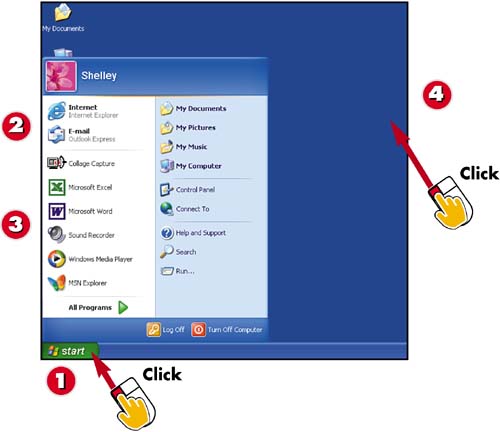
To open the Start menu, click the Start button.

graphics/two_icon.jpg

At the top of the menu, you see the programs you use for the Internet and e-mail.

graphics/three_icon.jpg

The Start menu lists the programs you last used here. You can click any of the listed programs to start that program. To display additional programs, click the All Programs button.

graphics/four_icon.jpg

Press Esc or click outside the Start menu to close it.

INTRODUCTION

The Start menu is where you can access common programs and folders. The Start menu in Windows XP has a new look, so if you are upgrading for a previous version, take a look at how the Start menu is organized. If you are new to Windows XP, you can get a good sense of how to use the Start menu from this task.

TIP

Your Menu Is Different

What you see in your Start menu will be different than what appears here. You see the programs you last used and your selected Internet and e-mail programs.

TIP

Start a Program

For help on starting a program, see Part 2, "Working with Programs," which covers the various ways you can start a program, including from the Start menu.

Task 3: Opening and Closing a Window

graphics/01inf03.jpg

graphics/one_icon.jpg

Double-click the My Documents icon.

graphics/two_icon.jpg

The contents of this icon are displayed and a button for the window appears on the taskbar.

graphics/three_icon.jpg

To close the window, click its Close button.

INTRODUCTION

Windows XP displays all its information in onscreen boxes called windows . To work with any of the information on your computer, you must know how to display (or open ) these windows. Most content windows are represented by small pictures called icons. You can double-click an icon to display the contents of the window the icon represents. When you are done working in a window, you can close it.

TIP

No Icons on the Desktop

If you don't have the My Documents or My Computer icons on your desktop, you can open these content windows by clicking Start and then clicking the appropriate command (My Documents or My Computer). This opens the window for these icons.


Task 4: Minimizing a Window

graphics/01inf04.jpg

graphics/one_icon.jpg

Click the Minimize graphics/01inl01.jpg button in the window you want to minimize.

graphics/two_icon.jpg

The window disappears from the desktop, but a button for this window remains on the taskbar.

INTRODUCTION

You can reduce (minimize) a window so that it is still available as a taskbar button but is not displayed on the desktop. You might want to minimize a window to temporarily move it out of your way but keep it active for later use.

TIP

Redisplay the Window

To redisplay the minimized window, click the taskbar button. The window is opened onscreen.


Task 5: Maximizing a Window

graphics/01inf05.jpg

graphics/one_icon.jpg

Click the Maximize graphics/01inl02.jpg button.

graphics/two_icon.jpg

The window enlarges to fill the screen and the Maximize button changes to the Restore button.

INTRODUCTION

You can enlarge (maximize) a window so that it fills the entire screen. Doing so gives you as much room as possible to work in that window.

TIP

Restore the Window

You can restore the window to its original size. To do so, click the Restore graphics/01inl02.jpg button.

TIP

Moving and Resizing Windows

Note that when a window is maximized it does not have borders so you cannot move or resize it, as covered in the next tasks . To resize or move a window, you must restore it so that it has borders.

Easy Microsoft Windows XP Home Edition
Authors: Oap]Hara S.
Published year: 2003
Pages: 12-15/203
Buy this book on amazon.com >>