13.4 Bounded Buffer Example
13.4 Bounded Buffer Example
Program 13.1 below reproduces the bounded buffer implementation from Chapter 5, Program 5.6 published in the first printing and first edition of this book. In this section, we develop a detailed model of the synchronization of this program and investigate its properties. As usual, we abstract from the details of what items are stored in the buffer and how these items are stored. Consequently, the only variable that we need to consider modeling is the variable count that stores the number of items currently stored in the buffer. The state of the buffer monitor implementation is as follows with the count variable initialized to zero:
const Size = 2 // number of buffer slots ||BUFFERMON = ( Threads::LOCK || WAITSET || SAFEMON ||Threads::(count:VAR(0)) ).
Program 13.1: Buffer interface and BufferImpl class.
 |
public void put(Object o) throws InterruptedException; //put object into buffer public Object get() throws InterruptedException; //get object from buffer } class BufferImpl implements Buffer { protected Object[] buf; protected int in = 0; protected int out= 0; protected int count= 0; protected int size; BufferImpl(int size) { this.size = size; buf = new Object[size]; } public synchronized void put(Object o) throws InterruptedException { while (count==size) wait(); buf[in] = o; ++count; in=(in+1) %size; notify(); } public synchronized Object get() throws InterruptedException { while (count==0) wait(); Object o =buf[out]; buf[out]=null; --count; out=(out+1) %size; notify(); return (o); } } |
The alphabet for each thread is defined by:
set BufferAlpha = {count.VarAlpha, LockOps, SyncOps}
13.4.1 put() and get() Methods
We can now translate the put() and get() methods of Program 13.1 into FSP into a reasonably straightforward way. Since we have abstracted from the details of storing items in the buffer, we replace the actions to place an item in the buffer with the action put and the actions to remove an item with the action get.
/* put method */ PUT = (acquire -> WHILE), WHILE = (count.read[v:Int] -> // while (count == size) wait(); if v==Size then WAIT;WHILE else CONTINUE ), CONTINUE = (put // buf [in] = o; in=(in+1) %size; -> count.inc // ++count; -> notify -> release -> END ) + BufferAlpha. /* get method */ GET = (acquire -> WHILE), WHILE = (count.read[v:Int] -> // while (count == 0 ) wait() if v==0 then WAIT;WHILE else CONTINUE ), CONTINUE = (get // Object[o] = buf [out]; buf [out]=null; -> count.dec // --count; -> notify -> release -> END ) + BufferAlpha.
13.4.2 Producer and Consumer Threads
To investigate the properties of the bounded buffer implementation, we model systems consisting of one or more producer threads and one or more consumer threads. The producer threads call put() and the consumer threads call get () as shown below.
PRODUCER = PUT;PRODUCER. CONSUMER = GET;CONSUMER.
We noted in section 13.2.1 that we must explicitly define the set of threads that will access the monitor being modeled. For the bounded buffer example, we have a set of producer threads, which put items into the buffer, and a set of consumer threads, which take items out of the buffer, identified as follows:
const Nprod = 2 // #producers const Ncons = 2 // #consumers set Prod = {prod[1..Nprod]} // producer threads set Cons = {cons[1..Ncons]} // consumer threads const Nthread = Nprod + Ncons set Threads = {Prod,Cons} The producer and consumer processes are composed with the processes modeling the buffer monitor by:
||ProdCons = (Prod:PRODUCER || Cons:CONSUMER || BUFFERMON).
13.4.3 Analysis
To verify our implementation model of the bounded buffer, we need to show that it satisfies the same safety and progress properties as the design model. However, the bounded buffer design model was specified in Chapter 5, which preceded the discussion of how to specify properties. Consequently, we simply inspected the LTS graph for the model to see that it had the required synchronization behavior. The LTS of the implementation model is much too large to verify by inspection. How then do we proceed? The answer with respect to safety is to use the design model itself as a safety property and check that the implementation satisfies this property. In other words, we check that the implementation cannot produce any executions that are not specified by the design. Clearly, this is with respect to actions that are common to the implementation and design models – the put and get actions. The property below is the same BUFFER process shown in Figure 5.11, with the addition of a relabeling part that takes account of multiple producer and consumer processes.
property BUFFER = COUNT[0], COUNT[i:0..Size] = (when (i<Size) put->COUNT[i+1] |when (i>0) get->COUNT[i-1] )/{Prod.put/put,Cons.get/get}. The LTS for this property with two producer processes, two consumer processes and a buffer with two slots (Size = 2) is shown in Figure 13.7.
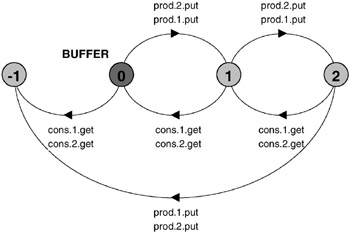
Figure 13.7: LTS for property BUFFER.
We are now in a position to perform a safety analysis of the bounded buffer implementation model using the composition:
||ProdConsSafety = (ProdCons || BUFFER).
With two producer processes (Nprod=2), two consumer processes (Ncons=2) and a buffer with two slots (Size=2), safety analysis by the LTSA reveals no property violations or deadlocks. In this situation, the implementation satisfies the design. However, safety analysis with two producer processes (Nprod=2), two consumer processes (Ncons=2) and a buffer with only one slot (Size=1) reveals the following deadlock:
Trace to DEADLOCK: cons.1.acquire cons.1.count.read.0 cons.1.wait // consumer 1 blocked cons.1.release cons.2.acquire cons.2.count.read.0 cons.2.wait // consumer 2 blocked cons.2.release prod.1.acquire prod.1.count.read.0 prod.1.put // producer 1 inserts item prod.1.count.inc prod.1.notify // producer 1 notifies item available prod.1.release prod.1.acquire prod.1.count.read.1 cons.1.unblock // consumer 1 unblocked by notify prod.1.wait // producer 1 blocks trying to insert 2nd item prod.1.release prod.2.acquire prod.2.count.read.1 prod.2.wait // producer 2 blocks trying to insert item prod.2.release cons.1.endwait cons.1.acquire cons.1.count.read.1 cons.1.get // consumer 1 gets item cons.1.count.dec cons.1.notify // consumer 1 notifies space available cons.1.release cons.1.acquire cons.1.count.read.0 cons.2.unblock // consumer 2 unblocked by notify cons.1.wait cons.1.release cons.2.endwait cons.2.acquire cons.2.count.read.0 cons.2.wait // consumer 2 blocks since buffer is empty cons.2.release
The deadlock occurs because at the point that the consumer process calls notify to indicate that a space is available in the buffer, the wait set includes the second consumer process as well as both the producer processes. The consumer is unblocked and finds that the buffer is empty and goes back to waiting. At this point no further progress can be made and the system deadlocks since neither of the producer processes can run. This deadlock occurs if either the number of producer processes or the number of consumer processes is greater than the number of slots in the buffer. Clearly in this situation, the implementation given in the first printing of Chapter 5 was incorrect!
To correct the bounded buffer program of Chapter 5, to handle the situation of a greater number of producer or consumer threads than buffer slots, we need to replace the calls to notify() with calls to notifyAll(). This unblocks both consumer and the producer threads, allowing an insertion or removal to occur. Replacing the corresponding actions in the implementation model removes the deadlock and verifies that the Java program is now correct.
The lesson here is that it is always safer to use notifyAll() unless it can be rigorously shown that notify() works correctly. We should have followed our own advice in Chapter 5! The general rule is that notify() should only be used if at most one thread can benefit from the change of state being signaled and it can be guaranteed that the notification will go to a thread that is waiting for that particular state change. An implementation model is a good way of doing this.
The corrected model satisfies the following progress properties, which assert lack of starvation for put and get actions:
progress PUT[i:1..Nprod] = {prod[i].put} progress GET[i:1..Ncons] = {cons[i].get} 
EAN: 2147483647
Pages: 162