| [ LiB ] |
This chapter covered the first steps of organizing your company, which should happen in three steps:
Decide ownership stakes. Sit down and figure out how the founders see their contributions and what level of ownership and control they expect. Think about whether a vesting schedule would make sense.
Choose a business entity. Take a look at the business entity options available: the C-corporation, S-corporation, and LLC make the most sense for developers, because they give all of the
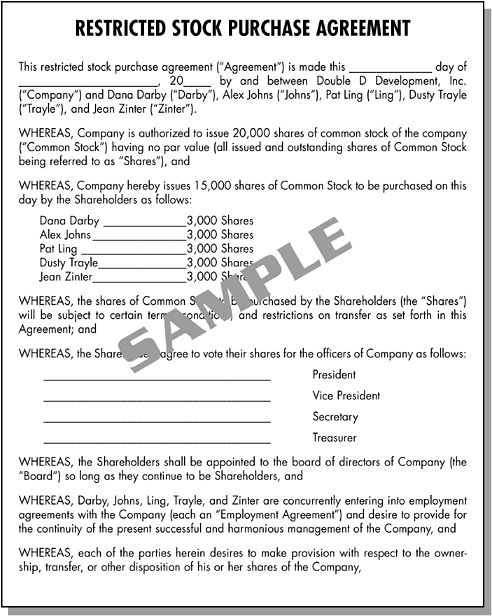
Issue the ownership. Once you know how you'll be allocating ownership and what business entity is best for your company, you'll need to execute an ownership agreement controlling relations among the owners.
The C-corporation is usually not appropriate for young companies because of its entity-level tax, but because most of the profits will be reinvested and/or paid to owners as salary, the entity tax becomes less of an issue. Furthermore, QSBC stock can cut the owners' capital gains tax in half if the stock is owned for five
The S-corporation offers a lot of the C-corporation's benefits but without the double tax. Ownership is limited to 75 or fewer individuals, howeverwhich means no corporate investment. Lots of entrepreneurs start their companies as S-corporations so that they can deduct initial capital losses against their income and capital gains tax, reorganizing (tax-free) later as a C-corporation.
The LLC is another popular option for game developers. It has the benefits of an S-corporation without the limit on ownership. It also doesn't have all of the regulatory requirements of a corporation (annual meetings, filing minutes, and so on). However, there are some drawbacks to the LLC, such as the difficulty of transferring ownership or adding owners, and the lack of
| [ LiB ] |
| [ LiB ] |
Financing in Action
Introduction
How Much Money Do YouNeed to Raise?
Raising Money/Financing the EarlyStage Venture
Selling the Company
Getting Into and Out of Trouble
Summary
| [ LiB ] |
| [ LiB ] |
After a couple of weeks working on the prototype, Dusty and Alex report to the
Meanwhile, the group started a time chart for its prototype and supporting documents that
Dana wanted to have the pitch ready so that she could set meetings for two upcoming big
conferences: GDC and E3. As a new company, albeit one staffed by an old team, she knew their
pitch needed to be airtight. She could rely on her cofounders to make a great
She knew that the real decision about their game would be made by a committee they would
never see and who might not speak English as a primary language, so her responsibility would
be to assemble a
A one-sheet as the cover page, giving the
The team bios (Dana)
A stripped down design specification (Pat)
A short technical specification (Dusty)
A budget and schedule (Dana)
"Screenshots" and representative art for every section of the document (Jean and Alex)
New staff or not, the group was recognizing that its initial $25K would probably need a boost to cover costssoftware, travel to pitch meetings, rent, a network, and maybe even stipendsuntil a deal came through. A big staff would probably decrease the amount of time required to build the prototype and pitch materials, but it might mean getting an office, a real network, more software, and maybe even computers if everyone didn't have her own.
As Dana presented it, the group had two options: either forgo a fundraising and do everything
by the bootstraps or scratch up some money and give away some of the company.
Bootstrapping was a definite possibility, but would probably add a lot of time to their develop
ment schedule. "Furthermore," she noted, "we'll have to have some kind of office and network
for a publisher to look at when they come around for due diligence." Raising money would
take time and
It was decided that Dusty and Alex would talk to their old
She and Michael discussed Double D's funding options. Because the amount of money needed
by the group was relatively small,
As she was leaving Michael's office, her mobile phone rangit was Cokie Totenberg. Cokie had been an external producer on a Defunct project managed by Dana and was now in product development at the same publisher. They'd gotten along very well and had stayed in touch.
"I hear you've taken over Defunct."
"Bad news
"Only the worst. Is it true? I hear you've got everybody back together in your garage."
"I don't have a garage."
"Yeah, whatever. Anyway, I don't know if it's true or what, but in case it is, we've got a GBA shooter port that we're going to need done pretty soon. Are you interested?"
"Definitely not. Revenue? That sounds like a terrible idea."
"Good. Expect a call from us
"Oh. Um right."
"And one day, your godfather will come to you with a request, and at that time, you are
expected to
Dana put her phone away and
Dana called Jamie and explained the situation to the attorney, who worked in Northern
Pacifica. "Our old company just closed down. I don't think that the
Jamie asked Dana if she had a good relationship with the owners of Defunct. "Yeah, very
good." "Well, you can have me contact them first, or you could do it, or we could do it togeth
er. Let them know what you are interested in doing. If what you are saying is correct about the
asset not having value to
Jamie
Dana and the rest of the founders decided on a price they could pay for the engine and the
tools, and agreed that an installment plan would be best. They agreed too that they would be
willing to
The next day, Malachi called to say that he and Edward, as the sole shareholders of Defunct,
would approve a sale of the IP to Double D for half of the cash Dana
| [ LiB ] |