Chapter Summary
Master My Stories
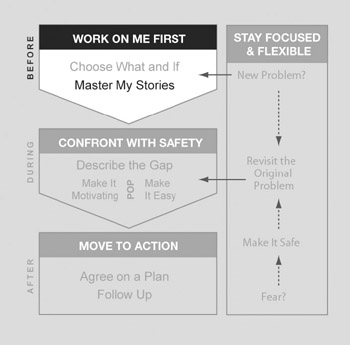
Now we ve selected a problem and thought about the circumstances in a way that puts us in the best state of mind. In short, we ve learned how to master our stories by seeking out all the possible influences that contributed to the problem.
-
Master my stories. The second step in the model also takes place before you actually speak. As you approach a crucial confrontation, take care you don t establish a horrible climate by charging in half-informed and half-cocked. To avoid this costly mistake, work on your own thoughts, feelings, and stories.
-
Tell the rest of the story . Ask why a reasonable, rational, and decent person would do what you ve just seen as well as if you yourself are playing a role in the problem.
-
Look at all six sources of influence. Examine the force of self, others, and things ”all either motivate or enable others to keep their commitment.
-
Expand motive to include the force of others. Do others praise and support the desired behavior or do they provide pressure against it? Is the reward system aligned? If people do what s required, will they receive a carrot or a stick?
-
Finally, add ability. Can others do what s required? Does the task play to their strength or weakness? Are people around them a help or a hindrance? Do the things around them provide a bridge or a barrier ?
Additional Resources
Do you recognize the stories you re telling that may be keeping you from the results you want? Visit www.crucialconfrontations.com/book for commonly told stories and see if they sound familiar.
What s Next?
Now that we re fully prepared, it s time to open our mouths and talk about the failed promise. How do we first talk about the gap we ve observed ? What should be the first words out of our mouth? Let s take a look.

EAN: 2147483647
Pages: 115