Here s our model of the skills we ll cover throughout this book. We ll build this model piece by piece as the chapters unfold. We ve started with the principle Work on Me First. We ve learned that before we utter a word, we have to start by asking what crucial confrontation to hold and if we should hold it.
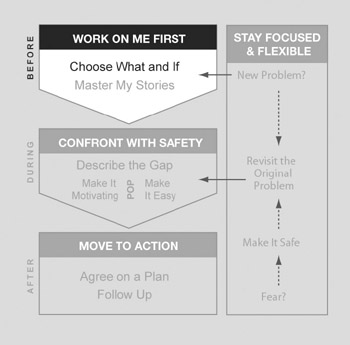
We start every crucial confrontation with two questions ”WHAT and IF:
WHAT. The first time a problem comes up, talk about the original problem or the C ontent. If the problem continues, talk about the P attern. As the impact spills over to how you relate to one another, talk about your R elationship. To help pick the right level, explore what came after the behavior (the consequences) as well as what came before it (the intent). As the list of potential problems expands, cut to the heart of the matter by asking what you really do want and don t want ”for yourself, the other person, and the relationship.
IF.
To determine if you re wrongly going to silence, ask four questions: Am I acting it out? Is my conscience nagging me? Am I choosing the
Once you ve decided to confront a problem, you have to make sure that you yourself are in the right frame of mind. You have to work on yourself first. This isn t always easy;
Have you ever noticed? Anybody going slower than you is an idiot, and
anyone going faster than you is amaniac .”George Carlin
Anyone who has ever dealt with crucial
This can be
Imagine that you re part of an overworked, stressed-out management team that s sitting around a table large enough to double as an airport runway, discussing what it ll take to finish a development project. The phone rings. The quality manager picks it up, carries on a heated discussion, and then slams the phone back onto its cradle.
It s final assembly. The software we just completed is giving them fits, she says with a look typically associated with the act of biting the head off a chicken.
Oh great! The software is glitchy! shouts the vice president of development.
Within seconds the entire leadership team is complaining about the unorthodox, selfish, weird software testers. Then they arise as one and start
As the team
The stupid gear heads only have to run a simple testing package. That way they can catch problems early on and we never send software on to final assembly, where it can cause costly delays.
Why didn t they run the tests? you ask.
That s what we re about to find out, answers the senior VP as the vein on his forehead swells to the
Obviously, this
What makes these crucial confrontations interesting is that the underlying cause doesn t really matter. If leaders start out with strong emotions, believing that they are on the moral high road, the interaction is likely to turn out
The scene continues as the managers rush in like so many deputies preparing for a lynching. They catch the programmers checking out a cool new Web site with a free game download and then do what one might expect: They snarl at the guilty testers, call them unflattering
This ugly battle rages until the information technology manager, who just walked into the building, hears about what s happening to his people and rallies to the testers. A full-fledged shouting match ensues. It s not long before the IT manager is accusing the rest of the management team of
The managers are now so
We used to call the first 30 seconds of a crucial confrontation the hazardous half minute because the overall climate and eventual results are often set in place in seconds. We were wrong. The climate isn t set in the first 30 seconds; it just becomes visible in that time frame. We establish the climate the moment we assume that the other person is guilty and begin feeling angry and morally superior. It takes only a moment to send a crucial confrontation down the wrong track, and it all takes place inside our heads. Here s what this looks like:
Another person does something, and, as a result, we re propelled to action. Here s the
Under these circumstances we come to some of the most ignorant conclusions imaginable. For instance, a fellow comes home from a long road trip and is feeling amorous, but his wife isn t. Soon he s pacing around and muttering to himself. Finally, here s the plan his blood-starved brain comes up with: I ve got it. I ll try to woo her with a
Consider the software development leaders. First came the observation: The software isn t working. Next came the story:
The testers didn t run the final tests because they don t like doing them; in fact, they live in their own little world and don t care what happens to others. Then came the feeling of anger, followed by a fierce and futile attack. This entire path to action ”the jump from observation, to story, to feeling, to action ”takes but a moment and sets the tone for everything that