Flylib.com

Books Software


Showing and Selecting Layers


Showing and Selecting Layers

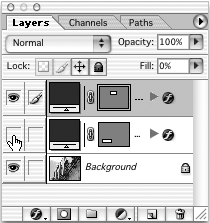
Show or Hide a Layer

graphics/common_icon.gif

Mouse: Click in Eye icon area

graphics/09fig04.gif

Show Just This Layer/Show All Layers

graphics/common_icon.gif

Mac: Option + click in Eye icon area

Win: Alt + click in Eye icon area

View and Select One Layer at a Time

graphics/common_icon.gif

Mac: Option + click layer name

Win: Alt + click layer name

This tip works when only one layer is currently visible. In other words, hide all other layers except one. Then you can use this tip to simultaneously show the next layer you select and hide the previously shown layer.

Note: There is a subtle difference here when clicking the layer name versus clicking the eyeball area. If you click the eyeball area instead, the previous layer stays selected as the active layer, not the layer you just clicked the eyeball for.

Show/Hide Multiple Layers

graphics/common_icon.gif

Mouse: Drag through Eye icon area

Activating Layers

graphics/common_icon.gif
  Mac Win
Next Visible Option + ] Alt + ]
Layer (Up)    
Previous Visible Option + [ Alt + [
Layer (Down)    
Bottom Layer Option + Shift + [ Alt + Shift + [
Top Layer Option + Shift + ] Alt + Shift + ]

If only one layer is visible when you use this shortcut, then the next layer activates and becomes visible, and the previous layer gets hidden. This is a quick way to isolate and cycle through your layer stack by viewing one layer at a time by using this shortcut repeatedly.

Select a Layer by Name

graphics/common_icon.gif

Mac: Ctrl + click the canvas

Win: Right + click the canvas

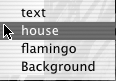
This shortcut works only when the Move tool is active. If you currently have a different tool selected, you can add (Cmd) [Ctrl] to the shortcut to temporarily switch to the Move tool. This shortcut displays a pop-up menu that lists all the available layers directly under the cursor, as long as a layer actually has some pixels under the cursor. Simply choose the layer you want from the list. This shortcut illustrates the need for you to always name your layers something relevant rather than using the default names of Layer 1, Layer 2, and so on.

graphics/09fig05.gif

Select the Topmost Visible Layer

graphics/common_icon.gif

Mac: Cmd + Ctrl + Option + click

Win: Ctrl + Alt + Right + click

This shortcut selects the topmost layer directly under the cursor.


Editing Layers

Change Layer Opacity in 1% Increments

graphics/common_icon.gif

Both: Type two numbers quickly (11=11%, 63=63%, and so on)

This shortcut works only when you have an active selection or the Move tool is the active tool. Otherwise, this shortcut changes the opacity of the active Painting tool.

Change Layer Opacity in 10% Increments

graphics/common_icon.gif

Both: Type a single number (1=10%, 2=20%, and so on)

This shortcut works only when you have an active selection or the Move tool is the active tool. Otherwise, this shortcut changes the opacity of the active Painting tool.

Blend Mode Shortcuts

graphics/common_icon.gif

These shortcuts work only when the active tool doesn't support blend modes. Otherwise, this shortcut changes the opacity of the active painting tool. Blend modes can also be selected from the pop-up menu in the Layers palette.

Blend Mode Mac Win
Next Mode Shift + + (plus)  
Previous Mode Shift + - (minus)  
Normal / Threshold (bitmap mode only) Option + Shift + N Alt + Shift + N
Dissolve Option + Shift + I Alt + Shift + I
Multiply Option + Shift + M Alt + Shift + M
Screen Option + Shift + S Alt + Shift + S
Overlay Option + Shift + O Alt + Shift + O
Soft Light Option + Shift + F Alt + Shift + F
Hard Light Option + Shift + H Alt + Shift + H
Linear Light Option + Shift + V Alt + Shift + V
Vivid Light Option + Shift + J Alt + Shift + J
Pin Light Option + Shift + Z Alt + Shift + Z
Color Dodge Option + Shift + D Alt + Shift + D
Color Burn Option + Shift + B Alt + Shift + B
Darken Option + Shift + K Alt + Shift + K
Lighten Option + Shift + G Alt + Shift + G
Difference Option + Shift + E Alt + Shift + E
Exclusion Option + Shift + X Alt + Shift + X
Hue Option + Shift + U Alt + Shift + U
Saturation Option + Shift + T Alt + Shift + T
Color Option + Shift + C Alt + Shift + C
Luminosity Option + Shift + Y Alt + Shift + Y

Edit Layer Options

graphics/common_icon19.gif

Menu: Layer Layer Options

Mouse: Double-click layer thumbnail or layer name

By popular request, in Photoshop 7, Adobe has restored the ability to rename a layer simply by double-clicking the layer name. Layer properties remain accessible by double-clicking the layer thumbnail.

Edit Layer Properties

graphics/common_icon18.gif

Menu: Layer Layer Properties

Mac: Option + double-click layer thumbnail or layer name

Win: Alt + double-click layer thumbnail or layer name

Edit Blending Modes and Layer Styles

graphics/common_icon5.gif

Menu: Layer Layer Style

Mouse: Double-click layer thumbnail or layer name

graphics/09fig06.gif

Edit Adjustment Layer Options

graphics/common_icon1.gif

Menu: Layer Adjustment Options

Mouse: Double-click Adjustment icon

graphics/09fig07.gif

Convert the Background Layer

graphics/common_icon17.gif

Mouse: Double-click the background layer and change its name

Or, in versions prior to 6.0, with the Move tool selected, nudge the layer up and then down by one pixel, using the up and down arrow keys.

The Background layer cannot support transparency. Use these shortcuts to convert the Background layer into a layer that does support transparency. The default name is Layer 0, but you can change the name to anything you want. You also need to convert the Background layer if you want to reposition it in the layer stack.

Note: If you want to add a Background layer back to a file, the only choice is to use the Layer New Background menu command. (In Photoshop 6 and 7, the menu selection is Layer New Background from Layer. If a Background layer already exists, the menu selection is Layer New Layer from Background.)