8.6 Blind Adaptive Equalization of MIMO Channels via SMC
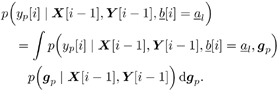
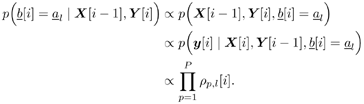
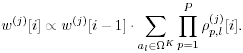
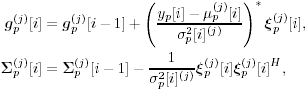
| Many systems can be modeled as multiple-input /multiple-output (MIMO) systems, where the signals observed are superpositions of several linearly distorted signals from different sources. Examples of MIMO systems include space-division multiple access (SDMA) in wireless communications, speech processing, seismic exploration, and some biological systems. The problem of blind source separation for MIMO systems with unknown parameters is of fundamental importance and its solutions find wide applications in many areas. Recently, there has been much interest in solving this problem, and there are primarily two approaches: an approach based on second-order statistics [5, 99, 470, 495], and an approach based on the constant- modulus algorithm [218, 261, 494]. In this section we treat the problem of blind adaptive signal separation in MIMO channels using the SMC method outlined in Section 8.5. The application of SMC technique to blind equalization of single- user ISI channels with single transmit and receive antennas was first treated in [276] and then generalized to multiuser MIMO channels in [543]. 8.6.1 System Description Consider an SDMA communications system with K users. The k th user transmits data symbols { b k [ i ]} i in the same frequency band at the same time, where b k [ i ] Equation 8.107 where Denote Then (8.107) can be written as Equation 8.108 We now look at the problem of online estimation of the multiuser symbols and the channels H based on the received signals up to time i , Then the problem becomes one of making Bayesian inference with respect to the posterior density Equation 8.109 For example, an online multiuser symbol estimation can be obtained from the marginal posterior distribution 8.6.2 SMC Blind Adaptive Equalizer for MIMO ChannelsFor simplicity, assume that the noise variance s 2 is known. The SMC principle suggests the following basic approach to the blind MIMO signal separation problem discussed above. At time i , draw m random samples, from some trial distribution q ( ·). Then update the important weights Equation 8.110 with for a l Following the discussions above, the trial distribution is chosen to be Equation 8.111 and the importance weight is updated according to Equation 8.112 We next specify the computation of the two predictive densities (8.111) and (8.112). Assume that the channel g p has an a priori Gaussian distribution: Equation 8.113 Then the conditional distribution of g p , conditioned on X [ i ] and Y [ i ] can be computed as Equation 8.114 where Equation 8.115 Equation 8.116 Hence the predictive density in (8.112) is given by Equation 8.117 where Equation 8.118 Note that the above is an integral of a Gaussian pdf with respect to another Gaussian pdf. The resulting distribution is still Gaussian: Equation 8.119 with mean and variance given, respectively, by Equation 8.120 Equation 8.121 Therefore, (8.117) becomes Equation 8.122 with Equation 8.123 The filtering density in (8.111) can be computed as follows : Equation 8.124 Note that the a posteriori mean and covariance of the channel in (8.115) and (8.116) can be updated recursively as follows. At time i , after a new sample of Equation 8.125 Equation 8.126 with Equation 8.127 Finally, we summarize the SMC-based blind adaptive equalizer in MIMO channels as follows: Algorithm 8.11: [SMC-based blind adaptive equalizer in MIMO channels]
Equation 8.128 Equation 8.129 Equation 8.130 with
Equation 8.131
As an example, we consider a single-user system with single transmit and single receive antenna and with channel length L = 4. In Fig. 8.9 we plot the channel estimates as a function of time by the SMC adaptive equalizer. It is seen that the channel can be tracked quickly. Note that, in general, when multiple users and/or multiple antennas are present, there is an ambiguity problem associated with any blind methods , which can be resolved by periodically inserting a certain pattern of pilot symbols. For more discussions on the SMC blind adaptive equalizer, see [276, 277]. Note also that it is possible (and sometimes desirable) to make an inference of the current symbols Figure 8.9. Convergence of the SMC blind adaptive equalizer. |
 W and W is a signal constellation set. The receiver employs an antenna array consisting of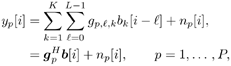
 ,
, 
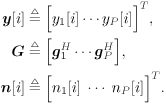

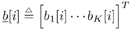
 . Assume that the multiuser symbol streams are i.i.d. uniformly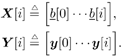

 and an online channel state estimation can be obtained from the marginal posterior distribution
 according to (8.97). The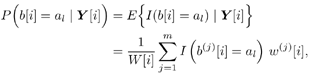
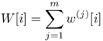



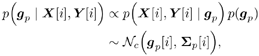


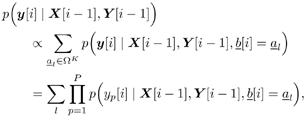





 is drawn, we combine it with the past samples
  be the quantities computed by (8.120) and (8.121) for the imputed



 ,
, 



 .
.  :
: 
 and
and 


 in (8.103) is below a threshold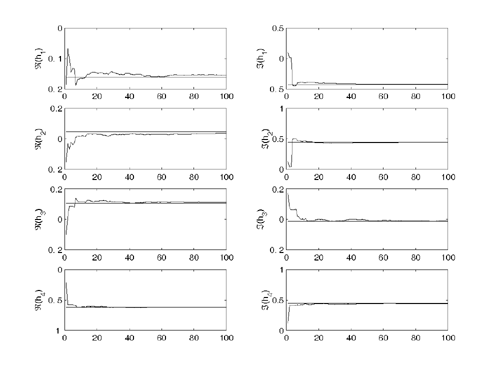

EAN: 2147483647
Pages: 91