Flylib.com

Books Software


Chapter 3. creating the data entry layout


Chapter 3. creating the data entry layout

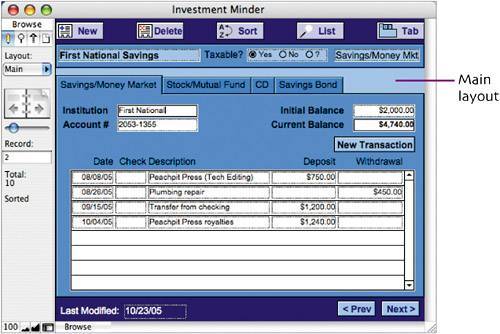
As explained in Chapter 2, the default layout created when you define the initial set of fields can sometimes be used as-is. But if you want the database to be attractive and pleasant to use, it's more common to design a custom layout instead. Normally, layouts are created with the New Layout/Report wizard . By starting with the wizard, you can select a formatting theme and colors, as well as specify the fields to use. However, since our default layout already contains the necessary fields, we'll use it as the starting point for Main, the data entry layout. (Note that all changes to layouts are made in Layout mode.)


about layout tools

While some simple layout modifications (such as changing a field or label's size and position) can be accomplished using only the Selection tool (the arrow), FileMaker has many other tools you can use to create and edit layouts.

In Layout mode, the tool panel appears in the status area . To create an object, select a drawing tool, such as the Line Tool. To change a property of a selected object (such as its fill color ), select Fill or Pen Tool options.

You'll use commands and options on the Text Formatting toolbar (below) to change the formatting of fields, field labels, and static text strings on the layout. If the toolbar isn't visible, choose View > Toolbars > Text Formatting.

Use the Size palette (View > Object Size) to precisely set an object's size or position. The numbers in the Size palette change to reflect the currently selected object's position, width, and height. To change the object's position or size, type a new number into the appropriate box and press or / .

To enable or disable a layout tool, choose its command from the View menu. A View command preceded by a check mark is enabled.


color the layout parts

It's easier to properly place fields on a layout if you've prepared its background. We'll start with something simplecoloring the layout parts.

To edit a layout, you must first switch to Layout mode. Choose View > Layout, press / , click the Layout icon at the top of the status area, or choose Layout from the mode pop-up menu at the bottom of the document window.

There are two ways to color a layout background. If you only want to color some of it, you can draw a colored box that's the exact size needed. If you want to color an entire part, on the other hand, there's a simpler method. Click the part label (such as Header, Body, or Footer) and then pick a fill color from the tool panel. Apply the colors below to the Header, Footer, and Body parts.


format fields and labels

Since all the necessary fields are already on the layout and most will share the same format, we can save some time by formatting them now.

In Layout mode (View > Layout Mode), select all the field labels.

You can drag a selection rectangle around the labels using the Selection Tool or -click each label. However, the fastest way is to select one of the labels and then press / .

Format the labels as Arial, 12 pt., Bold .

You can choose formatting options from the Format submenus or from the Text Formatting toolbar (View > Toolbars > Text Formatting).

Select one field, and then press / to select all fields. Format the fields as Arial, 10 pt .

Select all fields and labels by choosing Edit > Select All. To change them all to the new height, choose Arrange > Resize To > Largest Height.

Select only the fields again. Set the fill color to white and the effect to Engraved .

To create a 1-point black border around every field, choose Format > Field/Control > Borders. Ensure that Borders is selected in the drop-down list in the Field Borders dialog box. Click the Top, Bottom, Left, and Right check boxes, and then click OK.