Flylib.com

Books Software


Duplicating Master Symbols


Duplicating Master Symbols

Although you can always modify the instances of a symbol on the Stage, if you need to use one variation of a symbol over and over, you can duplicate the original master symbol and then modify the duplicate to create a new master symbol with those variations.

To create a duplicate symbol

1.

In the Library panel, select the symbol you want to duplicate.

2.

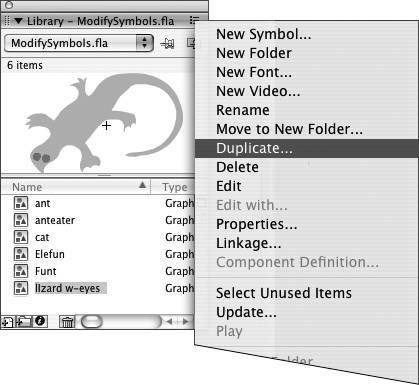
From the Options menu, choose Duplicate ( Figure 7.32 ).

Figure 7.32. From the Library panel's Options pop-up menu, choose Duplicate to make a copy of the selected symbol.


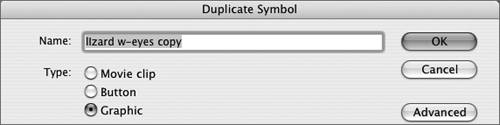
Flash opens the Duplicate Symbol dialog, giving the duplicate symbol a default name ( Figure 7.33 ).

Figure 7.33. In the Duplicate Symbol dialog, you can name the new symbol (the default name is the original name plus the word copy ) and assign its type.


3.

If you want, type a new name for your symbol.

4.

Choose Graphic as the symbol type.

5.

Click OK.

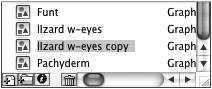
Flash adds the new symbol to the library at the same level in the hierarchy as the original ( Figure 7.34 ). The duplicate doesn't link to the original symbol in any way. You can change the duplicate without changing the original, and vice versa.

Figure 7.34. Flash puts duplicated symbols at the same library level as the original symbol.


Deleting Master Symbols

Deleting symbols can be a little trickier than deleting shapes or groups on the Stage. Deleting one instance of a symbol from its place on the Stage is easy; use the methods for cutting or deleting graphics discussed in Chapter 4. Deleting symbols from the library isn't difficult but does require some thought, because instances of the symbol may still be in use in your movie.

To delete one symbol from the library

1.

In the Library panel, select the symbol you want to remove.

2.

To delete the symbol, do either of the following :

  • At the bottom of the window, click the Delete button (the trash-can icon) ( Figure 7.35 ).

    Figure 7.35. Click the trash can icon to delete a selected library item.


  • From the pop-up Options menu in the top-right corner of the window, choose Delete ( Figure 7.36 ).

    Figure 7.36. You can also choose Delete from the Library panel's Options menu to remove selected symbols from the active document.


Tip

  • In earlier versions of Flash, deleting symbols from the library was a permanent operation. Flash even warned you of that fact when you chose to delete master symbols from the library. With Flash 8, you can undo deletions from a library.


To delete a folder of symbols from the library

1.

Select the folder you want to remove.

2.

Follow step 2 of the preceding task.

Flash removes the folder and all the symbols it contains from the library.

Tip

  • Always check the usage numbers before you delete library items ( Figure 7.37 ). You don't want to delete a symbol that you're currently using in a movie, which is especially easy to do if you've nested symbols within symbols. Some earlier versions of Flash warned you when you tried to delete an item that was in use in a movie. Flash 8 doesn't.

    Figure 7.37. Be sure to update use counts before deleting a symbol (in the Library panel, choose Options > Update Use Counts Now). Then check to be sure the item you want to delete isn't being used in the movie.


Converting Symbol Instances to Graphics

At times, you'll want to break the link between a placed instance of a symbol and the master symbol. You may want to redraw the shape in a specific instance but not in every instance, for example. To convert a symbol back to an independent shape or set of shapes, break it apart, just as you break apart grouped shapes (see Chapter 5).

To break the symbol link

1.

On the Stage, select the symbol instance whose link you want to break.

2.

Choose Modify > Break Apart, or press -B (Mac) or Ctrl-B (Windows) ( Figure 7.38 ).

Figure 7.38. The Properties tab of the Property inspector reveals that the selected graphic is a symbol instance (top). To break the link with its master symbol, choose Modify > Break Apart. The Properties tab of the Property inspector reveals that the selection now consists of shapes; it's no longer a symbol instance (bottom).


Flash breaks the link to the symbol in the library and selects the symbol's elements. The Properties tab of the Property inspector no longer displays information about the instance of the symbol; it displays information about the selected shapes.

If you grouped any of the original elements, they remain grouped after you break the link; ungrouped elements stay ungrouped . Any symbols that existed within the original symbol remain as instances of their respective master symbols. Now you can edit these elements as you learned to do in previous chapters.