Chapter 10: Develop Your Capacity to Reconcile Dilemmas
OVERVIEW
We are very aware of the dangers of stereotyping cultures. That is not our purpose. The examples of dilemmas of marketing we have given throughout this book were chosen to help you, the reader, begin to think about some of the challenges you face when dealing with marketing across cultures. Being able to apply the methodology presented throughout this book will give you a general framework that you can apply across any culture.
Similarly we cannot obviously hope to have listed every dilemma you will face. The more you look for dilemmas the more you will realise how important they are as the root underlying cause of the problems you face - for yourself (the ideographic level) and for your organization (the nomothetic level).
Because marketing is about messages, not only about what is said but how it is said, you are faced with first eliciting the dilemmas and then reconciling : The first step is to express your problem in the form of a dilemma. Let's take an example. How should we design our advertisement? Yes, there is the old adage: "a picture is worth a thousand words," but a picture is not as effective as words in conveying factual information. So we can express the issue as:
| On the one hand... | On the other hand... |
|---|---|
| Should our message be conveyed primarily in pictures? | Should our message be conveyed primarily in words? |
Advertisers often place great emphasis on vivid and creative illustrations or photography. But ads that contain the same information, presented in either visual or verbal form, have been found to induce different reactions . The verbal versions affect ratings on the utilitarian aspects of the product, while the visual affects esthetic evaluation more (Grass and Wallace, 1994).
Verbal elements are more effective when reinforced by an accompanying picture especially if the illustration is "framed" (the message in the picture is the same as the text or audio). It requires more effort to process visual data, and that is why these are more appropriate for higher-level constructs. But verbal content also disappears more rapidly from the memory. So we also have to consider aspects of repetition.
| On the one hand... | On the other hand... |
|---|---|
| Should we repeat our message to keep reinforcing it to achieve familiarity ? | Should we restrict the frequency of our message to avoid boredom and oversaturation? |
Familiarity breeds contempt, but people also like to see things that are familiar to them because it reinforces their value systems and makes them comfortable by giving some stability in their lives. Too much repetition gives rise to habituation, so that the consumer no longer pays attention to the stimulus (message/advertisement). We therefore have to reconcile what is normally known as the twofactor theory. This states that two separate processes are carried out when a consumer sees the repeat of an ad. This can be summarized as:
| On the one hand... | On the other hand... |
|---|---|
| Should we repeat our message to keep reinforcing it to achieve familiarity? | Should we restrict the frequency of our message to avoid boredom and oversaturation? |
| It increases familiarity and reduces uncertainty about the product or service | Boredom increases with each exposure |
There comes a point where the amount of boredom exceeds the amount of uncertainty that is reduced.
Advertisers can reconcile this dilemma by limiting the amount of exposure per repetition - by using very short, 15-second spots for example. They can also alter the content slightly so that the common theme remains but with sufficient changes to keep the viewer alert.
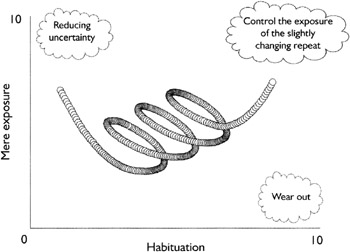
Figure 10.1: The repetition versus familiarity dilemma
You can practice now by thinking about the following marketing problems and seeing if you can express these in the form of dilemmas.
In advertisements:
-
Should a conclusion be drawn, or should this be left to the viewer/reader or listener?
-
Should all sides of the argument be presented or just the single-sided case that "pushes" the product's benefits?
-
Should explicit comparisons be made with a competitor's products?
-
Should sex appeal be used?
-
Should negative emotions be exploited (e.g., fear)?
-
Should humor be used?
-
How concrete or vivid should the imagery and arguments be (such as showing a bad crash in a drink-drive campaign)?
The point we are making is that marketers face dilemmas constantly, and these become even more significant when transferring across cultures. So not only do you need to think about these fundamental marketing issues as dilemmas, but also about how the value orientations of each culture will affect the significance of each horn of the dilemma and how the differences can be reconciled.
 |
When formulating your marketing issues as a dilemma remember that:
We define a dilemma as "two propositions in apparent conflict," In other words a dilemma describes a situation whereby you have to choose between two good or desirable options. For example, on the one hand we need, flexibility whilst on the other we also need consistency. So a dilemma describes the tension that is created due to conflicting demands.
What is not a dilemma? Here are some examples;
-
A description of a current and ideal state: "We have good communication tools but we need to use them better."
-
An either-or option: "Should we start hiring new employees now or wait till next year?''
-
A complaint: "We make good, strategic plans but due to lack of leadership we are not able to follow them through."
How to formulate a dilemma?
-
Avoid the above examples of non-dilemmas.
-
Describe a specific situation to explain the context of the dilemma. .
-
Describe the positive elements of both sides of the dilemma (e.g., individual versus group ; objective versus subjective ; logic versus creativity; analytical versus intuitive; formal versus informal; rules versus exceptions, etc.),
| |

EAN: 2147483647
Pages: 82
- A View on Knowledge Management: Utilizing a Balanced Scorecard Methodology for Analyzing Knowledge Metrics
- Measuring ROI in E-Commerce Applications: Analysis to Action
- Technical Issues Related to IT Governance Tactics: Product Metrics, Measurements and Process Control
- Managing IT Functions
- Governing Information Technology Through COBIT