Flylib.com

Books Software


Play the Radio


Play the Radio

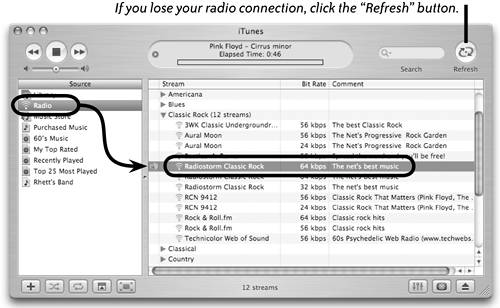
Click the "Radio" icon to open the Radio Tuner so you can tune into the Internet radio stations that are built into iTunes (or whose addresses you have entered). These stations play a wide variety of music, news, and talkshow programs (netcast in the streaming MP 3 format).

To play the radio in iTunes

1.

Click the "Radio" icon in the Source pane to see the radio options in the "Stream" column (the same column that is labeled "Song Name " when the selected Source is a CD, an album, or your Library).

Choose which columns to display in the Radio Tuner window: From the Edit menu, choose "View Options…."

2.

Click the disclosure triangle of a radio category to see the various choices of streaming Internet connections.

3.

Double-click a stream to begin playing it. iTunes will open the designated URL (web address) and start playing the content.

iTunes uses technology called "Instant On Streaming" that allows content to start playing immediately. It continues to download data as the file plays. If you do not have a full-time Internet connection, connect to the Internet before you double-click a radio selection.

Some radio stations are available in several bit rates (kilobits per second) which affect the quality of the streams. Streams with higher bit rates sound better, but tend to break up over slow connections. If you have a dial-up Internet connection, choose streams with lower bit rates, such as 24 kbps.
To enter another radio address

If you know the web address of a streaming MP 3 radio station that's not in the iTunes Radio Tuner, you can manually enter it.

1.

From the Advanced menu at the top of your screen, choose "Open Stream…."

2.

In the text field of the "Open Stream" window enter the web address. The address must be a complete URL , including the stream file name.


Music File Formats

iTunes works with six audio file formats: MPEG -4 AAC , MP 3, CD-DA , AIFF , WAV , and Apple Lossless. Using the Import feature, iTunes can encode CD-DA files from a CD to MP 3, AIFF , or WAV files. It can also encode MP 3, AIFF , and WAV files to CD-DA format when burning a CD. Each file format is suited for a specific purpose.

To select an encoder when importing files, see page 109 .


  • CD-DA (Compact Disc Digital Audio) is the file format used on all music CD s. When you burn a CD from a playlist, iTunes by default automatically encodes the files in the playlist as CD-DA formatted files so they'll play on CD players. In the iTunes preferences window you can set iTunes to burn files in the MP 3 format, or as a data disc which will retain the original file format of song fileswhatever they happen to bebut the songs may not play in a CD player.

  • MP 3 ( MPEG -3) is a highly efficient compression system that reduces music files up to 90 percent, but maintains a very high quality. Highly compressed, MP 3s are ideal for downloading from the Internet or for storing on your computer.

  • MPEG-4 AAC (Advanced Audio Coding) format compresses files even smaller than MP 3 without a noticeable loss of quality. When iTunes imports a song from a CD to your computer, by default it encodes the CD-DA formatted song to an AAC format. MP 3s and AAC s are ideal for storing music on your computer, requiring 80 to 90 percent less disk space than other formats.

    If you have a version of QuickTime installed that's older than version 6.2, songs are by default imported in the MP 3 format instead of the AAC format.


  • Apple Lossless encodes CD-DA files ( CD music files) into a size that's half the size of the original file, without any loss of quality. This format creates files that are larger than the MP 3 and AAC formats, but if you have a discriminating ear for music, the Apple Lossless format provides the best quality possible.

  • AIFF (Audio Interchange File Format) is sometimes referred to as Apple Interchange File Format. It is a music format used by the Macintosh operating system. Web designers use snippets in the AIFF format for sound files that can play in web pages on a Macintosh computer. The file size of the Beatles song "I Want To Hold Your Hand" is 24.3 MB as an AIFF file, compared to 2.7 MB as an MP 3 file.

  • WAV (Windows waveform format) is a music file format used by the Microsoft Windows operating system. Web designers use snippets in the WAV format for sound files that can play in web pages on a Windows computer. The file size of the Beatles song "I Want To Hold Your Hand" is 24.3 MB as a WAV file, compared to 2.7 MB as an MP 3 file.