MAC Sublayer Functional Description
|
|
The MAC functional description is presented in this subsection. The architecture of the MAC sublayer, including the distributed coordination function (DCF), the PCF, and their coexistence in an IEEE 802.11 LAN are introduced.
MAC Architecture
The MAC architecture can be described as providing the PCF through the services of the DCF, as shown in Figure 5-33.
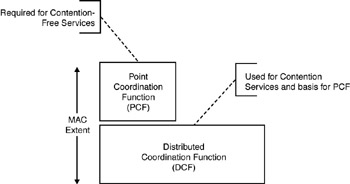
Figure 5-33: MAC architecture
Distributed Coordination Function (DCF) The fundamental access method of the IEEE 802.11 MAC is a DCF known as CSMA/CA. The DCF will be implemented in all STAs, for use within both IBSS and infrastructure network configurations.
For an STA to transmit, it will sense the medium to determine if another STA is transmitting. If the medium is not determined to be busy, the transmission may proceed. The CSMA/CA distributed algorithm mandates that a gap of a minimum specified duration exist between contiguous frame sequences. A transmitting STA will ensure that the medium is idle for this required duration before attempting to transmit. If the medium is determined to be busy, the STA will defer until the end of the current transmission. After deferral, or prior to attempting to transmit again immediately after a successful transmission, the STA will select a random backoff interval and will decrement the backoff interval counter while the medium is idle. A refinement of the method may be used under various circumstances to further minimize collisions — here the transmitting and receiving STA exchange short control frames (RTS and CTS frames) after determining that the medium is idle and after any deferrals or backoffs prior to data transmission.
Point Coordination Function (PCF) The IEEE 802.11 MAC may also incorporate an optional access method called a PCF, which is only usable on infrastructure network configurations. This access method uses a point coordinator (PC), which will operate at the AP of the BSS, to determine which STA currently has the right to transmit. The operation is essentially that of polling, with the PC performing the role of the polling master. The operation of the PCF may require additional coordination, not specified in the 802.11 standard, to permit efficient operation in cases where multiple point-coordinated BSSs are operating on the same channel, in overlapping physical space. The PCF uses a virtual carrier sense mechanism aided by an access priority mechanism. The PCF will distribute information within Beacon management frames to gain control of the medium by setting the NAV in STAs. In addition, all frame transmissions under the PCF may use an interframe space (IFS) that is smaller than the IFS for frames transmitted via the DCF. Using a smaller IFS implies that point-coordinated traffic will have priority access to the medium over STAs in overlapping BSSs operating under the DCF access method. The access priority provided by a PCF may be utilized to create a CF access method. The PC controls the frame transmissions of the STAs so as to eliminate contention for a limited period of time.
Coexistence of DCF and PCF The DCF and the PCF will coexist in a manner that permits both to operate concurrently within the same BSS. When a PC is operating in a BSS, the two access methods alternate, with a CFCFP followed by a contention period (CP).
|
|

EAN: N/A
Pages: 88
- Using SQL Data Definition Language (DDL) to Create Data Tables and Other Database Objects
- Performing Multiple-table Queries and Creating SQL Data Views
- Working with Comparison Predicates and Grouped Queries
- Retrieving and Manipulating Data Through Cursors
- Exploiting MS-SQL Server Built-in Stored Procedures