Operational Management Capabilities Model
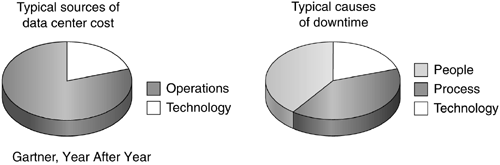
| The sections in this chapter have identified several areas of opportunity and focus to define and prepare an N1 Grid solution. Sun's technologies for automating the virtualization and provisioning of applications (or other layers of the stack) are ready to help you create efficiencies in your data center or extend those solid efficiencies into areas of strategic business flexibility. While these new capabilities require a level of rigor in architecture, business process, and security, the benefits of doing this work are clear. Implicit in this rigor and change is the impact on process and people the processes that become automated and the new ways that people architect, implement, and manage business services. This section introduces Operational Management Capabilities Model (OMCM) to help define the capability and prepare to focus on the state of readiness of your people and processes for N1 Grid solutions. The OMCM defines key process areas that provide a measure of the people, processes, and tools that give an organization the ability to deliver IT services to an agreed-upon service level in a predictable fashion with acceptable risk and cost. Analyzing the people, processes, and tools in an organization associated with each OMCM level can help an organization prioritize its improvement efforts. FIGURE 4-4 repeats the reminder that the N1 Grid solution is built on the insight that people and processes account for the vast majority of data center costs and causes of downtime (FIGURE 4-4). Figure 4-4. Typical Causes of Costs and Downtime
The N1 Grid architecture helps customers move their IT operations to higher levels of functionality and operational maturity. The OMCM describes a hierarchy of management decision-making activity that provides an indicator of the maturity and added value of various types of IT organizations. This model (as shown in TABLE 4-9) is based on the thesis that the more value an IT organization adds to its host organization, the more likely it is that IT management spends its time on resolving higher-level issues. At the lowest level of organizational maturity, the IT operation moves from one emergency to another. Moving up the scale, organizations manage increasingly higher-level sets of issues. The highest level is reached by IT organizations whose primary decision-making focus is on how to best use IT to add value to the businesses they support.
The point here is that by automating the work of infrastructure management and by providing tools for the high-level allocation and control of resources, the N1 Grid architecture provides a ladder for IT organizations to achieve higher levels of organizational effectiveness. There is a paradox at work here, however. Organizations at the higher levels of maturity are the organizations that most likely recognize the value of the N1 Grid and adopt the technology and principles early on. To a great degree, their mind set and underlying infrastructures tend towards being ready for the N1 Grid architecture. Organizations at the lower levels of maturity are the organizations that need the N1 Grid architecture the most, but they are less likely to see the value of the N1 Grid architecture because their infrastructures and management cultures face higher barriers or cultural shifts in making the migration to the N1 Grid architecture. Nonetheless, the N1 Grid architecture offers capabilities and benefits to operations at all stages of organizational maturity. TABLE 4-9 outlines some examples of how the N1 Grid architecture can be used to improve maturity level of IT operations or, at least, the types of activities that a customer at a particular level should consider first. |

EAN: N/A
Pages: 144