Chapter Nine Selling When You re Not First
Nine Selling When You re Not First
Overview
It was 3:15 a.m. when the hotel phone rang. It was Ulrich Hanson calling me from Dallas, Texas. I was in the United Kingdom and his early-morning call startled me.
“Keith, I’m sorry for calling you in the middle of the night,” Ulrich said. “I have an emergency, and I was afraid I would miss you if I waited until tomorrow.”
“That’s okay,” I said, struggling to wake from a deep sleep. “What can I do for you?”
“We’ve just received word that we’ve lost a very important strategic deal in Argentina,” he said, his voice tense and filled with stress. “Time is of the essence, and I want you to help us with a competitive strategy and a tactical plan to salvage this account.
“Keith, I know this is asking a great deal of you, but can you come to Dallas right away? Can you get here tomorrow? I don’t care how you do it or how much it costs. I need your help on this.”
His offer made my decision easy. It was my first opportunity to fly on the Concorde, the fastest commercial airplane in the world. Because of the time difference, I effectively arrived in New York before I had taken off. I was back in Dallas later that same day and in plenty of time to participate in the first strategy session on the opportunity.
While flying from London to New York, I had time to reflect on his phone call. Ulrich Hanson, country manager for EDS in Latin and South America, was committed to implementing a sales process to help his team better manage the complex selling environment it faced in the outsourcing business. (Ulrich, along with his direct reports and his salespeople, had spent a week in Dallas learning how to implement Solution Selling—I had even taught the workshops.)
Within three weeks of the training, a large manufacturer in Argentina asked to visit the EDS facilities in the United States. The manufacturer wanted a thorough briefing on EDS’s outsourcing capabilities and said it was evaluating two or three outsourcing companies. Company executives would make a fast decision. They agreed to send a packet of information ahead of time so EDS could better prepare for their visit.
Of course, EDS happily encouraged their visit. This is every salesperson’s dream. Or is it? The Argentinean manufacturer was already at vision and it did not include EDS. The manufacturer only wanted EDS for comparison and price negotiations, and Ulrich and his team played right into their hands.
Ulrich realized what he and his team had done. He was angry and disappointed in himself for not seeing this one and for not doing things differently. They had played by someone else’s rules in an active situation. Ulrich realized he should have deployed the End-Around competitive strategy and vision re-engineering, which he had learned from Solution Selling. Instead, his team focused on supplying the prospect with an outsourcing proposal to replace the company’s existing and outdated technology.
Ironically, this was the right thing to do. However, automating the manufacturer’s current chaotic processes would just result in better-automated chaos. The missing link was the need for business process re-engineering before putting the new automation into place.
Using Solution Selling’s process steps, I helped the EDS team determine what the real business problems were. The manufacturer was losing more than half a billion dollars a year, and it was close to going out of business. Survival was the paramount goal. The company’s current manufacturing procedures were old and outdated, and the costs of its information system were prohibitive.
Ulrich and his team got back into the opportunity by admitting to the prospect that EDS hadn’t properly analyzed the manufacturer’s current technology and manufacturing processes. EDS won the manufacturer’s attention by disclosing a way to reduce the cost of its information system and, more important, reduce the overall costs of manufacturing by $10 million annually. EDS previously had not wanted to go down this path, because this analysis and proposal would add costs on the front end, and the customer was extremely cost conscious. Furthermore, EDS felt such an approach would delay the decision and it wanted to avoid that too.
Once the prospect agreed to listen, EDS was able to deploy an End-Around strategy and re-engineer the existing vision. EDS successfully rearranged the playing field. The approach changed the buying requirements from a technology capability focus to an industry expertise focus, where competitors of EDS could not compete or win.
EDS was very fortunate to get a second chance with this opportunity and win the business. Here is Ulrich Hansen’s note to me:
Shortly after the last of three classes were conducted by our group in our SBU, we discovered an opportunity in Argentina. A major competitor of ours was about to sign the first outsourcing contract in that country. Since we arrived late on the scene (mainly due to not having a presence in Argentina), we were not in “Column A.” By using all the wisdom in your process and your strategies and techniques, we got the playing field rearranged from “technology” to our strength, “industry capability.” When our competitor mistakenly accepted the new playing field, it was outplayed! In summary, we signed the first outsourcing multiyear contract in Argentina worth over $40 million.
WHEN TO COMPETE
Ulrich Hansen’s story raises several questions: When should you engage or disengage from an opportunity? And if you engage, which strategy should you employ? The right answers can lead to improved win odds, realized sales forecasts, and increased sales revenue; the wrong answers can lead to increased selling costs, missed sales forecasts, and low morale. You must decide whether to stay and compete, or disengage and move on. The cost of doing business today is too high and selling resources are too limited to pursue every opportunity that comes along.
In the past, Solution Selling focused on strategies dealing with latent, or Not Looking opportunities. Today, that’s not the case. Solution Selling has been enhanced to better assist salespeople in the competitive world of active or Looking opportunities. I am a firm believer that you should evaluate every active opportunity that’s out there. I also firmly believe that you will not win them unless you deploy the right competitive strategy and tactical plan, which brings me to the famous Chinese general and philosopher Sun-Tzu.
Sun-Tzu’s book The Art of War (Sun-Tzu Ping-Fa) is the oldest account of formalized military strategies and tactics of warfare. Though he lived long ago (ca. 400–320 b.c.e. ), his strategies and tactics still apply and are studied in modern business management, and his book is required reading in many business schools. Sun-Tzu regarded war as a road either to safety or to ruin, a matter of life and death, and a subject that cannot be neglected. He talked about when to fight and when not to do so and which strategy to use.
Selling is like that too. I regard sales as a road either to safety or ruin, a matter of success or failure, and a subject that cannot be neglected. We must be aware of the consequences of poor planning, wasteful selling actions, and careless personnel. Deciding when to compete and selecting the right selling strategy are crucial to success in the marketplace.
PREEMPT THE COMPETITION, GET THERE FIRST
Get there first; set the buying requirements; become Column A. Preempt the competition. That’s the best strategy and the best advice I can give salespeople when it comes to winning in competitive environments. I realize that deploying this strategy may not always be possible, but there is one thing I know for sure: it cannot work unless you try.
Often we find ourselves in situations where the competition has established itself in Column A. When we do, we have to take action to replace the competition. Can you still win if you didn’t define the problems and create the vision? Can you win if you’re Column B or C? What does it really take to overcome someone in Column A? This chapter answers those questions.
When a buyer phones or sends you an RFP announcing that he or she is in the market for what you have to sell, it’s very enticing to compete, to respond, to immediately begin selling. We fail to recognize that the buyer has a vision, and it’s not one we helped create. Don’t be too anxious to walk into this minefield. Step back and assess the situation.
It’s difficult to compete against a competitor who is already in Column A. Remember, the research indicates that those companies and salespeople who are in Column A win more than 90 percent of the time. One of my largest clients, IBM’s Software Group, tracked its results worldwide and verified the findings. IBM’s results showed that 93 percent of the time some other company won the business if IBM did not define the problems and set the requirements.
The lesson is clear: if another competitor is first choice, your chances of winning are slim—about 10 percent. Put another way, you stand a 90 percent chance of losing. The staggering fact is that salespeople spend most of their time and efforts on situations they didn’t create and where they have less than a 10 percent chance of winning. If you find yourself engaging in this practice, stop the insanity.
FIVE RULES FOR DECIDING WHETHER TO COMPETE OR NOT
The first step is to measure the odds of winning. Sun-Tzu said, “In respect of military method, we have, firstly, Measurement; secondly, Estimation of Quantity; thirdly, Calculation; fourthly, Balancing of Chances; fifthly, Victory.”
In Solution Selling, we use five rules. Each will help you decide whether or not to engage. In the bustle and chaos of selling, there is usually little time to assess an opportunity. But when it comes to competing against competitors who are already in Column A, we have to pause and consider our actual chances of winning.
Rule 1 Don t Fool Yourself, Your Team, or Your Manager
Start by asking yourself a very basic question: Is this opportunity active (Looking) or latent (Not Looking)? If it’s active, then don’t fool yourself into thinking you have a good a chance of winning. The worst thing salespeople can do in competitive situations is fool themselves. The consequences of making the wrong decision can be severe, and not just in lost time, money, and resources. It can be personally and politically devastating to get involved in opportunities that you have no chance of winning.
By being honest with yourself, you can assess your real chances, select the right strategy, and build a tactical plan that gives you a realistic chance of winning. Remember, the win rate on active opportunities (when you’re not first) is not encouraging. This doesn’t mean give up; it means it’s time to be realistic. You have limited time, money, and resources; use them wisely. Always remember, not all sales opportunities are created equal.
Rule 2 Qualify the Opportunity, Perform an Opportunity Assessment
I find that most salespeople need a job aid to assist them when they’re deciding whether to pursue an opportunity. It’s never too early or too late to disengage from an opportunity that does not meet a set of defined standards. The sooner you disengage from opportunities that you have no chance of winning, the sooner you can work on opportunities where you do.
I think of opportunity assessment like a game of poker. Who wins the most money? It usually isn’t the person who stays in each hand the longest. He or she tends to commit more time and money and then doesn’t win. Players who fold early when they realize their chances of winning are low tend to win the most money.
Why do salespeople need a job aid or a third party to assist them with making the decision whether to engage or disengage? Is it because they don’t trust themselves? It seems that salespeople get too caught up in their desire to win and thereby lose their objectivity
The Opportunity Assessment Worksheet illustrated in Figure 9.1 helps the salesperson answer two very basic questions: Should we compete? and, Can we win? This is especially important in active opportunities that you didn’t initiate or create.
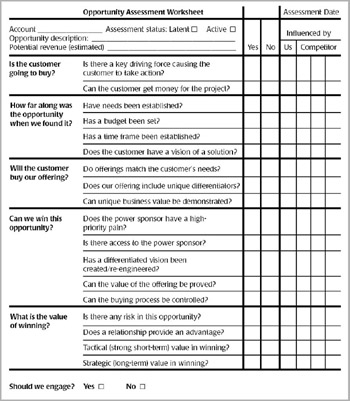
Figure 9.1: Opportunity Assessment Worksheet
Notice in this example that we have created columns and a grading legend to help salespeople assess for themselves how they compare with their competition. Once you have decided to compete, it’s important to determine what it’s going to take to win.
When you use the Opportunity Assessment Worksheet, some of the key questions to ask include: Do you have access to power? Can you identify the power person’s business (and personal) pains? Does the power person’s vision of a solution match the capabilities of your products and services? What is the value associated with solving the problem? Can you exert control over the buying process?
Earlier, I introduced the formula for a successful sale: Pain x Power x Vision x Value x Control = Sale. This is a component of the Opportunity Assessment job aid that can be used to quickly qualify opportunities. Remember, because this is a formula, if you have a zero in any element on the left, you get a zero on the right.
Once you’ve assessed your chances, you should have a better idea of your competitive advantage or lack of one. If the odds look good, it’s time to select a competitive strategy and determine the tactical steps that need to be implemented in order to win.
Rule 3 Select a Competitive Strategy
The key word in Rule 3 is select. To select a strategy, you first need to know what it is and how it is used. I make a big deal out of selecting, because many people unconsciously select a strategy (not knowing they have done so) that won’t allow them to win. The four competitive strategies for active opportunities are:
- Head-to-Head
- End-Around
- Divide and Conquer
- Stall
Each strategy has its own strengths and weaknesses. It’s important to understand each one (see Figure 9.2).
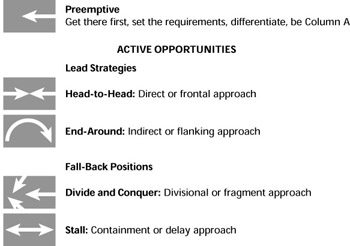
Figure 9.2: CompetitiveStrategies
Head-to-Head Strategy Sun-Tzu said, “In the practical art of war, the best thing of all is to take the enemy’s country whole and intact.” He insisted that your forces must have overwhelming strength: “It is the rule in war, if our forces are ten to the enemy’s one, to surround him; if five to one, to attack him; if twice as numerous, to divide our army into two.” Superiority gives us a competitive advantage.
The Head-to-Head strategy is the number one strategy deployed in competitive selling situations. It’s also the number one strategy selected in the majority of lost opportunities. Most salespeople unconsciously resort to it, even though it may not be the correct strategy for the situation. They are unaware of other ways to compete, and they fail to anticipate their competitors’ maneuvers. Salespeople using a Head-to-Head competitive strategy simply match feature and function, competing directly with the competition, giving it their best shot—and end up losing.
In competitive situations, if a stronger competitor enjoys an entrenched position and you want to defeat the competition, don’t choose a Head-to-Head strategy. It will almost certainly lead to a lost opportunity. The principles of competition dictate that to win using a Head-to-Head strategy—taking heed of Sun-Tzu’s advice—you must have a greater advantage, depending on the competitor’s position and level of entrenchment. Hopefully, you enjoy a 2 to 1 advantage in competitive commercial situations (preferably, a 10 to 1 or at least a 5 to 1 advantage would be better). Keep in mind, this advantage should be considered from the customer’s perspective, not your own: Does the customer think you’re twice as good as the competition? Don’t be unrealistic; take stock of your strengths and carefully assess your opportunity.
An example of the dangers of using a Head-to-Head strategy involved one of my clients, Texas Instruments. Several years ago, the company’s software division released a software development tool that was far superior to anything else in the market. The company’s salespeople could simply walk into almost any opportunity and do a product demonstration, and they would win because their product was so superior. It didn’t matter if the customer was actively looking and about to buy from a competitor. Texas Instruments’s product was so far superior and so much better; it clearly had a 2 to 1 or greater advantage over its competition.
Within a year, competitors caught up with Texas Instruments’s product by adding additional features and functionality to their products.
However, Texas Instruments’s people were slow to react to this and continued to compete using their old Head-to-Head strategy. Texas Instruments’s salespeople started losing opportunities. That’s when my telephone rang.
Texas Instruments’s product was still good (but no longer vastly superior), and the company had to figure out a way to compete under these different circumstances. Texas Instruments went on to learn what to do—use an End-Around strategy.
End-Around Strategy Sun-Tzu was not shy about avoiding a head-to-head battle he could not win. He wrote, “If equally matched, we can offer battle; if slightly inferior in numbers, we can avoid the enemy; if quite unequal in every way, we can flee from him.”
If you don’t have a strong advantage, don’t compete Head-to-Head; instead, select the End-Around strategy, or indirect selling maneuver. (In Solution Selling, the tactic used to support the End-Around strategy is called vision re-engineering, which is discussed in the next chapter.) The End-Around strategy is a powerful default strategy and should be used in selling situations where you are not in Column A.
How many companies and salespeople are willing to walk away from active opportunities that find them? Not very many, and I include myself in that category. Why are we like this? Is it because we’re so competitive and believe our competition’s rightful market share is zero? Is it because these people are buying what we’re selling, and we really don’t have that much going on right now? Or maybe it’s because our company has labeled this account as a “strategic account” and we have “no choice”—we have to respond to every opportunity coming from this company. Always remember the concept that I introduced earlier concerning column fodder. If you’re not in Column A, then you must be in Column B, C, or D, and the odds of winning are not very good.
Your product may be superior, but is it superior enough to beat the Column A vendor head-on in a feature-function competition?
Deploying the End-Around strategy means that you’re not going to compete on the existing and established buying requirements. It’s necessary to change the rules of the game, and you can do this by changing the evaluation matrix, changing the buying requirements, or even expanding the requirements. If you can do this and you bring value to the situation, you stand a good chance of moving into Column A. The End-Around strategy is the preferred competitive strategy when you’re not first. The next two strategies—Divide and Conquer and Stall—should be used as fall-back strategies; don’t lead with them. However, as the sale proceeds and you see that your chances are not encouraging, you may want to shift to one of these other two strategies.
Divide and Conquer Strategy Although you would like to win the whole opportunity and make the big sale, sometimes—despite your best efforts—you can’t. Instead of competing for all the business, go after a part of the business, a part you know you can win.
Deploying the Divide and Conquer strategy keeps your competition from winning the whole thing. With a piece of the opportunity, you can, in the future, work to increase the amount of business you do with the customer—from the inside. If the competition wins the whole opportunity, chances are you’ll have difficulty getting business from the customer in the future. This isn’t a desirable position, particularly if you value the account.
Stall Strategy This is a delay strategy, and it’s used when the features and capabilities of your company, its products and services, cannot compete effectively. Sun-Tzu assured us that “He will win who, prepared himself, waits to take the enemy unprepared.” If you find yourself losing, it may be useful to stall or slow down the buyer’s buying process until you can figure out a winning approach.
Companies that own market share are in a much better position to use the Stall strategy than those that do not. Market leaders often use this strategy globally in their marketing efforts. One example of this strategy involves Lotus Development Corporation and Microsoft. Lotus had established itself as the leader in work group and collaboration software with its product, Lotus Notes. Microsoft decided to deploy a Stall strategy until its work group product, Exchange, was fully ready. Microsoft preannounced Exchange and asked prospective customers who were evaluating work group software to delay making a purchasing decision. This strategy was very effective. Many customers decided to wait until the Microsoft product was on the market before making their final purchasing decision. Today, Microsoft’s position in work group and collaboration software is very strong.
Rule 4 Communicate Your Strategy to the Team
Setting expectations and communicating strategy are critically important in selling, especially in team selling. In business today, it’s rare to have salespeople working totally on their own without any help or assistance.
It’s not fair for salespeople to use sales support people without adequately preparing them. Problems occur when salespeople know the situation but don’t properly communicate and orchestrate the correct competitive strategy and tactical plan. I frequently hear sales support people complain that salespeople talk about how great an opportunity is but never share the real nature of the situation. I’d rather have a salesperson tell his or her team, “This is a competitive situation, and we didn’t bring this from latent to active, so we’re behind. In order to win, we’ll have to deploy the End-Around strategy, which means we need to decide our most effective differentiators, meet with the prospective customer, and re-engineer the customer’s vision around our differentiation.” Better this realistic assessment than pumping up team members about how great the opportunity is and mismanaging their expectations. People can deal with the truth and they will do a better job when they know the real nature of the competitive landscape. Having a process and consciously knowing what competitive strategy to follow makes the entire team better.
Rule 5 Play to Win, Invest Resources Wisely
Before you can execute a tactical plan, you must first know what it is. You should also be prepared to adjust the plan during the execution phase based on the buyer’s and the competition’s actions. Since our default strategy is the End-Around strategy, I will focus on how to build and execute a tactical plan to support this strategy.
When you’re not first and not Column A, the strategy you want to deploy is the End-Around strategy. That’s what to do. But the next question is, How do you do it? It starts with knowing what your company’s strengths and weaknesses are. It’s fine to say, “Change or re-engineerr the buyers vision”; it’s another to know what to change.
I often recommend that salespeople use the Sales Formula—Pain Power Vision Value Control Sale—as a basis to build their tactical plan. Start by breaking down what you know about each of these elements and honestly assess where you stand. That’s what the opportunity assessment job aid helps you do. After assessment, decide how to attack each element. Get the team involved as early as possible in this exercise. The more involvement members have early on, the better. They become part of the solution, rather than part of the problem later.
DIFFERENTIATORS
Sun-Tzu identified and compared his differentiators (the enemy’s strengths and weaknesses), writing, “Carefully compare the opposing army with your own, so that you may know where strength is superabundant and where it is deficient.”
I suggest using three elements in defining effective differentiators:
- Define and list the aspects of your company and its products and services that are different from the competition.
- Estimate the uniqueness of the differentiation compared to your competition. Use a scale of 0 to 10.
- Estimate the value of each differentiator to your customers. Use a scale of 0 to 10.
Start with a blank piece of paper and write at the top, “Our Differentiators,” and then start listing them. List anything and everything you can think of that may be a differentiator. If you’re not sure, ask someone. Don’t be afraid to ask—this is very important. After all, it’s hard to create and re-engineerr visions if you don’t know your differentiators. If you think there is something that makes any aspect of your company different, list it.
For example, if your company has been in business for fifty years and that makes you different, then write that down. It could be financial stability, international coverage, or you may have distribution capabilities that add value. Put them on the list. Do the same exercise for all your products and services.
The second step is to estimate how unique each differentiator is using a scale of 0 to 10. Zero has little or no uniqueness and ten is unique. I use the term estimate because it’s difficult to have everyone agree. It’s okay to estimate based on opinion, as you will see.
The third step is to estimate the value of the differentiator to a customer. Try and put yourself in the mind of the customer and think of value from his or her perspective as much as possible. Use a scale of 0 to 10. Zero has little if any value and ten has great value. Again, this scale is based on the judgment or opinion of the salesperson. Be careful not to overestimate the value of the differentiator unless you’ve spoken with the customer and he or she has specifically verified the value of the differentiator to you.
Once the list is complete with estimated weighting for uniqueness and value, it’s time to plot the findings. See Figure 9.3.
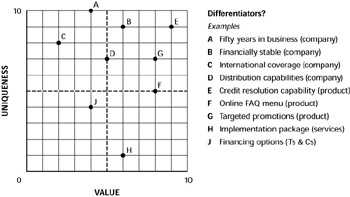
Figure 9.3: Differentiation Grid
On the vertical axis, rate the uniqueness of each differentiator, plotted against the horizontal axis for value to the customer. Each differentiator is rated from 0 to 10 for both parameters. You will end up with dots all around the chart.
The differentiators that made it to the upper-right quadrant are both unique and valuable. They are your strengths and they really make a difference to the customer. These are the differentiators that salespeople must make into must-have capabilities on the part of the customer.
The ones in the lower-left quadrant have little value and are not unique. The others are somewhere in between and can be used in certain circumstances, but only after you have attempted to make the upper-right quadrant differentiators real and important issues with the customer. Keep in mind that the differentiators will move from quadrant to quadrant over time. That’s why it’s important to keep company, product, and service knowledge along with marketing messages and materials updated as markets mature.
The importance of this exercise is to take an honest look at your differentiators and their competitive strengths. You want to get input from marketing, customer support, and other departments to help evaluate the factors of uniqueness and value. This is an eye-opening experience for many of our clients.
When you’re not first, do things differently. The win rate is low, often not worth the expense of competing, unless you can change the playing field. The specific actions depend on each situation, but there is a logical sequence to competing and winning. Sometimes the best thing to do is simply walk away.
Most of the time, when you’re not first and you decide to compete, you need to deploy the End-Around strategy and re-engineer the existing vision of the customer to your vision of a solution.
Part One - Solution Selling Concepts
Part Two - Creating New Opportunities
- Chapter Four Precall Planning and Research
- Chapter Five Stimulating Interest
- Chapter Six Defining Pain or Critical Business Issue
- Chapter Seven Diagnose Before You Prescribe
- Chapter Eight Creating Visions Biased to Your Solution
Part Three - Engaging in Active Opportunities
Part Four - Qualify, Control, Close
- Chapter Eleven Gaining Access to People with Power
- Chapter Twelve Controlling the Buying Process
- Chapter Thirteen Closing: Reaching Final Agreement
Part Five - Managing the Process

EAN: N/A
Pages: 106
