Flylib.com

Books Software


Network Elements


Network Elements

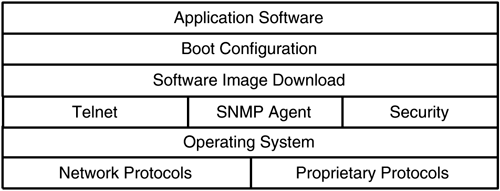
The previous sections have introduced networks with a brief overview of some of their components and management infrastructure. This section examines NEs a little more closely. Figure 2-6 illustrates (in no particular order) some of the typical software components that combine to make up an NE.

Figure 2-6. Typical NE software components.

graphics/02fig06.gif

An example of an NE is an intelligent line card, which is hosted inside another system, such as a PABX, ATM/MPLS switch, or IP router. An intelligent line card is essentially a computer inside another computer and may contain millions of lines of source code hosted on an embedded real-time operating system, such as pSOS or VxWorks. Some characteristics of intelligent line cards include the following:

  • They can extend the lifespan of the host by adding advanced functions such as SNMP and VoIP for a PABX.

  • They can take a long time to develop.

  • Operators like to extract the maximum performance from them ”for example, port bandwidth.

  • They increasingly incorporate numerous layer 1, 2, and 3 protocols.

An NMS interacts with the SNMP agent in Figure 2-6, getting and setting MIB object instances and also receiving notifications. Clearly, the SNMP agent in the NE competes for compute and I/O resources with all the other onboard software entities. During times of high device loading, the SNMP agent may become starved of resources. This is a bad thing because the management facility can become essentially disabled. High loading can occur when:

  • Many voice calls are in transit through a PABX.

  • Large numbers of ATM virtual circuits are transporting many ATM cells .

  • Large numbers of IP packets are in transit across a router.

  • Network topology changes result in routing protocol convergence.

Compute resource depletion is one type of NE congestion. It can sometimes be cured by some combination of changing process priority, adding extra memory, or adding extra processing power. A more subtle problem is one in which the number of managed objects becomes so great that the NMS finds it hard to keep up with changes. This is the general area of scalability and is discussed in Chapter 3, "The Network Management Problem."


Introducing MPLS: First Chunk

We use MPLS as a running example throughout the book. Deployment of MPLS in the enterprise core is likely to occur only in extremely large organizations. Typically, such organizations have global reach and may already use a lot of ATM. Service providers are already deploying MPLS. Enterprises may initially deploy MPLS on WAN backbones and later on, they may move MPLS into the network core . In fact, the expansion of MPLS to the enterprise premises (via the MPLS UNI) is part of the work of the MPLS Forum.

On a more general note, a good understanding of MPLS is important for appreciating issues such as traffic engineering, network-QoS, and connection-oriented IP networks.

This section introduces the first chunk of MPLS [DavieRehkter2000] technology presented in this book. MPLS is essentially quite simple, but the building blocks are a little difficult to learn because they span both layers 2 and 3 and require some understanding of signaling and IP routing protocols. For this reason, the discussion is split into easy-to-understand, bite- sized chunks , [1] starting here and finishing up with the case study on some aspects of MPLS network management in chapters 8 and 9.

[1] This is in keeping with our concepts of learning about network management and creating NMS solutions. These ideas are introduced in later chapters, but for now we say that a given technology must be understood before an attempt is made to manage it. This is obvious enough, but the depth of understanding is the key. In many cases, a good overview is all that is needed to get started on producing an NMS solution. This is the model we use with MPLS.