Random File Access
| < Day Day Up > |
| If you're adventurous, you can do random reads and writes within a file, as previously mentioned. The following sections briefly cover some tools you'll need to do random reads and writes; they are not covered more extensively because you shouldn't need them often. Opening Files for Read and WriteUntil now, you've looked at three methods for opening files. Files could be opened for reading, they could be opened for writing, or they could be opened for appending. Files can also be opened for both reading and writing at the same time. Table 15.1 lists the various modes available for opening files. Table 15.1. Summary of Open Modes
Notice the following:
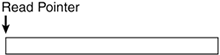
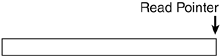
Moving Around in a Read/Write FileWhen a file is opened, the operating system keeps track of where in the file you happen to be. This pointer is called the read pointer . For example, when a file is first opened for reading, the read pointer is at the beginning of the file, as shown here: After you've read through the whole file, the read pointer is at the end of the file, as shown here: To reposition the pointer to any spot within the file, you must use the seek function. The seek function takes two arguments: The first is an open filehandle, and the second is the offset in the file that you want to seek. The last argument is what the offset is relative to: 0, the beginning of the file; 1, the current position in the file; or 2, the end of the file. The following are some examples of seeking within a file: # open existing file for reading and writing open(F, "+<file.txt") die "file.txt error: $!"; seek(F, 0, 2); # Seek to the end of the file print F "On the end"; # Appended to the end of the file seek(F, 0, 0); # Seek back to the beginning of the file print F "This is at the beginning"; The tell function returns the position of the current read pointer in a file. For example, after running the preceding snippet, tell(F) would return 24 ”the length of "This is at the beginning" ” because the read pointer is sitting immediately after that text. By the Way This section barely touched upon the seek , tell, and open commands. For more information on these commands, consult your online documentation. The seek , tell , and open functions are documented in the perlfunc manual, which you can access by typing perldoc perlfunc at the command prompt. Additionally, a longer explanation of open is in a manual section called perlopentut; for that documentation, type perldoc perlopentut at a command prompt. |
| < Day Day Up > |

EAN: 2147483647
Pages: 241