Flylib.com

Books Software


Section 81. Crop and Straighten Photos in Photoshop


#81. Crop and Straighten Photos in Photoshop

Although digital photography has become increasingly popular these days, you may still find yourself scanning in some old photo prints on your flatbed scanner. But having to crop and straighten each print afterwards has always been a pain. Well, we can put all this tedium behind us now and let Photoshop's amazing Crop and Straighten Photos command do the work for us. This remarkable command not only automates the process of cropping and straightening your photos for you, it can do so to multiple images within a single scan.

Fixing Bad Splits

If Photoshop incorrectly splits one of your photos in a scan when you perform the Crop and Straighten Photos command, you may have to force Photoshop to work on that image separately. Draw a selection around the image and leave some of the background around it (usually white from the scanner lid). Then hold down Option/Alt as you choose the Crop and Straighten Photos command. This directs Photoshop to separate just that one image from the background.


Follow the steps below to use the Crop and Straighten Photos command:

1.

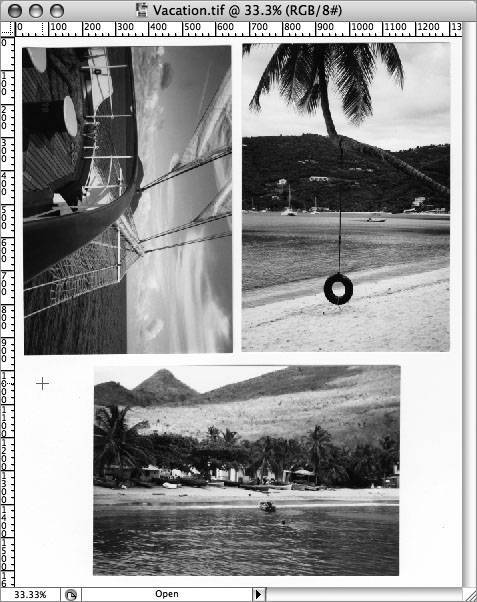
Place your prints on your flatbed scanner and scan them all in at once ( Figure 81a ). To get the best results, arrange your prints on the scanner bed so they are at least 1/8 of an inch apart from one another. It's also a good idea to disable any automatic adjustment settings your scanner software may offer since they often take into account the entire scanned image. You can always adjust the individual images in Photoshop once they've been cropped (and straightened) from the scanned file.

Figure 81a. With the Crop and Straighten command, you can save time by scanning in several photos at once.


2.

Open the scanned file in Photoshop. If you want to apply the Crop and Straighten Photos command to specific images in the scan, make a selection around them.

3.

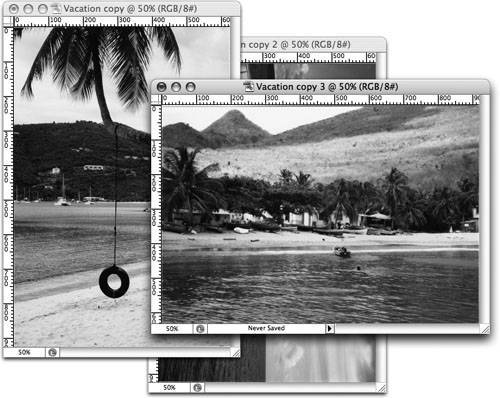
Choose File > Automate > Crop and Straighten Photos. Photoshop processes the scanned file, detecting the edges of each image, and then crops, straightens, and separates them into individual files ( Figure 81b ).

Figure 81b. Once the Crop and Straighten command has worked its magic, you'll end up with a separate document window for each image.


4.

With each image conveniently cropped and straightened for you, you can then make any adjustments to them (see #27) and save them as individual files.


#82. Using the Image Processor in Photoshop

These days our computer hard drives are inundated with an overabundance of images we offload from our digital cameras , download from stock photography services, or create ourselves . Processing all these images into different file formats or image dimensions can be daunting at best. Fortunately, Photoshop CS2 introduces the Image Processor, which processes multiple files. It performs many common image- related tasks so you don't have to create an action and use it within a Batch command.

Applying Settings from the First Image

If you're processing a set of camera raw files taken under the same lighting conditions or your source images' color profiles don't match your working profile, you can select the Open first image to apply settings option. This will give you an opportunity to adjust settings in the first image when it opens and have those adjustments applied to the remaining images being processed .


Here's how to use the Image Processor:

1.

In Photoshop, choose File > Scripts > Image Processor. The Image Processor window appears ( Figure 82 ).

Figure 82. The Image Processor is well suited for common image handling needs where creating a Batch action would be overkill.


2.

Select the image files you want to process. If you already have the images that you want to process open in Photoshop, select the Use Open Images option. Otherwise, click the Select Folder button and choose the folder that includes the images ready for processing.

3.

Select the location where you want to save the processed files. You can save the files to the same location or choose a different folder.

4.

Select the file types along with the options that you want the Image Processor to save (e.g., JPEG, PSD, TIFF). You can opt to convert your files into one of these formats or any combination at the same time. Selecting multiple formats at once will result in each type being saved when your images are processed. Selecting the Resize To Fit option will resize the images to best fit within the dimensions you enter while retaining their original proportions .

5.

You can optionally set any of the other processing options. You can select a Photoshop action (see #84) to run or decide to include copyright information or a color profile within each image processed.

6.

Click the Run button and the Image Processor will start working its magic. Your images will be saved to the destination you specified within folders named using the file formats you selected.

Processing Images via Bridge

Many of the Automate commands in Photoshop's File menu are also available from within Bridge. Image Processor just happens to be one of them. Select the images you want to process within Bridge and then choose Tools > Photoshop > Image Processor. The Image Processor window then opens in Photoshop, and the Images to process options area is changed to "Process files from Bridge only {selected count}."