Flylib.com

Books Software


59 Designing with the Titler s Design Primitives


#59 Designing with the Titler's Design Primitives

In Premiere Pro, one of the Titler's most useful functions is the set of design primitivessuch as circles, rectangles and ellipsesyou can use to create backgrounds that make your text titles readable irrespective of the video playing behind them. At a high level, you have to draw the shape, make it a color that highlights your font color , and if desired, make it translucent so it interferes with the background video as little as possible.

Cut Your Design Time

The new tool "New Title Based on Current Title" in the upper-left corner of the Titler is a great way to create multiple titles with the same look. Click the button to create a new title, which Premiere Pro will force you to name , then make your changes and move to the next .


Here's how you build titles using primitives.

1.

In the Timeline, place the current-time indicator at the start location for the title you're producing.

2.

Open the Titler by pressing F9 or by choosing File > New > Title.

3.

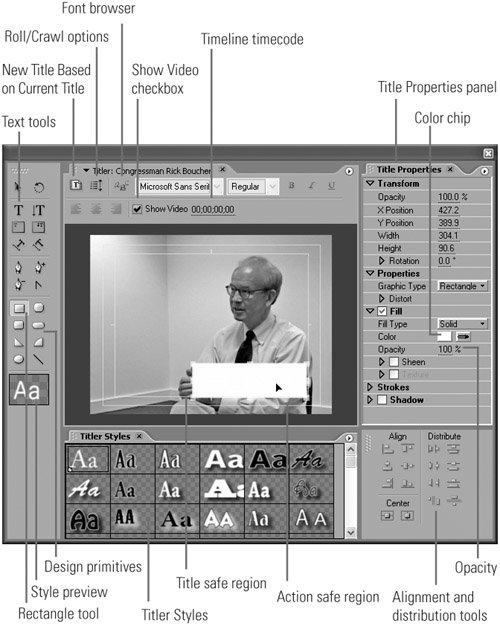
In the middle-left section of the Titler, click the desired shape for your background object ( Figure 59a ). The example uses a rectangle.

Figure 59a. Here's the Titler in all its glory . Note the white rectangle under the Congressman. Note also that you can drag panels around, which is how the Alignment panels ended up on the right.

Vertical Text? Diagonal Too?

Spend some time experimenting with the text tools in the upper-left corner of the Titler, which supply great options for diagonal and vertical text. Ditto for the Fill, Strokes, and Shadow options in the Title Properties panel in the upper-right corner. You'll learn that the Titler is an incredibly functional tool.


4.

Draw the shape in the desired location. In the example it's a rectangle under the Congressman, placed within the title safe region, of course.

5.

To adjust the color in the Title Properties panel (in the example, the white title font needs a dark background behind it), click the color chip under the Fill property.

6.

In the Color Picker window, drag the selection circle to a dark gray color. Close the window.

7.

In the Title Properties panel, set the Opacity property under the Fill property to 50%.

8.

Add your text in the selected font, color, and size .

9.

Adjust your background to fit the text. Close the Titler window and your new or modified title will save automatically ( Figure 59b ).


Figure 59b. Here's the titlefast, easy, and highly readable, courtesy of the dark, translucent background.


Import Logos into the Titler

If you're creating a title around a logo, you can import the logo into the Titler by right-clicking inside the Design window and choosing Logo > Insert Logo. If you use your logo frequently, you can save the title as a template as described in #58.


#60 Producing Rolling Credits

Most television shows and movies end with rolling credits. Let's go through the basics of creating rolling credits in Premiere Pro, assuming that you have the Titler open and are ready to type.

Preview with Transitions Inserted

If you're adding transitions to the beginning and end of your rolling or crawling credits, remember that these transitions can affect what's viewable in your title. If you add a transition and don't specify a sufficient Preroll or Ease-In duration, the transition may obscure the first few names or items in your credits.


1.

Click the Type Tool and start typing your credits. Press Enter on your keyboard to add additional lines, and use the scrollbars to move the Design window with the text ( Figure 60a ).

Figure 60a. Here's the list of credits to scroll. Note how they extend below the Titler's visible area; use the scrollbar to read or edit the names.


2.

Click the Roll/Crawl Options button. Premiere Pro opens the dialog ( Figure 60b ).


Figure 60b. The Roll/Crawl Options dialog has lots of great options.


To Produce Crawls

Click Crawl in the Title Type section of the Roll/Crawl Options dialog, and choose the desired direction. Beyond that, the process is identical to producing rolls.


3.

In the Title Type section, choose Roll.

4.

In the Direction section, choose Crawl Left.

5.

In the Timing ( Frames ) section, choose among the following options.

  • Start Off Screen/End Off Screen Select these checkboxes to start or end the title with text completely off screen. If you elect to start off screen, the Preroll option is grayed out; if you end off screen, the Postroll option is grayed out.

  • Preroll This specifies the number of frames during which the title appears on screen before starting the movement. It's a useful option when you're dissolving into the title and don't want to obscure the initial frames.

  • Ease-In This specifies the number of frames during which the title slowly accelerates to full rolling speed.

  • Ease-Out This specifies the number of frames during which the title slowly decelerates from full rolling speed.

  • Postroll This specifies the number of frames during which the title stays on screen after the rolling stops. It's useful when you have "THE END" as the final text in your rolling credits and want to keep that on screen for a few extra moments before fading to a dramatic close.

5.

After making your selections, click OK to close the Roll/Crawl Options dialog.

Use Motion Controls for Other Motion

The controls in the Roll/Crawl Options dialog make rolls and crawls very easy to implement. You can also add motion to your text via the Motion Controls that Premiere Pro assigns to each clip on the timeline. See #53 for details on how to animate a track matte.


6.

Click the X in the upper-right corner to close the Titler.

7.

Drag the title to the timeline. Rolling speed is set by the duration of the title on the timeline. That is, if you drag the title over a 20-second duration on the timeline, it will roll faster than if you set it for a 30-second duration.