| ADO.NET is a set of classes that provide consistent access to multiple data sources, which may be either relational data from a database or hierarchical data expressed in XML. A driving factor in ADO.NET is a provision for disconnected access to data, which is much more scalable and flexible than the connection-oriented database access that is traditional in client/server systems. The DataSet class is the central component of the disconnected architecture. A dataset can be populated from either a database or an XML stream. From the perspective of the user of the dataset, the original source of the data is immaterial. A consistent programming model is used for all application interaction with the DataSet . The second key component of ADO.NET architecture is the .NET data provider, which provides access to a database and can be used to populate a dataset. A data provider can also be used directly by an application to support a connected mode of database access. Figure 13-5 illustrates the overall architecture of ADO.NET. Figure 13-5. The ADO.NET architecture block diagram. 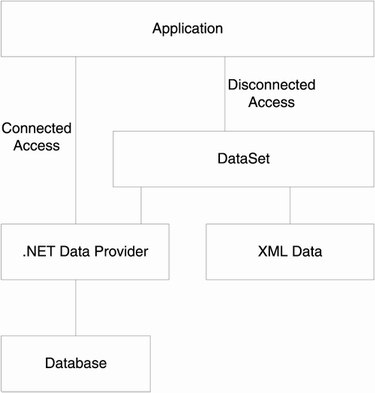 .NET Data Providers A .NET data provider is used for connecting to a database. It provides classes that can be used to execute commands and to retrieve results. The results are either used directly by the application or they are placed in a dataset. A .NET data provider implements four key interfaces: -
IDbConnection is used to establish a connection to a specific data source. -
IDbCommand is used to execute a command at a data source. -
IDataReader provides an efficient way to read a stream of data from a data source. The data access provided by a data reader is forward-only and read-only. -
IDbDataAdapter is used to populate a dataset from a data source. The ADO.NET architecture specifies these interfaces, and different implementations can be created to facilitate working with different data sources. A .NET data provider is analogous to an OLE DB provider, but the two should not be confused . An OLE DB provider implements COM interfaces, and a .NET data provider implements .NET interfaces. When OLE DB first came out, it immediately supplied a provider for ODBC. This single provider offered access to an array of data sources to any data source with an ODBC driver. A native OLE DB provider was offered for SQL Server. As time passed, more OLE DB providers became available. The situation today is similar for .NET data providers. Currently, there are two .NET data providers. The OLE DB data provider goes through the COM interop layer to talk to OLE DB. Thus, any data source with an OLE DB provider can be accessed through ADO.NET. The SQL Server data provider uses the native SQL Server wire protocol. As time passes , we can anticipate that additional native .NET data providers will be offered by different database vendors . To make your programs more portable, you should endeavor to program with the interfaces rather than using specific classes directly. In our example programs, we illustrate using interfaces to talk to an Access database (using the OLE DB data provider) and a SQL Server database (using the SQL Server data provider). Classes of the OLE DB provider have a prefix of OleDb, and classes of the SQL Server provider have a prefix of Sql. Table 13-1 shows a number of parallel classes between the two data providers and the corresponding interfaces. Table 13-1. Comparison of Classes in the OLE DB and SQL Server Data Providers | Interface | OLE DB | SQL Server | | IDbConnection | OleDbConnection | SqlConnection | | IDbCommand | OleDbCommand | SqlCommand | | IDataReader | OleDbDataReader | SqlDataReader | | IDbDataAdapter | OleDbDataAdapter | SqlDataAdapter | | IDbTransaction | OleDbTransaction | SqlTransaction | | IDataParameter | OleDbDataParameter | SqlDataParameter | Classes such as DataSet , which are independent of any data provider, do not have a prefix. .NET Namespaces ADO.NET classes are found in the following namespaces: -
System.Data consists of classes that constitute most of the ADO.NET architecture. -
System.Data.OLEDB contains classes that provide database access using the OLE DB data provider. -
System.Data.SQLClient contains classes that provide database access using the SQL Server data provider. -
System.Data.SQLTypes contains classes that represent data types used by SQL Server. -
System.Data.Common contains classes that are shared by data providers.  | 

