Make
|
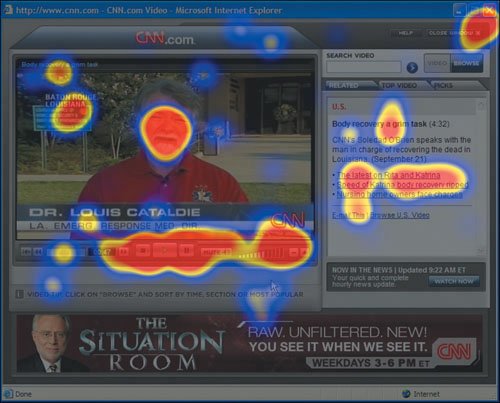
Tip: When to Take a Commercial Break
If your videos have commercials, it's better to play them after the primary clip than before. When commercials play before the main clip, people
|
Eye-tracking diagram of a
www.cnn.com
The Practice of Simplicity
Throughout this book, we've been evangelizing simplicity, but ironically, the practice of simplicity is not at all simple. It's easy to build a bulky design by adding layer upon layer of navigation and features; it's much more difficult to create simple,
Take interior decorating, for example. Why are some rooms more
The animation on this site interferes with its content. The tumbling man in the upper left distracts people from the content they came to the site to get. One
"I like these icons but they can be a bit too much you get fed up seeing them come up all the time. The images and graphics are fine for a while, but then you want to get on with it, without the interference of the chap tumbling over."
www.nestle.com It's the same with Web sites. Good designers get the maximum use out of limited space (both screen space and bandwidth) by paring down the interaction to the essentials. Gratuitous effects, graphics, and pictures take away from the important elements you want to display on your site. When everything is flashing and screaming for attention, nothing gets it. Take a good, critical look at your site. See if you find any extraneous design elements that are cluttering it up. Make every effort to simplify the interactions on your site. Is there a slick or fancy feature that's more difficult to use than a simple static one? Every icon, picture, graphic, and animation should serve a purpose and communicate something meaningful. Before adding design elements to your site, ask yourself:
If the answer is "no," eliminate it.
What does this picture of a sunflower have to do with corporate responsibility (not to mention its
www.bms.com
Before adding a design element to your site, ask yourself: Does it simplify the user's task? Does it add value to the user? If the answer is "no",eliminate it.
Look at the two versions of the navigational menu on the Tiffany & Co. Web site. In the first design, the translucent menu opens on top of the image, making the menu extremely difficult to read. The second design is an improvement because the text is
An earlier version of the Tiffany & Co. Web site used transparent
www.tiffany.com
Since our study, Tiffany.com improved the navigational menu design without
www.tiffany.com
Now let's look at two approaches to map design, the first interactive and the second one not. The interactive map shows the locations of restaurants in the city. Moving the cursor over each orange ball reveals the restaurant
The second map is easier to use. It reveals information about each establishment without forcing people to work harder than they have to. The map gives people the most relevant information at a glance without requiring any clicks. While the first map might seem slicker, it's not as functional as the simpler one.
{% if main.adsdop %}{% include 'adsenceinline.tpl' %}{% endif %} This interactive map probably required more time and resources to create than a static map would, but it is less useable.
http://surfcityusa.com This low-tech design serves its purpose, giving people relevant information quickly and easily.
www.flagshipresearch.com
Developing fewer features allows you to
In one study, we asked
The robust feature allowed people to do advanced things such as:
This Virtual Tour contained a lot of useful information. Most people couldn't figure out how it worked, however, and so they never saw much of the content. In addition, it was slow to load, had progressive disclosure, and the sound effects impeded people's progress. Users want direct answers when seeking information; feature-rich applications often hamper users because the interactions tend to be circuitous. Here are some of the comments from our test users about this instance of fancy design: "This ball shooting up is annoying.…I'm trying to figure out if any one of these balls indicates the Playhouse.…It took me a while to find the Playhouse." "I didn't notice the little arrow. What am I supposed to do with that? I don't get what that is." "I don't really want to do this grand tour. It takes a lot of time. You get all of this stuff coming up: music, introsomething I would rather not go through." "Constructing maps and loading panoramasthis is more information than I would want to have. I don't need the architectural drawings. I just want to see where the restaurant is relative to the Opera House. I wish I had a list on here that showed the entities within the Sydney Opera House, like where I can find a restaurant, but I don't see it. I like the panorama view but I don't need that right now. I wish they had Search, so I could type in 'playhouse' and it would show me the Playhouse rather than bouncing around the entire multilevel Opera House." "It's rather distracting, this 3D thing. It's a little overkill. This is like the USS Enterprise. If you've never been on it, you wouldn't know where to begin. It's pretty and dynamic, but how helpful is it?" When you find users comparing your user interface to that of the Star Trek spaceship, it's usually not a good sign.
This virtual tour might be enjoyable for a few people who have a lot of spare time and
www.sydneyoperahouse.com People were more successful at finding locations on a well-labeled static map than on a complex interactive one. The simple sketch has enough detail to give people context and orientation. Having the main areas labeled helps them make associations and understand the layout of the facility.
www.sydneyoperahouse.com
(Facing page, top) This is the first of two splash pages on the Wynn Las Vegas Web site. Not only is this two-step entry process time consuming, the options on this page are based on the company's priorities, and not on the end users'. The first things people want is to find information about this hotel, not Buy Tickets or Book Now. Asking people to Buy Tickets and Book Now is premature. In addition, these terms are vague and have overlapping meanings in this context. At this stage,
www.wynnlasvegas.com
(Facing page, bottom) This is the first of two splash pages for the Wynn Las Vegas Web site. Not only is this two-step entry process
www.wynnlasvegas.com |