Preface
xv Preface
xix Usability Then and Now xxi Who Should Read This Book? Ten years ago, the Web was exciting to people. Today it's routine. It's a tool. If it's convenient, they will use it; if not, they won't. With ten times as many sites and probably a hundred times as many pages on the Web, users are getting less tolerant of difficult sites, so every design flaw means lost business. Usability has become more important than ever. This book has two goals. The most important is implied by its title: to prioritize our extensive knowledge of Web usability into the essentials that all people need to know if they work on a Web projectwhether as designers, marketing managers, programmers, or writers. Our second, and related, goal is to update our Web usability guidelines from the 1990s to reflect our findings since 2000. We began user testing of Web sites in 1994. During the last 20 years, we have identified literally thousands of usability problems and developed as many guidelines for avoiding them. Our company, Nielsen Norman Group, has published almost 5,000 pages of reports from our research into how thousands of users on four continents interact with the Web, with nearly 3,000 screen shots from hundreds of sites. All very good, informative, and valuable researchif we do say so ourselves. But we recognize that you may not have time to read 5,000 pages. So this book distills the most valuable information from our research into a single volume. Of course, we believe in all our guidelines and we would prefer that all designs complied with everything that's known about how to make sites better for users. But realistically speaking, not every site can do everything. Many projects will have to focus first on the most important usability issues and defer the rest to later. This book will help you do just that. If anything, Web usability is much more critical now than it was when we began our research because the competitive environment has sharpened. As we discuss further in Chapter 2, the growth of decent search engines means that people use a predominant strategy when they start researching something on the Web (which also happens to be the time when they are susceptible to new brands). They type a few words into a search engine and get a nice list of companies that are competing to solve their problem. All are one click away, and none get the time of day if they impose too many barriers or delays in getting users what they want.
People expect a lot of Web sites today, and they are less and less tolerant of bad design. This book highlights the critical usability mistakes that Web sites make repeatedlymistakes that lead to customer dissatisfaction and lost business. The guidelines we offer for better design are based on behavioral research and observation, not on our opinions. Unlike market researchers, we do not simply ask people to speculate how they would use an interface because self-reported data is frequently unreliable and doesn't adequately answer usability questions. Instead, we employ user-testing methods that are based on observational strategies. We give people realistic tasks to perform on the Web and observe them as they interact with various sites. This means that we discover what users actually do, not what they say they do. Focus groups and surveys are nice at assessing people's general preferences, but they are worthless for discovering whether people can use a site or what specific design elements to use when. Only observational research can get valid answers to these questions.
If you are considering whether this book contains information that is useful to you,ask yourself: Are users trying to accomplish something when they visit my site? If the answer is "yes," then you should be concerned about usability. Don't look for advice on programming language or other implementation details in this book. Our concern is how the user experience feels to the person at the other end of the cable. Ultimately, this book is about your customers and what they need, not about you. In the early years of the Web, we were the only ones to conduct systematic user testing of sites, so our early findings received substantial attention and were widely cited. That was good back then, but it's a problem now because some people think that our guidelines haven't changed since 1994. So the second goal of the book is to update our old guidelines from the 1990s in the light of our research findings since 2000. The guidelines that we developed after 2000 have tended to hold up in the studies we have done since then, and we usually end up simply supplementing them with ever-more new ones that reflect new developments on the Web. Not so for the research results from the 1990s. The studies we have done in recent years have sometimes contradicted these findings, so the early guidelines now need to change. Interestingly, some of our early usability findings do hold true today because the fundamental interactions on the Web haven't changed as much as you might think. People still click on links to navigate through pages. And people's cognitive abilities don't change much from one decade to the next, so usability guidelines, which reflect human capabilities, evolve slowly. The people who use the Web haven't changed that much either; 80 percent of those who will be using your site in ten years are the same people who are using sites now (except they will be older and need bigger font sizes). Still, designers, users, and technology have all changed, and this book aims to set the record straight on how old usability guidelines have fared in light of these changes. In particular, Chapter 3 contains a detailed analysis of the most important early usability problems and provides advice for how to deal with these issues today. What has changed is this: Web technology is less brittle, and extremely slow dial-up connections are getting to be rare, so many guidelines that aimed to alleviate early technical constraints are being replaced by equivalent (but different) guidelines that address the corresponding human constraints. For example, in the 1990s most users' connections were too slow to view video over the Internet, and those few who could download video often faced crashes or system incompatibilities. So the main guideline for video was to avoid it. Today, video works from a purely technical perspective, so we can remove this guideline. Instead, we need new ones that address the fact that users watch Web-based video differently than they watch broadcast television.
Because this book includes a fraction of the information that we have accumulated over the years, it is the proverbial tip of the iceberg. In fact, we have boiled down our findings to less than ten percent of our full reports, you could say it's just the tip of the tip. For those interested in reading about our research and documentation in more detail, a box at the end of each chapter provides references to many of our in-depth reports cited within. Usability Then and NowJakob's book Designing Web Usability: The Practice of Simplicity (New Riders Publishing, 2000) appeared in print at the cusp of the first Internet bubble and was called a "landmark" because of its role in changing Internet professionals' attitudes toward Web design. Before DWU, most companies simply wanted cool sites. In fact, the best-selling Web design book at the time, Creating Killer Websites, advocated splash screens and other design atrocities. After DWU was published, many Internet managers realized that killer sites killed business. They discovered that the best way to do business on the Web was to create sites that their customers could use. The Web is not television. People don't go there to zone out. People go to the Web with a specific purpose in mind. They have their hands on their mouses, ready to interact and be engaged. Designing Web Usability was a manifesto. It strove to sell readers on the "practice of simplicity" over the cool design and complex user interfaces that dominated the Web at the time, and it did so partly by deconstructing many screen shots of miserable Web sites in the style of the day. In fact, when rereading DWU today, the biggest complaint most people have is that the screen shots look outdated. Fortunately, many of the design mistakes we warned against have now gone out of fashion. Unfortunately, new mistakes have arisen to take their place. This book is filled with new screen shots that show what design elements failed current users and caused much misery and lost business.
Success rates are up and user failures are not nearly as common as they used to be on the Web. The usability movement has had measurable results in terms of improved user experience. Overall, however, the Web has improved. We are now able to include many screen shots of designs that work well. Also, measured usability has increased substantially in terms of how quickly and how well users can get things done on Web sites. The most simple usability measure we collect is the success rate: Can people use the site at all? On average, success rates are up and user failures are not nearly as common as they used to be. In other words, the usability movement has had measurable results in terms of improved user experience. The Web contained fewer than 10 million sites when DWU was published. That was certainly enough to make usability an important issue: If sites were difficult to use, people already had plenty of other places to go. At the time of this writing, the Web has 80 million sites and by the time you read these words, it will probably have crossed the 100 million markabout ten times as many sites as seven years ago. More important than the numbers, however, is the change in users' attitudes toward the Web. DWU came out at the tail end of the time when the Web was interesting in its own right. It was exciting to be able to reach around the world and have information come to your desktop in an instantor, more often, 30 seconds. Of course, you couldn't do that much on the Web, and whenever you found what you were looking for, you were grateful. Today the situation is quite the opposite. People's expectations have expanded with the massive expansion of the Web. People just assume that the Web has what they want. They turn to search engines with all kinds of questions, and usually something comes up that has the answers. They assume that sites work. They assume that they will find whatever they are looking for and can buy almost anything online. The Web is a tool. Consider the way that people think about that other onetime-dazzling invention, the telephone. They don't wake up in the morning and think, "Today I will experiment with my telephonic apparatus and place a call to somebody so that I can assess the sound quality of the connection." Their use of the telephone is driven by their real-world needs. The same is true for the Web, as far as average users are concerned. You, dear reader, are not the average user, as proven by the fact that you care enough about the Web to buy a book about it. (Just as the people who buy books about how telephones work are telephony engineers, and the way they think about phones is different from the way that most telephone users do.) One of the goals of Designing Web Usability was to shake up the world of Web design and make it pay attention to human needs. It succeeded, but only in part. Most Web projects today pay lip service to user experience, and it's rare to find Internet managers who don't list usability as a top goal for their sites. Unfortunately, in practice sites continue to violate many well-documented usability guidelines and as a result do not reach even a fraction of their business potential.
It's no longer enough to say that you want to design for your customers. If you give usability the priority it deserves on your site, you will be designing for them. We hope to change that with this book. Our aim is to continue the usability revolution begun with Designing Web Usability, and to force Web sites to be successful by following the most important guidelines that have been developed during the last decade. No more excuses. We know what really works on the Web, so it's no longer enough to say that you want to design for your customers. If you give usability the priority it deserves on your site, you will be designing for them. Who Should Read This Book?This book is for people who have business goals for their Web sites. Obviously, this includes e-commerce sites that sell online and corporate sites that promote products that sell through offline channels. But our definition of "business goal" encompasses much more than selling products or services. If yours is a news site, you want people to find, read, and understand your stories, and possibly also sign up for your email newsletter. If you are a nonprofit organization, you want to promote your cause and perhaps attract donations online. And if you are a government agency, you want to support taxpayers by giving them the information they pay you to produce and minimize bureaucracy by allowing them to receive information and even services online. If you are considering whether this book contains information that is useful to you,the key question to ask yourself is: Are users trying to accomplish something when they visit my site? If the answer is "yes," then you should be concerned about usability. Of course, there are also Web sites that don't have "business goals." Maybe you have an art site that's a pure expression of creativity. Or maybe you are a Web designer who fields a personal site to show off experimental designs that wouldn't work on client sites. Perhaps you have a site that's only intended for your three best friends. Our guidelines are not geared for these types of sites because they don't aim to attract users who need to be able to get something accomplished. If you have a site that doesn't need to support users' goals, do as you please and you won't lose any business because you are not aiming to get any. For intranets, on the other hand, there is much applicable information in this book, even though it is geared mainly for Internet sites. There are some differences in the design guidelines for each because of differences in their intended audiences. For example, intranets do not need to compete for users, who go to them primarily for work-directed tasks, whereas Web users' are usually driven by their own needs. Still, intranets use Web technology; they are online information systems, and users navigate their pages using skills, knowledge, and expectations gained from navigating popular Internet sites. The information and guidelines in this book are for both large and small companies. In fact, we use the word "companies" loosely, to include noncommercial entities such as nonprofits, government agencies, and even personal sites that provide information to outside users. Whether you have hundreds of thousands of employees or just yourself doesn't matter. Users still see one page at a time when they visit your site, and they still click the Back button to leave it if it is too difficult to use. You may not call the people who use your site "customers," as we tend to do. You may use terms such as "consumers," "members," "volunteers," "readers," "citizens"something that does not directly imply a business relationship. However, once people visit your site, they become customers of a sort, to the extent that they are in the "market" for something that you may be able to supply. They may or may not pay for this service with money. They surely will pay with their attention and maybe even with their loyalty if you treat them well. Myspace allows young users to create a social environment where they can design their own pages and comment on their friends' pages. If you are designing a page like this, this book is not for you. If you just want to reach a closed clique of your closest friends, usability guidelines are not going to be of much help. Of course, we can say, "Don't use background graphics that obscure the text and make it difficult to read," just as we can advise against having an animated heart that constantly moves around on the left side of the page. And this advice would be correct for a site that has a business goalincluding that of selling to teens. In fact, our usability studies with teenage users show that teens don't want business sites or government sites that are made to look as if they were created by teenagers when they were not. But when young people make personal sites to express their personality, traditional usability simply doesn't apply. 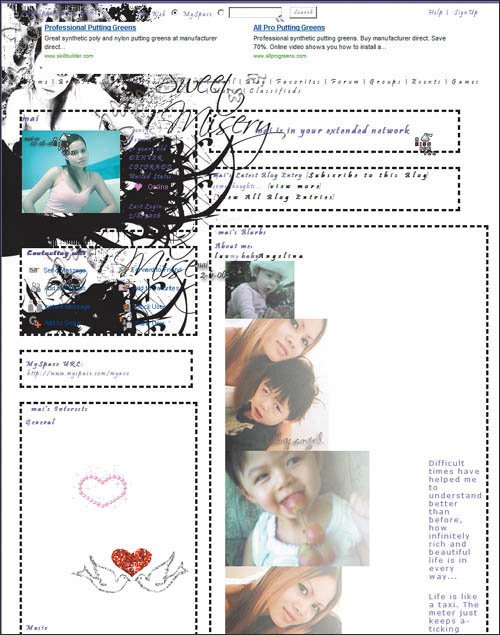 www.myspace.com In fact, good usability has two benefits: On the one hand, it supports your business goals on the Web and thus helps your company make more money. This is the angle we take throughout this book because we want to motivate you (and your boss) to take usability seriously. On the other hand, usability empowers humans and makes it easier and more pleasant to handle the technology that's infusing every aspect of modern life. We don't want to get all soft-hearted, but making life better and more enjoyable does seem to be a worthy goal. Watching people who feel oppressed by technology is not a happy sight, but it's a common one in user testing. By improving usability, we can enable people with little education to hold meaningful jobs, we can connect senior citizens with the community, we can give users with disabilities the same information and service as everybody else, and we can allow everyone to spend their time with computers more productively and reduce their feelings of frustration and powerlessness. The happiest thought of all is that these improvements in quality of life don't come at the expense of your profits. On the contrary, usability benefits business and it benefits humanity. Jakob Nielsen and Hoa Loranger, May 2006 |

EAN: 2147483647
Pages: 107