Section 5.3. Speed-to-Market Advantages
5.3. Speed-to-Market AdvantagesIt is predicted that the overall adoption rate for UWB will be more than triple that for Wi-Fi due to the following reasons. Leveraging Existing StandardsWhile 802.11 was created from the ground up (MAC, PHY, etc.), the 802.15.3a is based on an existing MAC from 802.15.3 and is targeted at products that already have completed upper layers (USB 2.0 and 1394). Multi-Industry MomentumThe current industry organizations such as the MBOA and IEEE 15.3a groups include most of the leading PC, CE, and semiconductor companies who have mostly collaborated so far toward achieving a common standard. Increasing Consumer Demand for Plug-and-Play Digital Content StorageBoth the PC and CE industries are focused on providing plug-and-play solutions for storing as well as sharing their video and audio contents between consumer electronics devices and PCs. The number of consumer devices with integrated hard drives is doubling and the demand for related products is increasing by more than 50 percent per year [1]. UWB Is Targeting a Broad Range of ProductsThese include PCs, notebooks, DVD players, printers, camcorders, digital cameras, game consoles, digital TVs, and stereos. Many of these have been increasing by at least 50 percent per year. Single StandardUnlike cables, the wireless PAN market requires that all UWB systems cooperate to prevent interference with one another. Flexible and ScalableUWB provides variable spectral filling of the wideband channel and better coexistence with other radio systems. It also enables scalable performance in terms of technology advancement and application requirements. Low CostUWB enables full CMOS integration that will eventually lower the production costs and provides easier integration. The switching cost for manufacturers to use UWB instead of or as well as FireWire and/or USB 2.0 is also very low. Low PowerPower consumption to data rate ratio (mW/Mb) will be 5 to 10 times better than 802.11 and includes scaling to the power requirements of small battery-powered CE devices such as digital audio players and handheld computers. Recent developments in both the consumer electronics and PC industries make UWB an almost perfect wireless solution to drive and benefit from the ongoing convergence of entertainment and computing. A few of these products include audio and video projection, still and video camera links, game consoles/controls, home theater systems, set-top boxes, and portable audio devices. In the next five to ten years, UWB will also likely be used in mobile communications devices such as smart phones, in order to integrate the mobile industry with the CE and PC industries as well. UWB's existing target markets (excluding WLAN and low-data WPAN) will include more than 1 billion units shipped in 2008. As Figure 5-2 illustrates, ON World's UWB projections are based on a relatively small percentage of the greater target market for the next few years, with almost unlimited potential beyond this. Figure 5-2. Total UWB potential markets, 20042010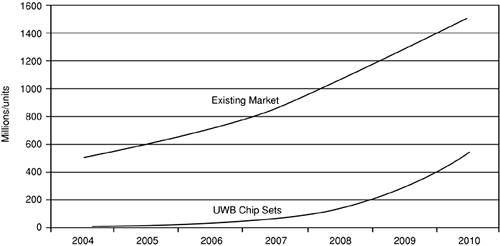 |

EAN: 2147483647
Pages: 93