10.2 OFDM Communication System
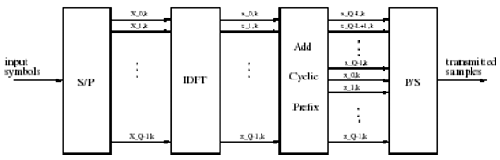
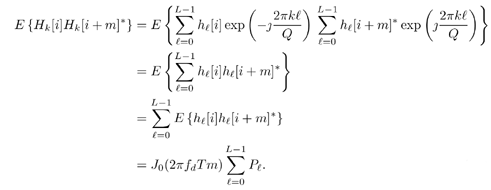
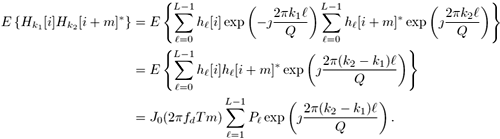
| Figure 10.1 is a block diagram of an OFDM communication system. A serial-to-parallel buffer segments the information sequence into frames of Q symbols. An OFDM word at time i consists of Q data symbols X [ i ], X 1 [ i ], ..., X Q -1 [ i ]. An inverse discrete Fourier transform (IDFT) is first applied to the OFDM word, to obtain Figure 10.1. Block diagram of a simple OFDM transmitter. Equation 10.1 A guard interval with cyclic prefix is then inserted to prevent possible intersymbol interference between OFDM words. After pulse shaping and parallel-to-serial conversion, the signals are then transmitted through a frequency-selective fading channel. The time-domain channel impulse response can be modeled as a tapped-delay line, given by Equation 10.2 where Equation 10.3 Equation 10.4 where * denotes the convolution, Equation 10.5 For OFDM systems with proper cyclic extensions and proper sample timing, with tolerable leakage, the received signal after demultiplexing at the k th subcarrier can be expressed as Equation 10.6 where { N k [ i ]} k contains the DFT of the noise samples { n m [ i ]} m , and Equation 10.7 Assume that for each l , 0 Equation 10.8 where P l is the average power of the l th tap and f d is the Doppler spread. Assume further that the L fading processes are mutually independent. Since { H k [ i ]} k are linear transformations of { h l [ i ]} l , then for each k , 0 Equation 10.9 Hence from (10.6) and (10.9) it is seen that the received frequency-domain signal at each subcarrier k follows a flat-fading model with the same fading autocorrelation function as that in the time domain. Hence the OFDM system effectively transforms a frequency-selective fading channel into a set of parallel flat-fading channels. However, note that the frequency-domain channel responses of different carriers are correlated. In fact, we have Equation 10.10  |

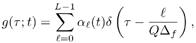
 denotes the maximum number of resolvable channel taps, with t



 , and {

 ; and {


EAN: 2147483647
Pages: 91