Flylib.com

Books Software


Classification Methods for Remotely Sensed Data, Second Edition - page 207

[Cover] [Contents] [Index]

Page 283

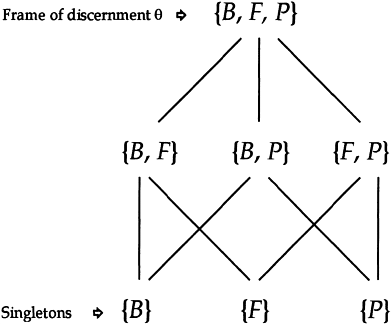
Figure 7.3 A representation of subsets of frame of discernment {B, F, P} made up by bare soil, forest and pasture.

(7.15)

Suppose now one is somewhat uncertain about the reliability of this data evidence and is only willing to commit oneself to label the pixel with, for example, 80% confidence. Then one should change the previous bpa by multiplying each element by 0.8, which leads to:

(7.16)

Note that the quantity of bpa expressed by 6 is denoted by m (θ) and is expressed in this case by:

(7.17)

which is the measure of uncertainty or ignorance; in our case 80% confidence leads to 20% uncertainty and this is reflected in the labelling process.

7.4.2 Belief function and belief interval

In what follows , both the belief function (or support) and the plausibility of each labelling proposition within evidential reasoning are described. A belief function, denoted by Bel, for a hypothesis ψ is defined as the sum

[Cover] [Contents] [Index]
[Cover] [Contents] [Index]

Page 284

of the mass of evidence which is committed to the ψ and to its subsets (if any), while plausibility of ψ, denoted by Pl, is defined as one minus the Bel committed to ψ’s contradiction, denoted by Bel (~ψ). It is more convenient to explain such definitions in terms of mathematical representation:

(7.18)

For instance, using the example discussed earlier, the Bel for hypothesis {B, F} can be represented by:

(7.19)

and it can be found that Bel (ψ) is a measure of the total amount of belief in ψ including all ψ’s subsets. When ψ is a singleton, Bel (ψ)= m (ψ). For instance, Bel({B}}=m({B}) . The plausibility for hypothesis {B, F} can be represented by:

(7.20)

Bel (ψ) can thus be interpreted as the minimum amount of evidence that a pixel is properly labelled with ψ, while Pl (ψ) can be interpreted as the maximal extent to which the current evidence could allow one to belief ψ (Shafer, 1979). Note that Pl (ψ) provides another choice for us to make a decision when there is no evidence, which exactly supports hypothesis ψ.

If a pixel belongs to ψ then the probability P (ψ) may lie somewhere between the interval:

(7.21)

with the range Pl (ψ)– Bel (ψ), which in turn means that

(7.22)

That is, Pl (ψ) and Bel (ψ) provide the upper bound and lower bound of the probability of the subset. Recall from Equation (7.15) that the belief, plausibility, and interval for each class are:

[Cover] [Contents] [Index]
[Cover] [Contents] [Index]

Page 285

(7.23)

In the above case, the interval is equal to m (θ), and one may finally choose class P as the label of the pixel of interest because in Equation (7.23) each interval is the same, and class ‘pasture’, i.e. subset {p}, has the highest belief and plausibility in comparison with the other two classes.

Now consider a more complicated instance. If one holds the following evidence for each hypothesis:


then the belief, plausibility, and interval become:

(7.24)

[Cover] [Contents] [Index]
[Cover] [Contents] [Index]

Page 286

In such circumstances, if one considers only single-class labelling, one may still choose {P}, because its belief and plausibility are the highest without considering the set {B, F} . However, it may be sensible to collect more evidence rather than to generate a label for the pixel using the single class evidence alone. If other evidence is available, the evidence combination problem will arise. This issue is considered in Section 7.4.3

To investigate further the relationship between belief and plausibility, one can speculate that plausibility is always equal to or greater than belief, that is:

(7.25)

which leads to:

(7.26)

Equation (7.26) is derived on the basis of the observation that both Bel (ψ) and Bel (~ψ) have no subset in common, and Bel (ψ) and Bel (~ψ) are each made by the sum of bpa of its own subsets . If we let ψ= P, it follows that:

(7.27)

The above expression specifies what the interval or uncertainty is, and it is then apparent that 1– Bel (ψ)– Bel (~ψ) can be greater than 0, which confirms Equation (7.26).

7.4.3 Evidence combination

In most cases, more than one set of evidence is available, and the decision to label a pixel is made based on the accumulation of all of the evidence. D-S theory acknowledges such a requirement and provides a formal proposal for multi-evidence management.

The aggregation of multiple belief functions is called Dempster’s orthogonal sum, or Dempster’s rule of combination (Shafer, 1979). Let Bel a and Bel b denote two belief functions, and let m a and m b be their corresponding bpas. Dempster’s orthogonal sum generates a new bpa, denoted by m a m b , which represents the result of combing m a and m b . The result of the accumulation of both belief functions, denoted by Bel a Bel b , is derived from m a m b . If m (ψ) denotes the new aggregated bpa, the combination rule can be specified by:

[Cover] [Contents] [Index]