MARKET BELIEFS ABOUT BRANDS
Consumers develop beliefs about companies and their products in the context of their own value systems. Thus some shoppers will go to a "large" store because they believe that there will be more choice as the store is physically large, whereas in reality a small, maybe specialist shop may have a wider range of particular products to select from.
Marketers think that some of these beliefs are fixed and therefore ought to be shared by all cultures. For example, Goldberg et al. (1990) identified that consumers tend to believe that:
-
Brands are all the same.
-
Generic products are just the same products as brands, but are sold with different labels at a lower price. Quality is the same, except in the case of "seconds."
-
The best brands are those with the highest sales. (This produces positive feedback, because the more a marketer can establish a brand the more it will sell because it is selling well...)
-
When in doubt, a local or national brand, rather than international one, is a safe purchase.
-
Consumers can't save money in stores that always have sales.
-
Stores that are just open offer lower prices.
-
A good brand or product will sell itself and doesn't need to be pushed constantly. The harder the advertising push/sell, the more the consumer associates this with lower quality.
-
When you buy heavily advertised brands, you are paying for the label and not the quality of the product.
-
Products from larger companies are cheaper than those from smaller companies - because they can pass on economies of scale to the purchaser.
-
Synthetic goods are lower in quality than those made of natural materials.
-
New products should be avoided until the price falls from the initial premium and any problems are sorted out.
On this basis, marketers are faced with a series of dilemmas when transmuting their brands across cultures. Do they assume consumers are universalistic and will always follow these beliefs, or do they particularize, perhaps because it is late on the day before a birthday and they must buy a gift before the shops close?
Such basic beliefs by consumers are said to derive from the principle of cognitive consistency, which means that they value harmony in their thoughts and feelings and are motivated to maintain it. This explains why we may hear people saying something like this: "I know I wouldn't like Guinness, which is why I've never tried it."
Consumers can recall constructs from memory more easily if the words used in brand names are composed of words from their more frequently used vocabulary. It is then easier for them to remember these brand names due to the higher levels of awareness the names already have and because of what they evoke. Younger people will often have a different vocabulary from their parent's generation, and that immediately induces some market segmentation.
A second choice is to develop a name that at least sounds like a familiar one or uses similar phonemes to those in the consumers' mother tongue. The name "Coca-Cola" scores well on this model in China. The almost identical words mean "tastes good and makes you happy" and the Chinese have also given it a nickname of "ke-le," meaning enjoyable, which is easy to remember. Not surprisingly those brand names in China with a western flavor have a higher level of awareness with the younger generation than they do with potential consumers in the urban middle class or those in rural areas. Conversely "Chinese-sounding" brand names have a higher level of awareness among the latter categories of consumers, because they look and sound more familiar.
In 2001, Dong and Helms gave these examples of translations of brand names for Chinese markets:
| Translation type | Original | Pronunciation | New meaning | Model | Target market segment |
|---|---|---|---|---|---|
| Free | Apple Computers | ping-guo dian-nao | same | neutral | All |
| Literal | Microsoft | wei-ruan | No meaning | neutral | All |
| Created meaning | Ford | fu-te | Happy and special | neutral | New rich entrepreneurs, corporate customers |
| Modified meaning | Head and Shoulders | hai-fei-si | Sea with flying silky hair | Western | All |
| Modified meaning | Oil of Olay | yu-lan-you | Oil of orchard flower | Chinese | All |
| Literal, but meaning lost | Kraft | ka-tu | No meaning | Western | Younger generation, urban middle class |
| Literal, but meaning lost | BMW | bao-ms | Precious horse | Chinese | Rich entrepreneurs |
Companies can no longer hide behind the carefully manipulated image of their product brands. Even giants like P&G and Unilever have learned that they must explain themselves to global consumers more effectively. Consumers are more demanding than ever before and competitors are ruthless . Therefore those companies that can reconcile brand names from their original parentage with the cultures of the new markets using these creative translations have to work a lot less hard in communication by heavy advertising. Brand name translation is so much more than simply avoiding any embarrassing faux pas.
But what is important behind this model is that attitudes and meaning are formed in a context and are therefore different in different cultures. For this reason, the consumer tends to infer hidden dimensions in the product or service from tangible or observable attributes. This is why we are keen to tidy the garden, put flowers on the table, and make the bathroom smell nice when we are trying to sell a house, hoping prospective buyers won't notice the terrible traffic noise outside. Carefully washing and polishing a car that hasn't been serviced or maintained for ages is similar.
The key to moving brands across cultures is therefore to reconcile the original attributes that helped establish the brand in the first place with new associations relevant to the value orientations of the new market. Thus in a culture that has a long time horizon and a propensity for the past in terms of the way they give meaning to "time," consumers will form an association between the quality of a brand and the length of time the manufacturer has been in business. In cultures with more of a future orientation, they will tend to form a positive association with new variations of an established brand. In other words, purchasers tend to see what they are looking for. But for the brand managers, this is a major challenge: to try to influence these basic beliefs. The dilemma is between the changes required for the new market versus keeping the original brand image.
It is interesting that the categorization of products has strategic significance here. How a product is grouped determines its competition and what criteria prospective purchasers will apply. When trying to estimate the market share of Heineken beer, do we include only other premium beers, or lager, or all beers, or even soft drinks? What is the group of alternatives from which the consumer is making a choice? The concern for the international brand manager is to discover that the brand they are responsible for is not in the same "category" as it is in the original, successful home market. People from low-context cultures tend to see smaller categories - they are more specific about their range of choices. They want a lager beer, so what choice is available to them at the point of purchase? Those from diffuse cultures see the need for a drink as part of a meal or social setting and as an element in the whole scene. They may not start from the perspective of wanting a beer, but wanting something that is complimentary to and reinforces the total situation.
This is easy to misjudge. Pepsi A.M. was an attempt to position this brand as a coffee replacement with consumers who would normally start the day with a cup of coffee. It was so successful that consumers wouldn't drink it at any other time, so the product failed to broaden its market.
Today's brand manager needs a conceptual framework to help navigate this minefield. Macrae and Unclex (1997) propose "brand chartering." They break the problems down to three steps, which we translate into our "language" as the dilemmas that derive from:
-
creating and communicating the brand,
-
managing the brand system and organization, and
-
directing and structuring the brand.
The first process involves eliciting the dilemmas that arise from how certain products can be branded so that they offer value to consumers and customers in a profitable business model. This means understanding issues of meaning from the essence, identity, and heritage of the brand. The basic dilemma is between the meaning communicated by the brand owner and the meaning given by the potential buyer. Differentiating what you have to offer is becoming increasingly difficult as markets become ever more oligopolistic. Many markets - such as that for small family cars - are perceived as converging in attributes by consumers. Being different costs a fortune and requires full risk assessment. Smaller players have an advantage as they can offer distinctiveness .
The second process is also a dilemma. On the one hand we need local adaptations, but we have to retain consistency in the operational management of the brand. How does the international supermarket chain Tesco maintain its commitment to both food and clothing when it has branches in disparate locations? More checkouts may be required in some areas where customers want fast service. In others, such as Eastern Europe, this type of "new" shopping in plentiful stores is a social experience, and talking to your neighbor at the (relatively few) checkouts is part of the pleasure - not the pain - of that experience.
Finally, in structuring the brand, marketers face the dilemma of how far to push the marketing of the end product as the brand. Renault is recognized as a corporate brand, whereas the Clio is advertised as a distinct brand within the portfolio of vehicles. What is the appropriate architecture? And by architecture we can question at the strategy, organizing, and operational levels.
We can also usefully consider the notion of brand archetypes, which we discussed in Business Across Cultures in more detail. The aim is to develop a perceptual map of how value systems translate into consumer needs, and thereby define characteristics of brand products or brand services that meet these needs. By linking this thinking to our seven dimension model - described in Chapters 2 and 3 - we can construct a number of typologies by combining the dimensions. For example, if we combine individualism on one axis with challenge and stability on the other, we find a number of archetypes that are shown in Figure 5.7
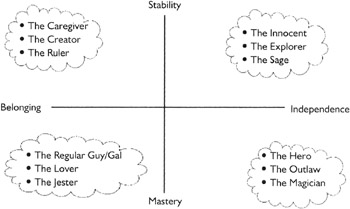
Figure 5.7: Brand archetypes
 |
Pears' Soap was one of the longest running brands in marketing history and was named after a London hairdresser, Andrew Pears, who patented the translucent soap bar. The famous "Bubbles" marketing campaign featured a small boy and established Pears as part of everyday life across both sides of the Atlantic.
As Haig recounts (2003), in recent years the mass-produced block of soap has been replaced by liquid products such as shower gels, body washes, and liquid soap. "In pursuit of cleanliness, the soap bar has been deemed unhygienic," Madelaine Bunting wrote in the Guardian (October 2001). It is especially seen as such in the US.
In addition, the Pears brand was built on advertising and when such support was taken away, the brand identity lost its meaning and became irrelevant. Brands built on advertising need advertising to sustain them.
The market share fell to only 3 percent and Unilever announced that it was to discontinue the brand in February 2000. The shift to liquid soap products was obviously a factor in the decline of Pears but Unilever held on to their "Dove" soap. This still sells exceptionally well because it is highly differentiated - it is bought not for cleanliness being next to godliness, but for keeping skin soft and beautiful.
| |
Each metaphor gives us the origin of the dilemmas that brand managers face. The metaphors in the first category of independents (top right) are the Innocent, the Explorer, and the Sage. All three archetypes in this category are individualistic in nature. The Innocent is universalistic, internally oriented, ascriptive, and past oriented; typical examples are Coke and McDonald's. The introduction of "New Coke" showed what happens if you deviate from the archetype . This was developed with a somewhat sweeter taste to compete more directly with Pepsi; it didn't work. Coca-Cola had to return to classic Coke, as being "the Real Thing."
Successful products also exist in an opposite set of archetypes (shown bottom left for this example). This trio give the customer the impression of " belonging ." They all share a communitarian orientation. For instance, the Lover types are often present in cosmetics, fashion, and travel organizations, and refer to sex appeal and beauty. They share an affective, diffuse, and external orientation. Latin brands - such as Yves St Laurent, Diesel, Gucci, and Ferrari - are leading the pack.
In order to be successful internationally with any particular brand marketers need to reconcile contradictions between the archetypes to a higher level. The reconciliation of opposite systems of meaning, or archetypes of brands, achieves success by making them less sensitive to differing cultural interpretations. The aim should be to create an integrated brand.

EAN: 2147483647
Pages: 82
- ERP Systems Impact on Organizations
- Challenging the Unpredictable: Changeable Order Management Systems
- Enterprise Application Integration: New Solutions for a Solved Problem or a Challenging Research Field?
- Context Management of ERP Processes in Virtual Communities
- Distributed Data Warehouse for Geo-spatial Services