Uploading Your Module Distribution
|
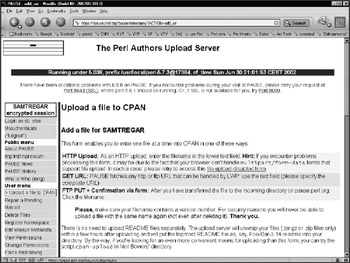
When you have a new version of your module to release, you'll use the PAUSE upload file form (see Figure 5-2), found in the User Menu sidebar at http://www.pause.cpan.org. There are three ways to upload your module distribution to CPAN: using HTTP upload, providing a URL, and via FTP.
HTTP UploadUsing HTTP upload is the easiest method in most situations. You'll need a modern[5] Web browser since many older browsers don't implement file upload correctly. To use this method, simply click the Browse button next to the file upload box and find the module distribution file you wish to upload. Then click the Upload this file from my disk button.
GET URLThe GET URL option allows you to tell PAUSE where to find your module on the Web. PAUSE will then go and retrieve this file for you. This option might be useful for projects that distribute modules on CPAN but also maintain a Web site that contains their module distributions. To use this method, enter the URL in the box and click the Upload this URL button.
FTP PUTThe FTP PUT method allows you to use FTP to upload a file to PAUSE. This is useful when you're doing development on a machine that can't run a modern Web browser. To use this method, first connect to the FTP server at pause.cpan.org via an FTP client. Log in as anonymous and use your e-mail address as your password. Change into the incoming directory and upload your file. Next, use a Web browser to visit the upload form on the PAUSE Web interface. At the bottom of the form, you'll see a list of module distributions—these are all the distributions waiting in the incoming directory. Select yours and click the Upload the checked file button.
Dealing with a Broken UploadOne way or another you'll eventually upload a broken file to CPAN. Either you'll transfer the file in ASCII mode FTP, or you'll forget to update some key piece of your distribution. There's only one way to deal with this situation—release a new version. This is because PAUSE will never allow you to upload a file with the same filename twice. Once you've uploaded MyModule-0.02.tar.gz, release 0.02 is set in stone. To fix a problem, you'll need to increment the version number and release MyModule-0.03.tar.gz.
[5]Netscape Navigator 4.0+ or Microsoft Internet Explorer 4.0+, but other browsers will certainly work. | ||||||||||||||||||||||||||||||||||||

 Companion Web Site

EAN: 2147483647
Pages: 110