Flylib.com

Books Software


2.8 Storage Area Networks (SANs)

only for RuBoard - do not distribute or recompile

2.8 Storage Area Networks (SANs)

The evolution of storage brings us to Storage Area Networks (SANs), described in detail in Chapter 4.

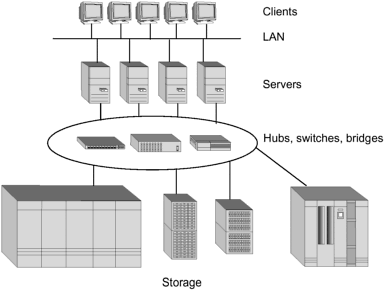
A Storage Area Network is based on the principle of networking devices together. As you learned in Chapter 1, the SAN consists of a group of mass storage devices (disk arrays and tape libraries) connected indirectly to host computer systems and each other by means of interconnecting devices such as hubs or switches.

Figure 2-10. Example of a SAN
graphics/02fig10.gif

Where LANs connect host computer systems together to share the access to servers and stored data, SANs connect storage devices together to provide host computer systems (and users) high-speed and immediate access to data. SANs also provide host computer systems multiple routes to data, as a measure of protection if failures happen. In some LANs where SANs are employed, the host computer system in control of some specific data can be failed over to another host system to guarantee access to data in case of a system failure. It can be configured so that any host can access any storage unit.

only for RuBoard - do not distribute or recompile

Chapter 3. A Brief Review of Fibre Channel

This chapter discusses:

  • Limitations of current mass storage architectures

  • How Fibre Channel answers these limitations

  • Advantages of Fibre Channel

  • Fibre Channel basics

  • Topologies

  • Fibre Channel functional levels and protocols

  • Fibre Channel Arbitrated Loop (FC-AL)

  • Hubs and topologies

Fibre Channel is the enabling technology of the SAN. This chapter explains the significant concepts.

only for RuBoard - do not distribute or recompile

3.1 Current Mass Storage Architectures

Current data transfer protocols (such as IPI, HIPPI, and SCSI) have problems that limit their effectiveness in mass storage. The limitations, illustrated in Figure 3-1, are:

Figure 3-1. Current Limitations
graphics/03fig01.gif
  1. Limited speed

  2. Limited distance between devices

  3. Limited number of devices supported

For example, the Small Computer System Interface (SCSI) is restricted to:

  • the bus being no longer than 25 meters

  • 32 SCSI devices per bus

  • a double cable system

In today s modern computer system environments, these restrictions are both very limiting to design and confining in space ”and it gets worse . The two-byte wide SCSI P-cable limits configurations to 16 devices.

The single-ended SCSI protocol is limited to eight IDs or addresses per bus (seven devices and one controller), and wide differential SCSI is limited to 16 IDs per bus (15 devices and one controller) to configure a one-terabyte disk storage unit. A fully redundant disk array would require 30 SCSI IDs (two per bus).

These concerns about limited speed, distance, and number of devices caused the industry to start thinking about alternatives. The alternative is Fibre Channel.

only for RuBoard - do not distribute or recompile

3.2 How Does Fibre Channel Help?

Fibre Channel is a new communications protocol designed to overcome the limitations of existing architectures. It is a generic data transport mechanism with the primary task of transporting data at the fastest rate possible using current technology. Fibre Channel is a scalable interface for achieving high-speed data transfer rates among heterogeneous systems and peripherals. System types include supercomputers, mainframes, workstations, and desktop PCs.

Peripherals include mass storage devices such as disk arrays and possibly tape libraries. The main purpose of Fibre Channel is to have any number of existing protocols over a variety of physical media and existing cable options.

Table 3-1 shows the various speeds and distances that can be attained using different cable types.

Table  3-1. Cable Types, Speeds, and Distances

SPEED (Mbps)

9 µm Single Mode

50 µm Multimode

62.5 µm Multimode

COAX

Mini COAX

TWINAX

STP

133


100 m

42 m

93 m

80 m

266

10 km

2 km

1 km

100 m

28 m

66 m

57 m

533

10 km

1 km

1km

71 m

19 m

46 m

48 m

1063

10 km

500 m

175 m

50 m

14 m

33 m

28 m

2125

2 km

500 m


4250

2 km

175 m


3.2.1 Fibre Channel Use for Mass Storage

Since Fibre Channel is a generic data transport mechanism, it can transmit a number of existing networking and I/O protocols:

I/O protocols:

  • SCSI

  • HIPPI

  • IPI

Network protocols:

  • IP

  • IEEE 802.2

Hewlett-Packard has chosen to support the SCSI-3 protocol over Fibre Channel for its mass storage environment. Mass storage consists of several device classes:

  • tapes

  • disks

  • disk arrays

only for RuBoard - do not distribute or recompile