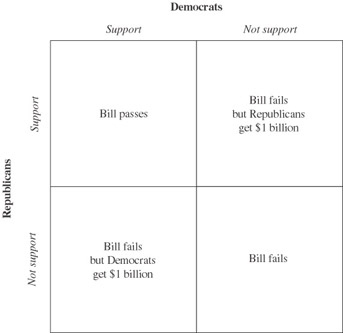
Warren Buffett once proposed using dominant and
Figure 15
In the game that Buffett proposed, supporting the bill is a dominant strategy, and not supporting it is strictly stupid. If the other party supports the bill then you have to as well or else they get $1 billion. Similarly, if they don’t support the reform, you should support the bill, and then use your billion dollars to crush them in the
[4] Campaign for America (September 12, 2000).

Games involving dominant or
How would you play the game in Figure 16? Obviously you should try to guess your opponent’s move. If you’re Player One you want to play A if your
Figure 16
Traffic lights are a real-life coordination mechanism. Consider Figure 17. It illustrates a game that all drivers play. Two drivers approach each other at an intersection. Each driver can go or stop. While both drivers would prefer to not stop, if they both go they have a problem.
Figure 17
Coordination games also manifest when you are arranging to meet someone, and you both obviously want to end up at the same location, or where you’re trying to match your production schedule with a supplier’s deliveries. Figure 18 shows a coordination game that two movie
Figure 18
Technology companies play coordination games when they try to implement common standards. For example, several companies are currently attempting to adopt a high-capacity blue-laser–based replace-ment for DVD players. Consumers are more likely to buy a DVD replacement if there is one standard that will run most software, rather than if they must get separate machines for each movie format. Consequently, companies have incentives to work together to design and market one standard.
In game theory land you do not trust someone because she is honorable or smiles sweetly when
Trust games are like coordination games except that you have a safe course to take if you’re not sure whether your coordination efforts will succeed. Figure 19 illustrates a trust game. In this game, both players would be willing to play A if each knew that the other would play A as well. If, however, either player
Figure 19
Figure 20 illustrates a trust game where both you and a coworker demand a raise. In this game your boss could and would be willing to fire one of you, but couldn’t afford to lose you both. If you jointly demand a raise, you both get it. Alas, if only one
Figure 20
In any trust game there is a safe course where you get a
Let’s consider a trust game
Workers who go on strike are also often engaged in trust games. Frequently, if all the workers show solidarity and
The obvious solution to any trust game might be for all parties simply to embark on the risky course. A small amount of doubt, however, might make the risk unbearable.
Doubts are
Figure 21 shows the mayhem unleashed by doubts within doubts. Obviously, in the game in Figure 21 the best outcome would occur if both people played A. Small doubts, however, could make this outcome
Figure 21
The
Figure 22
Imagine that before both players write down their choice they talk to each other about strategy. If you’re Player Two you obviously want to lie to Player One. Player One wins by matching your choice. Thus, if you intend to play heads, you should tell him you would play tails so he will try and match by playing tails, and you then win. Actually, this might not work since the other player knows you have an incentive to lie. If you are known always to lie, then people will acquire
Armies often play outguessing games with each other. During World War II, the Germans knew that the Allies would try invading Nazi-occupied Europe from Britain. The Nazis didn’t know, however, exactly where the Allies would land. Had the Nazis learned the landing locations, they would undoubtedly have deployed a massive number of troops at these points and probably repelled the invasion. The Allies, consequently, desperately tried to keep the invasion plans secret. Indeed, the Allies did more than this and spread false information to the Nazis. The invasion of Nazi-occupied Europe was successful because the Nazis thought the Allies were going to play tails when the Allies were really intending on playing heads.
In baseball, pitchers and batters play outguessing games. Batters try to predict what kind of ball the pitcher will throw, and pitchers try to hide their strategies. Pitchers always vary their throws to keep batters off balance and ensure that they never know what to expect. There would obviously be no advantage to a pitcher and batter negotiating over what kind of ball the pitcher should throw, since these players have conflicting goals. Pitchers and catchers usually signal to each other what kind of pitch will be thrown. The batter would be greatly helped if his team could decode these signals and transmit them to the batter. In outguessing games you can always gain by successfully
An outguessing game
Figure 23
Randomness manifests in all outguessing games. To see this in our stealing game, assume, falsely, that there is no randomness and the outcome of the game is for the employee never to steal. In this case the company would never bother watching. Of course, if the company never watched, the employee would always steal. It is therefore unreasonable to assume that the employee will never steal. Furthermore, if the employee always steals, then the company will always watch, which of course will lead to the employee never stealing, which in
American taxpayers play an outguessing game with the IRS. People who cheat on their taxes and get caught pay
When approaching an intersection at night, it would be a very bad idea to turn off your lights to keep the other drivers from guessing your intentions. In outguessing games, however, you always want to turn your lights off. This is because while in coordination games you are better off if your opponent knows your move, in outguessing games you want to hide your actions from your opponent. Or even better, you want to spread false information. Negotiations are pointless in outguessing games since both players have strong incentives to lie. The key to winning outguessing games is to hide, never trust, and always strive to deceive.
In the classic game of chicken, shown in Figure 24, two
Figure 24
In a chicken game, therefore, you win by convincing your rival that you will never turn. [6] Consequently, perception is reality in the game of chicken. Chicken is not just a game about who is more macho, but also about who more exudes an air of machismo. Each player wants the other to believe that he is so macho that he would rather die than give in. If you can convince your opponent that you are indeed macho, you will win the game and thus be proven macho.
Insane players have a massive edge in the classic chicken game, for would you ever want to
Most negotiations don’t lead to chicken games. Imagine that I own a good that you want to buy. If we fail to reach an agreement, we lose the benefit of the trade but don’t necessarily destroy anything of value. A chicken game can exist only when the players might get into an accident, and an accident
When Excite@Home fell victim to the tech crash, its bondholders attempted to play a chicken game by creating the possibility of an accident. AT&T used Excite@Home to help provide Internet ser- vice to many AT&T customers. When Excite@Home faced bankruptcy, AT&T started negotiations to buy Excite@Home’s assets. Excite@Home’s creditors were
The creditors got legal permission to close down their Internet services and
Figure 25
Imagine that I own a good worth $100 to you, so $100 is the most you would normally ever pay for it. Let’s further assume, however, that I have the ability to cause you $30 worth of damage, and I threaten to inflict this damage if you don’t buy my good for $125. As Excite@Home’s bondholders
Unfortunately for Excite@Home, they overestimated their ability to harm AT&T. AT&T was able to move their Internet customers quickly to other networks, thus greatly limiting the damage from an accident. After moving their customers, AT&T withdrew their previous offer for Excite@Home’s assets.
AT&T had what they thought was a long-term relationship with Excite@Home. In long-term business relationships you don’t
Free rider problems can cause chicken games to manifest. In free rider games players try to be lazy and benefit from the efforts of others. Consider the game in Figure 26. Imagine that this game came about because a boss assigned two employees to complete a task. Each employee can either work at the task or evade the job. If both people work, the task will be completed, and each employee will earn a payoff of 10. If both employees shirk, the job won’t get done, and both workers will be fired. To make this a free rider and chicken game, however, assume that if one employee works and the other shirks, the lazy employee who shirks gets a payoff of 15, while the stupid hardworking one gets only 0 (but doesn’t get
Figure 26
Both players would have an incentive to tell each other that they will definitely not do the work. If I can convince you that I won’t work, you definitely will so I can safely slack. Of course, you have the same incentive to convince me that you are going to
In both coordination and chicken games the players could coordinate their actions to avoid an accident. As you recall, in coordination games you always should believe the other party so avoiding bad
I recall one real-life game of chicken I played with my sister when we were both young teenagers in which there was an “accident.” Our mother told us she was going out to the yard but was expecting an important call. She told us to be sure to answer the phone when it rang. (This game took place in primitive times before answering machines had invaded middle-class
Assigning clear responsibility can avoid accidents in free rider/ chicken games. Let’s reconsider the game in Figure 26, in which both employees want the other to do the work. Recall that there is some chance that neither player will do the work because each expects the other to complete the task. Now imagine a simpler game in which the employer
Chicken games also occur between firms rather than just within them. Imagine that two firms are considering entering a local market in which there is room for only one firm to
As you recall, in outguessing games you want to stop your opponent from spying on you. In outguessing games, if your opponent figures out your strategy, he always wins. In chicken games, however, if your opponent knows your strategy, and that strategy is one of machismo, then you will triumph. Thus, if you believe that you could put up a brave front, you should welcome your opponent’s attempts to spy on you.
Indeed, disaster would result if you tried to rebuff spying attempts. Imagine that you have told your opponent that you are definitely going to enter this small market. You hope he will believe you and not try to enter himself. But further imagine that your opponent sends a spy to your business to see if you are really planning to enter. If you turn away this spy, what should he believe? Obviously, if you know that his spy would report that you were indeed planning on entering the market, you would welcome him. Since you are rebuffing the spying attempt, however, your opponent should suspect that you have something to hide. The only thing that you would have to hide is your lack of commitment to entry. Not welcoming spies signals that you could be a wimp. Since perception is everything in chicken games, being perceived as a wimp will indeed make you wimpy. It is therefore
The difference between counter-spying strategies in chicken and outguessing games comes about because in outguessing games a party always has something to hide. Regardless of what move a player plans to make in an outguessing game, she doesn’t want her opponent to become aware of her actions. Attempts at concealment in outguessing games tell your opponent nothing, since everyone would always try to hide everything in these games. In chicken games, however, a party wants to hide something only when she has a weak commitment to adopting the macho strategy. Thus, you can’t completely hide your actions from a spy in a chicken game because the very act of
A chicken game can result when multiple players seek a treasure. Imagine that a recently uncovered pirate’s diary indicates the existence of buried treasure somewhere on a small island. Let’s say the treasure would be worth $100,000 if found. Unfortunately, it would cost $70,000 to search the island and find the treasure. Since it would obviously be worth spending $70,000 to get a $100,000 treasure it would seem to be a good idea to search for the treasure. What happens, however, if two people know of the treasure’s existence? If they teamed up, they could split both the costs and the benefits. What if one party, however, wanted the whole treasure for herself? If both players spent $70,000 searching for the treasure, at most only one of them would find it. Spending $70,000 for a 50 percent chance of getting $100,000 is a terrible investment; even Las Vegas (but not government-run
When multiple firms conduct similar research, they are often on treasure hunts. Under the U.S. patent system the first company that discovers some useful invention receives all the rights to that invention. If my company makes the discovery one day before yours, I receive the patent rights, and you get to explain to your
How much should a company be willing to pay for a patent worth $10 million? They should be willing to pay up to, but not quite including, $10 million. Now imagine that multiple firms are simultaneously trying to get the same patent. If they all
Of course, the other firms would very much like for you not even to try. As a result they have a strong incentive to notify you that they are seeking the patent. Normally, we assume that companies like to keep research projects secret so other firms won’t steal their ideas. When playing patent chicken games, however, the optimal strategy is to broadcast your research goals loudly. As with any chicken game, firms will have an incentive to lie and exaggerate their commitment to getting the patent. If the firm sells stock, however, then securities fraud laws might prevent the firm from telling too grievous a lie about its research agenda.
{% if main.adsdop %}{% include 'adsenceinline.tpl' %}{% endif %}
For example, vaporware manifests because of chicken games. Vaporware is software that a company announces but doesn’t complete. Imagine that a $10 million market arises for a new type of business software. It would cost $7 million, however, for a company to develop this software. You want to capture this market, but you don’t want to develop the new software immediately. If your competition knew that you would take a year before starting to write the software, they would immediately start developing and capture the market for
The key to prevailing in a chicken game is to convince your opponent that you are committed to the macho course. You should welcome your opponents’ attempts to spy on you. If, however, you are certain that your fellow player is herself going to be macho, then your optimal strategy is to be a wimp so as to avoid an accident.
The Cuban missile crisis of 1962 was a game of chicken. The United States discovered that the Soviet Empire placed missiles in Cuba. Fortunately, America
We now know that the Kennedy Administration gave some consideration to invading Cuba. Had the United States invaded Cuba, the Soviets might have responded by taking West Berlin, and had the United States then tried to free West Berlin, war might have broken out between the two superpowers.
It must have appeared to President Kennedy that the United States was in a much stronger position than the Soviets were because America’s capacity to hurt the Soviets was far greater than the Soviet’s capacity to harm America. To President Kennedy it must have appeared as if the two
Unknown to the United States, however, it appears that the Soviet
The existence of the Soviet battlefield nuclear weapons would have made it easier for the Soviets and Cubans to resist an American invasion. Had President Kennedy known of these weapons’ existence, he surely would have given less consideration to invading Cuba. So, in this game of chicken, while Kennedy thought the Soviets were driving a small car, they were really driving a truck.
Recall, in games of chicken you always want to convince your opponent that you will be macho. Since the battlefield nuclear weapons clearly made it more likely that the Soviets would be macho, the Soviets made a serious mistake in not informing President Kennedy about the weapons’ existence. The Soviet Empire
In the end the Soviets
Burning money can be profitable! [10] To see the advantages of burning money, consider the chicken game in Figure 27.
Figure 27
Obviously in this game each player would want to convince his opponent that he is committed to being macho. If, for example, Player Two believes that Player One will be macho, then Player Two will be a wimp, giving Player One his highest possible payoff. Player One could actually signal his commitment to being macho by burning money.
Let’s expand the game in Figure 27. First, Player One has the option of publicly burning $5. Second, both players simultaneously choose their strategy. Player One’s strategy consists of two
If Player One elects to burn $0 and be a wimp, then his payoff is $0, regardless of whether Player Two elects to be a wimp or to be macho. On the other hand, if Player One elects to burn $5 and be a wimp, then his payoff is –$5, regardless of whether Player Two elects to be a wimp or to be macho.
Burning $5 and being a wimp is a strictly stupid strategy. If you are going to be a wimp, you are always better off not burning $5. Thus, everyone should predict that if Player One does burn $5, he would not be a wimp. Hence, if Player Two observes that Player One burns $5, then Player Two should assume that Player One will be macho. If Player Two believes that Player One will be macho, then Player Two will choose to be a wimp. By publicly burning $5, Player One credibly signals that he will be macho.
Businesses have no need to actually burn money, however; for they can publicly waste funds. The best way for you to waste your money is to send it to me. Companies can also burn money by paying for celebrity endorsements. For example, to signal your commitment to enter a new market that could only profitably support one firm you could hire an expensive celebrity to star in commercials announcing your intentions. With luck, the pricey commercials will convince rivals of your absolute commitment to enter the market so your rivals will stay away.
You can characterize games by their total payoff. In a fixed-sum game, what one player gets, another loses. Mathematically, in a fixed-sum game, the sum of the players’ payoff in each of the boxes adds up to the same number. Chess is a fixed-sum game in which if one player wins, the other must lose. Variable-sum games consist simply of all games that are not fixed sum. In variable-sum games the players can often benefit from working together.
In fixed-sum games cooperation is pointless because the player’s interests are diametrically opposed. In negotiations you seek to get something that makes you better off. If, however, my gain is your loss, then the fact that I want something necessarily means you shouldn’t give it to me.
You can consider a game to be like a pie. The players’ strategies determine the size of the pie and what percentage of the pie each player gets to eat. In variable-sum games the
Fixed-sum games can get nasty because you always want to inflict maximum pain on your opponent. Clearly, if his loss is your gain then you want him to suffer. For example, imagine that you and a coworker are up for a promotion that only one of you can get. If the only factor relevant to both payoffs is who gets the promotion, then the game is clearly fixed sum. In this game anything you could do to make your coworker look bad would increase your chances. Similarly, anything she could do to harm you would advance his interests. Thus, you would each benefit from sabotaging each other’s work and spreading degrading rumors about each other.
There are, however, very few fixed-sum games in business settings. In our promotion game we assumed that the only relevant consideration was whether you got the promotion. This assumption is clearly
Consider a market where only two firms sell widgets. These firms are almost
Imagine that in an effort to reduce its rival’s sales, one company falsely announces that the use of widgets causes cancer. This announcement strategy would almost certainly harm the rival firm. If this game were really fixed sum, harming its rival would always help the announcing firm. Of course, announcing that a product you produce causes cancer is
Politicians, however, do play fixed-sum games. Political candidates often run negative advertisements while companies almost never do because running for elected office is a fixed-sum game where only one candidate can win. Thus, anything that hurts your political rival helps you get elected. Imagine you’re running for office in a
To win, you must know what you are playing. Different games require different strategies. The game you’re in is determined by the alignment of the player’s interests, so when starting a new venture ask:
Does everyone have the same objectives?
Would other players benefit from lying to me about their strategy?
Is the game fixed or variable sum?
Do I want my opponent to guess my future moves?
Am I better off being perceived as rational or crazy?
In the next chapter we will look at simultaneous coordination games that are played by millions of consumers. The outcome of these games often determines the fate of high technology companies.
A dominant strategy gives you a higher payoff than all other strategies regardless of what your opponent does.
A strictly stupid strategy gives you a lower payoff than some other strategies regardless of what your opponent does.
You should always play dominant strategies and never play strictly stupid strategies, and you should assume that your opponent will do the same.
You should be open, honest, and trusting in coordination games.
A small amount of doubt can make it impossible for two parties to trust each other.
It’s useless to negotiate in outguessing games.
In chicken games perception is reality, so you must do everything to convince your opponent that you are committed to the macho course.
[5]
Shouldn’t a rational taxpayer realize the benefits his government provides him and thus gladly pay his taxes? No! If you alone didn’t pay taxes then the total tax revenue the government receives would be only trivially smaller. Consequently, by not paying taxes you would save a lot of money but not notice any reduction in governmental services. Shouldn’t a potential taxpayer worry that if many people didn’t pay their taxes then the government would have to cut back on services? Again, no! Your not paying taxes is certainly not going to cause many other people to not pay their taxes. (Especially because if you become a tax cheat you will probably not advertise your activities.) Furthermore, if many other people are not planning on paying their taxes there is probably nothing that you can do about it. Consequently, it is best for you to ignore whether other people will pay their taxes and just concentrate on how you can minimize your tax
[6] Actually, most sensible people would be better off never playing the classic game of chicken. If a sensible person somehow found herself in such a game the optimal strategy would simply be to turn at the earliest possible moment. The classic chicken game assumes, however, that both players desperately want to be perceived as macho.
[7] CNET News.com (December 4, 2001).
[8] See Dixit and Skeath (1999), 110–112.
[9]
Dixit and Skeath (1999) provide an interesting and readable game
[10] See McMillan (1992), 73–74.