Flylib.com

Books Software


Describing the Sales Process at Highlight


Describing the Sales Process at Highlight

An analysis of the Highlight Insurance sales process reveals the details outlined in Figure 3.1.
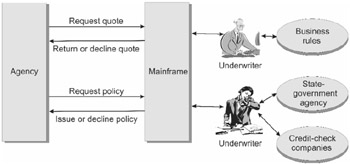
image from book
Figure 3.1: Sales process at Highlight Insurance

Here's the short story: Highlight's in-house underwriters make judgments about the risk involved in adding or keeping a customer. A set of business rules specify which underwriter handles which quote requests. When an agency requests a policy on behalf of a customer, an underwriter verifies the submitted details by writing to credit-check companies and state-government agencies such as the Department of Motor Vehicles (DMV).


Identifying Problems with the Current Process

Highlight's current process has several problems. First, it's too labor- intensive . The company's expansion will only increase the workload, and executives don't want to hire additional personnel to make up for inadequate technology.

The process is also inflexible and slow. Agents often want to see how a small change in coverage affects a quote, and they want an answer before the customer loses interest.

Another issue is that Highlight's current process doesn't handle direct sales. The company's Web site could let potential customers print request forms for subsequent faxing, but that solution is insufficient because it requires the customer to do work not required at the Web sites of other insurance companies. Aside from the issue of direct sales, the company has a competitive need to upgrade. Other insurance companies let agents submit online requests and receive quick feedback.

The process also has technical problems that are magnified by the complexity of software update, which includes coding (with technical code preparation on the mainframe), plus various kinds of testing, plus fixes and retesting as needed. After the code is correct, developers promote it from a test environment to a production environment, where the promoted code is tested yet again to ensure that users gain access to the correct version.

The main technical problems are twofold. First, existing applications combine different kinds of logic ( user interface, business processing, and data access) and are hard to understand. As described earlier, the effect is additional testing, coding time, and errors. Second, the logic that handles different state requirements isn't separated from the rest. The merging of changeable code with more stable code means that the stable code is usually touched during updates. The effect is to require tests that would be unnecessary if the two kinds of code were kept separate.

Technical problems have business implications. The excessive effort needed to update and test software increases Highlight's expense and slows its response to change, especially in two situations: when the company gains approval to do business in a previously unsupported state and when requirements change in a state already supported.


Communicating the Assumptions in Writing

As you collect requirements, and even as you build a new business process, make the assumptions explicit and present them to technical and business personnel alike, in writing. Your goals are

  • to specify the purpose of each application

  • to identify which parts of the software inventory can remain in use

  • to clarify which departments and personnel have which responsibilities during the project

  • to address issues that may lead to conflict

  • to help decision- makers reach agreement

  • to have a record that can be useful when people later ask what the rationale was for a given decision

If you fail to identify assumptions, you're likely to present a solution that needs rework .

Assumptions can concern a variety of issues, including

  • standards of measurement, with decisions such as:

    • Monetary values are in dollars.

    • Timestamps reflect Coordinated Universal Time.

  • scope of effort, with decisions such as:

    • Fee collection is outside of scope.

    • Underwriters are responsible for setting rejection criteria.

  • quality of service, with decisions such as:

    • Service A must be available 99 percent of the time.

    • The application must be able to support 1,000 requesters concurrently.

After you list assumptions, you'll discover that some don't apply to your project at all. That's normal. You'd do well to consider many issues even if you later ignore a few.