Flylib.com

Books Software


Java Number Cruncher: The Java Programmer s Guide to Numerical Computing
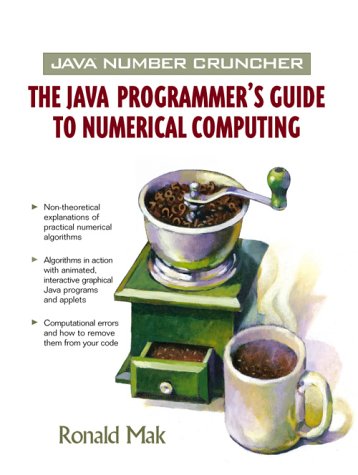
 
Java Number Cruncher: The Java Programmer's Guide to Numerical Computing
By Ronald  Mak
 
Publisher : Prentice Hall PTR
Pub Date : October 29, 2002
ISBN : 0-13-046041-9
Pages : 480
Supplier : tEAm FLY


In Java Number Cruncher , author Ronald Mak explains how to spot-and how to avoid-the subtle programming miscues that can cause vexing calculation errors in your applications. An authority on mapping pure math to computer math, he explains how to use the often-overlooked computational features of Java, and does so in a clear, non-theoretical style.

Without getting lost in mathematical detail, you'll learn practical numerical algorithms for safely summing numbers, finding roots of equations, interpolation and approximation , numerical integration, solving differential equations, matrix operations, and solving sets of simultaneous equations. You'll also enjoy intriguing topics such as searching for patterns in prime numbers, generating random numbers , computing thousands of digits of pi, and creating intricately beautiful fractal images.

Java Number Cruncher includes:

  • Practical information all Java programmers should know

  • Popular computational algorithms in Java-without excessive mathematical theory

  • Interactive graphical programs that bring the algorithms to life on the computer screen

  • Rounding errors, the pitfalls of integer arithmetic, Java's implementation of the IEEE 754 floating-point standard, and more

This book is useful to all Java programmers, especially for those who want to learn about numerical computation, and for developers of scientific, financial, and data analysis applications.


  Table of Contents
Java Number Cruncher: The Java Programmer's Guide to Numerical Computing
By Ronald  Mak
 
Publisher : Prentice Hall PTR
Pub Date : October 29, 2002
ISBN : 0-13-046041-9
Pages : 480
Supplier : Team FLY Copyright
      Preface
      How to Download the Source Code
      Part  I.   Why Good Computations Go Bad
        Chapter  1.   Floating-Point Numbers Are Not Real!
        Section 1.1.   Roundoff Errors
        Section 1.2.   Error Explosion
        Section 1.3.   Real Numbers versus Floating-Point Numbers
        Section 1.4.   Precision and Accuracy
        Section 1.5.   Disobeying the Laws of Algebra
        Section 1.6.   And What about Those Integers?
        References
        Chapter  2.   How Wholesome Are the Integers?
        Section 2.1.   The Integer Types and Operations
        Section 2.2.   Signed Magnitude versus Two's-Complement
        Section 2.3.   Whole Numbers versus Integer Numbers
        Section 2.4.   Wrapper Classes
        Section 2.5.   Integer Division and Remainder
        Section 2.6.   Integer Exponentiation
        References
        Chapter  3.   The Floating-Point Standard
        Section 3.1.   The Floating-Point Formats
        Section 3.2.   Denormalized Numbers
        Section 3.3.   Decomposing Floating-Point Numbers
        Section 3.4.   The Floating-Point Operations
        Section 3.5.   ±0, ± , and NaN
        Section 3.6.   No Exceptions!
        Section 3.7.   Another Look at Roundoff Errors
        Section 3.8.   Strict or Nonstrict Floating-Point Arithmetic
        Section 3.9.   The Machine Epsilon
        Section 3.10.   Error Analysis
        References
      Part  II.   Iterative Computations
        Chapter  4.   Summing Lists of Numbers
        Section 4.1.   A Summing Mystery ”the Magnitude Problem
        Section 4.2.   The Kahan Summation Algorithm
        Section 4.3.   Summing Numbers in a Random Order
        Section 4.4.   Summing Addends with Different Signs
        Section 4.5.   Insightful Computing
        Section 4.6.   Summation Summary
        References
        Chapter  5.   Finding Roots
        Section 5.1.   Analytical versus Computer Solutions
        Section 5.2.   The Functions
        Section 5.3.   The Bisection Algorithm
        Section 5.4.   The Regula Falsi Algorithm
        Section 5.5.   The Improved Regula Falsi Algorithm
        Section 5.6.   The Secant Algorithm
        Section 5.7.   Newton's Algorithm
        Section 5.8.   Fixed-Point Iteration
        Section 5.9.   Double Trouble with Multiple Roots
        Section 5.10.   Comparing the Root-Finder Algorithms
        References
        Chapter  6.   Interpolation and Approximation
        Section 6.1.   The Power Form versus the Newton Form
        Section 6.2.   Polynomial Interpolation Functions
        Section 6.3.   Divided Differences
        Section 6.4.   Constructing the Interpolation Function
        Section 6.5.   Least-Squares Linear Regression
        Section 6.6.   Constructing the Regression Line
        References
        Chapter  7.   Numerical Integration
        Section 7.1.   Back to Basics
        Section 7.2.   The Trapezoidal Algorithm
        Section 7.3.   Simpson's Algorithm
        References
        Chapter  8.   Solving Differential Equations Numerically
        Section 8.1.   Back to Basics
        Section 8.2.   A Differential Equation Class
        Section 8.3.   Euler's Algorithm
        Section 8.4.   A Predictor-Corrector Algorithm
        Section 8.5.   The Fourth-Order Runge-Kutta Algorithm
        References
      Part  III.   A Matrix Package
        Chapter  9.   Basic Matrix Operations
        Section 9.1.   Matrix
        Section 9.2.   Square Matrix
        Section 9.3.   Identity Matrix
        Section 9.4.   Row Vector
        Section 9.5.   Column Vector
        Section 9.6.   Graphic Transformation Matrices
        Section 9.7.   A Tumbling Cube in 3-D Space
        References
        Chapter  10.   Solving Systems of Linear Equations
        Section 10.1.   The Gaussian Elimination Algorithm
        Section 10.2.   Problems with Gaussian Elimination
        Section 10.3.   Partial Pivoting
        Section 10.4.   Scaling
        Section 10.5.   LU Decomposition
        Section 10.6.   Iterative Improvement
        Section 10.7.   A Class for Solving Systems of Linear Equations
        Section 10.8.   A Program to Test LU Decomposition
        Section 10.9.   Polynomial Regression
        References
        Chapter  11.   Matrix Inversion, Determinants, and Condition Numbers
        Section 11.1.   The Determinant
        Section 11.2.   The Inverse
        Section 11.3.   The Norm and the Condition Number
        Section 11.4.   The Invertible Matrix Class
        Section 11.5.   Hilbert Matrices
        Section 11.6.   Comparing Solution Algorithms
        References
      Part  IV.   The Joys of Computation
        Chapter  12.   Big Numbers
        Section 12.1.   Big Integers
        Section 12.2.   A Very Large Prime Number
        Section 12.3.   Big Integers and Cryptography
        Section 12.4.   Big Decimal Numbers
        Section 12.5.   Big Decimal Functions
        References
        Chapter  13.   Computing p
        Section 13.1.   Estimates of p and Ramanujan's Formulas
        Section 13.2.   Arctangent Formulas That Generate p
        Section 13.3.   Generating Billions of Digits
        References
        Chapter  14.   Generating Random Numbers
        Section 14.1.   Pseudorandom Numbers
        Section 14.2.   Uniformly Distributed Random Numbers
        Section 14.3.   Normally Distributed Random Numbers
        Section 14.4.   Exponentially Distributed Random Numbers
        Section 14.5.   Monte Carlo, Buffon's Needle, and p
        References
        Chapter  15.   Prime Numbers
        Section 15.1.   The Sieve of Eratosthenes and Factoring
        Section 15.2.   Congruences and Modulo Arithmetic
        Section 15.3.   The Lucas Test
        Section 15.4.   The Miller-Rabin Test
        Section 15.5.   A Combined Primality Tester
        Section 15.6.   Generating Prime Numbers
        Section 15.7.   Prime Number Patterns
        References
        Chapter  16.   Fractals
        Section 16.1.   Fixed-Point Iteration and Orbits
        Section 16.2.   Bifurcation and the Real Function f ( x ) = x 2 + c
        Section 16.3.   Julia Sets and the Complex Function f ( z ) = z 2 + c
        Section 16.4.   Newton's Algorithm in the Complex Plane
        Section 16.5.   The Mandelbrot Set
        References
Top