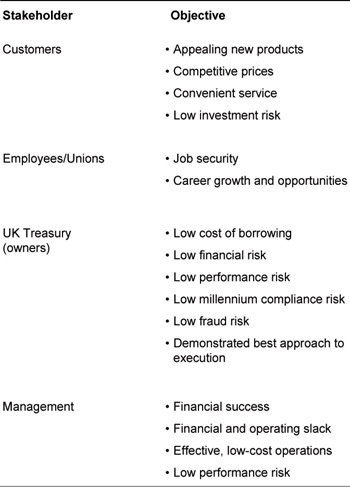
The first step in designing a working business model is to identify the critical stakeholders. These are the constituencies on both sides of the initiative that have a stake in its outcome. National Savings and Investments counted customers, employees, the Treasury, and management as the four key stakeholder groups. For Newport Systems, stakeholders included headquarters management, business unit management, investors, and
Exhibit 5.1:
Examples of NS&I stakeholder objectives.
However, they went even further. They also
When Don Brown of the UK Inland Revenue got involved in the agency’s outsourced information technology systems and processes, he addressed this issue by
Transformational outsourcing means making
What makes a good business model? First, it’s important to understand that business models are like
First, they offer unique value. Most often, this involves a combination of product and service attributes that offer more
Good business models exhibit a
Better business models are also hard to imitate. Whether through patents and proprietary assets, a lock on
Finally, better business models are grounded in reality. They are based on assumptions of customer behavior that actually hold true. They have cost structures that can be supported by the revenue streams, day in and day out. These criteria sound obvious, but many companies—new and old—don’t have a clear picture of where they make money and why customers prefer their offerings. One of my previous studies on this topic found a shocking statistic: 62 percent of executives interviewed could not easily
|
|
To
Officesupplies.com sells office products at
The great prices
Good service—including wide selection,
Good service and good prices build volume.
High volume enables Officesupplies.com to negotiate purchase
These discounts, along with a lean cost structure, give Officesupplies.com its profit, and the ability to lower prices further.
Profits attract capital for growth.
Growth helps the company attract top talent, which enables it to continue to improve its Web site and to sustain
|
|
Since most executives are unfamiliar with the process of designing business models, let’s start with the basics. Then we’ll talk about why this kind of analysis is
Designing a business model is a disciplined way of thinking through how your company will make money. Since organizations
A business modeling approach has one essential advantage over many other strategic frameworks: It is dynamic. Rather than painting a static picture of an organization’s functions, business modeling provides a more realistic operating view of how the key elements of the moneymaking (or value creation, for the public sector) process work together and reinforce each other (see Exhibit 5.2). To begin to design a business model, you will need to answer the following three
What stakeholders will we target and what value proposition(s) will we offer them?
Starting with customers, we need to ask
How will we deliver what we promise profitably?
How should we
How will we finance our enterprise? What kind of cash flows and cost structure will we have? How will we support that through investment or profits? What will we have to pay for capital and where will we get it? How can we make the most of our financial assets? For example, businesses that get cash up front from their customers—before they have to pay for the costs of goods and services—have a business model advantage over companies that get paid after products have been delivered.
Exhibit 5.2:
Business model overview
I call these ‘‘related’’ questions because they are not independent. In fact, they are highly intertwined. As a simple example, a company that intends to offer the highest quality automobile in the industry for a premium price—its value proposition—must have access to designers,
Each of the three business-model design questions hides a myriad of detailed considerations. And some of these are critical to the model. For example, one model’s value proposition might ask customers to pay for their automobiles in full when they receive them. Another model might allow them to pay over time. The latter could include charges on the unpaid balance, which could, of course, improve the model’s overall profitability. For example, furniture retailer Heilig Meyers used to concentrate its stores in rural areas where patrons had less access to easy credit. The store’s product margins were vanishingly small, but, for a time, it made
By answering the three key questions, you will develop an under- standing of how the organization creates value today. Your business- model dynamic has first-order effects that keep the basic business going. And to completely understand your model, you will want to articulate how it continues to create value (see Exhibit 5.3). The key here is to identify the tangible and intangible assets that are built as by-products of ongoing company operations.
Exhibit 5.3:
Articulating a business model.
Now we’re talking about second-order effects that enable the organization to adapt, grow, and thrive (see sidebar, ‘‘Officesupplies.com Keeps Delivering Value,’’ below). Operating businesses both rely on and create tangible and intangible assets. These include facilities and patents, as well as brand equity, know-how, relationships, and knowledge. For example, a business may rely on existing customer relationships for this month’s sales. The new products and services also build the relationship. These are the critical capabilities your organization draws on to operate, and they are the capabilities you build through the normal course of doing business.
|
|
Officesupplies.com’s dynamic goes further than just keeping its basic business rolling. In addition to first-order effects, the company has a second-order dynamic. This
Officesupplies.com’s business model gives it an important asset: a base of satisfied small and midsize business customers.
Officesupplies.com leverages this asset by expanding its offerings to these customers to include other convenience goods and services at excellent prices, such as office furniture, payroll services, insurance, and temporary help.
The broader product/service line increases Officesupplies.com value for convenience- and cost-oriented customers.
This improves customer retention and increases sales.
Increased sales enable Officesupplies.com to continue to expand its product line, customer service, and marketing reach.
This expansion fuels further sales growth and increases profitability.
|
|
Businesses extend and leverage these tangible and intangible assets to grow and increase their value. For example, a business could introduce new products under a successful brand. It could take manufacturing know-how in one product sector and use it to enter a new sector. This second-order dynamic makes a business model
To outline your organization’s business model(s), follow these steps. Remember, you have already identified your key stakeholder groups and their needs:
Identify the important sources of value you provide to each key
Identify what each stakeholder group gives you in exchange for the value you provide.
Lay out the key factors that enable you to deliver your value
Lay out the tangible and intangible assets that you build as a result of operating this business, and that can you can use to propel it forward.
Test the logic. Do the value propositions attract enough resources to enable the organization to deliver profitably? Do the operations build enough
Use the information to construct a diagram that shows ‘‘round’’ logic. If your organization has several divisions, ask yourself: Why is this one company? If you can identify the reason, make sure that factor is prominent in the operating business model. If you can’t, show the divisions as separate models.
[2] Jane Linder and Susan Cantrell, ‘‘Working Models,’’ Accenture Institute for Strategic Change Research Note, January 2000.