Special Edition Using Microsoft Office Outlook 2003
Authors: Cardoza P. Staples M.
Published year: 2003
Pages: 135-136/426
Buy this book on amazon.com >>

Creating Tasks from Other Outlook Items

All Outlook items can be created using a quick and powerful technique called AutoCreate. You can take items from any Outlook folder and drag them to your Tasks folder to easily create a task item. AutoCreate takes the information from the original item and populates a new task form with that information.

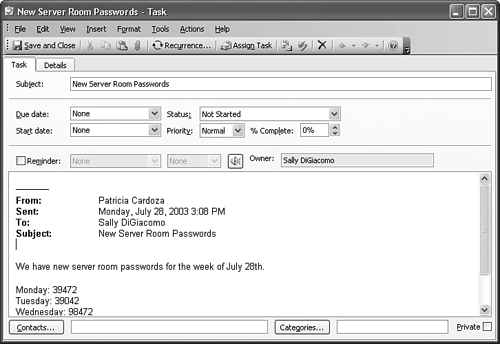
A typical example of using AutoCreate is to create a task from an email message. Drag the email message from your inbox and drop it on the Navigation Pane's Task icon. Figure 14.25 shows a task created using AutoCreate.

Figure 14.25. A task created from an email message inherits the header and body of that email message.

graphics/14fig25.gif

As you can see, the task inherits the subject of the email message, and the entire text of the email, including the header information, is copied to the body of the task. All you need to do is set a start date, due date, priority, and reminder.

You can also create tasks from Calendar entries. This> is often helpful if you have tasks to prepare for an upcoming meeting. You can drag and drop an appointment, meeting, or event from the Calendar folder to the Tasks shortcut on the Navigation Pane or drag the Calendar item directly to the TaskPad in Calendar view. When using AutoCreate for calendar items, Outlook fills in the due date of the newly created task to match the date of the appointment, meeting, or event. Outlook assumes that any task based on a Calendar item must be complete on or before the date of that Calendar item. Outlook also sets a reminder for any task AutoCreated from a Calendar item. The reminder is set for the day the task is due, at your default reminder time.

In addition to using AutoCreate to create tasks from appointments, you can also create appointments directly from tasks. Just drag a task from the TaskPad and drop it on your Calendar. A new appointment is created at the beginning of your workday .

Tasks and Mobile Computing

Personal information managers (PIMs) have steadily grown in popularity over the past several years . Personal digital assistants (PDAs) are available almost everywhere and can be purchased for less than 0. With this technology explosion, many people every day attempt to use electronic tasks to replace paper planners and sticky notes.

There are two main types of PDAs: Pocket PC devices and Palm devices. Both offer the capability to create and manage tasks and both synchronize with Microsoft Outlook through synchronization programs. Pocket PC devices use ActiveSync from Microsoft, and Palm devices use products such as PocketMirror and Palm HotSync Manager.

Complete instructions for creating tasks on mobile devices are beyond the scope of this book, but you need to know a little about task synchronization in Outlook if you plan to use a PDA.

Synchronization is a two-way process. Items created or updated on the mobile device are updated on the desktop computer, and items created or updated on the desktop computer are transferred to the mobile device. An item updated in both places will usually generate a synchronization conflict message. You need to select which item is the most current. That item will then be copied to both the mobile device and the desktop computer.

Only a small amount of the information about a task is transmitted to the mobile device. In the case of a task created on a Pocket PC device, no information from the Details page is transferred. In addition, there's no way of knowing whether a task has been assigned to you or if it's one you created yourself. You cannot assign a task to another individual from a mobile device. You must create the task on the mobile device and synchronize it to your desktop computer. You can then assign the task to another person.

A number of third-party products to help increase productivity are on the market. Many of these products either write directly to your Outlook tasks or mirror Outlook's task functionality.

NOTE

One popular product that's still widely used is Microsoft Team Manager (www.microsoft.com/TeamManager). Even though this product was cancelled in 1997, it's still in use today. Microsoft does not currently support Team Manager, having replaced many of the features with Microsoft Project. If you rely on Team Manager for your business, carefully test its integration with Outlook 2003.


Special Edition Using Microsoft Office Outlook 2003
Authors: Cardoza P. Staples M.
Published year: 2003
Pages: 135-136/426
Buy this book on amazon.com >>

Similar books on Amazon