Chapter Thirteen Closing: Reaching Final Agreement
Thirteen Closing Reaching Final Agreement
Overview
I was asked to speak at a company’s national sales meeting held near Tampa, Florida. I was warned that the president was very strong willed and that I should solicit his input for my speech. I called the company in advance to discuss my participation so that I could better support the theme of the meeting and the president’s message.
Because of the president’s schedule, we had a difficult time meeting before the event, but he agreed to pick me up at the airport on the day of the event so we could have thirty to forty-five minutes to talk during the drive from the airport to the meeting.
After we exchanged pleasantries, I asked him, “What message is important for me to deliver to your salespeople?”
He turned and looked at me, taking his eyes completely off the road, scaring me half to death. He said, “Keith, the one thing they really need help with is closing. They need to learn how to ask for the order and close more sales. I want your message to be close early, close often, and do not take ‘no’ for an answer.”
He concluded his minitirade by hitting his clenched fist against the steering wheel, emphasizing the point, and asked, “Can you do this?”
What should I say to this man? I thought. After all, I don’t believe in the approach he was describing, and that was certainly not what I planned on speaking about. I pondered the question, Do I tell him now, or do I wait? After all, it was very close to the time I had to go onstage and speak. However, being true to myself and true to what I believe in, I looked at him and said, “That’s not my philosophy on closing and that’s not what I had planned on speaking about.”
“What do you mean, that’s not your philosophy on closing?” he said.
I confidently said, “I don’t believe in nor do I teach people to close the way you’re describing.”
“Let me get this straight. You’re a sales consultant and a sales trainer and you don’t teach people how to close?”
Before I could respond, he said, “Why did we fly you down here, agree to pay you a lot of money, and ask you to be our keynote speaker if you’re not going to talk about closing?”
I could tell he was more than a little agitated. I figured I had better start to explain the logic behind my statement before he pulled the car over to the side of the road. I said to him, “I do have every intention of talking to your people about how to successfully close opportunities; however, my focus won’t be on this big event at the end of a sell cycle that everyone refers to as ‘the close.’” He began to calm down. Looking at me with a puzzled grin, he said, “Please continue.”
So I did. I said, “I believe that closing should be the natural evolution of the sales process. If everything is done well throughout the sales process, then the close becomes almost a nonevent. When salespeople have problems closing, it’s usually because of something they did or didn’t do earlier in the sales process.”
He didn’t say anything, but his nodding head provided me the approval I was looking for. Knowing that I had his attention, I continued, “Don’t get me wrong—I’ve been in plenty of negotiations near the end of a sale where closing the deal was a challenge. I think of those situations as hurdles associated with reaching a final agreement. No matter what your sales process looks like or the steps you’ve taken prior to the end of the sale, having to deal with obstacles and hurdles near the end are inevitable. I do plan on sharing thoughts around those types of circumstances with your people today.” A relieved look appeared on his face.
I further explained to him that sales research has verified that there is a direct correlation between the effectiveness of closing techniques and the size of the price of the item being purchased. In other words, the pressure associated with closing techniques works better when the price of the item is low and the impact of the decision on the buyer is not so great. On the other hand, closing techniques appear to be less effective and in fact harmful with expensive and major-impact purchases.
My comments on the research got his attention, because his company developed and sold higher-priced strategic application systems. I then asked, “How do you feel when you know that someone is using a closing technique on you?” He sheepishly said, “I don’t like it.”
The keynote address was a hit. The president hired us to help him implement Solution Selling.
CLOSING MISCONCEPTIONS
There is not a sales book on the market that doesn’t have something to say about closing. There is more written about closing than any other topic related to selling. Yet, with all that has been written and all that has been said about closing, it still comes up as the number one problem facing salespeople.
When I ask sales managers, “What’s the number one skill deficiency of your salespeople?” the most common answer is closing. When I follow up and ask, “What do you mean they have a problem closing?”
The typical response is, “You know, asking for the order, getting the business, doing the deal, making their numbers.”
Most organizations equate salespeople’s results with the skill of closing. The theory goes, if salespeople aren’t making their numbers; they must have a problem with closing. I’ve spent the majority of my professional life working with individuals and companies to improve their sales performance, and I can say without any hesitation that closing, the so-called skill of asking for the order, is not the big problem. Often my clients discover that the real problem with closing is not adequately defining or diagnosing the prospect’s problems in the first place.
CLOSING IS THE NATURAL EVOLUTION OF THE SALES PROCESS
The Solution Selling philosophy on closing is that closing is the natural evolution of the sales process. The best close is to not have to close per se. In other words, when buyers can see themselves solving their problems with the capabilities of your products and services and they realize the negative financial impact of delay, closing comes naturally. If salespeople are having a hard time closing business, it probably means that either they’re not following a proper selling process or they’ve skipped a critical step in the process.
The closing doesn’t start at the end, when you’re asking for the order; it starts at the beginning and continues throughout the sales process. The best way to pinpoint the source of selling difficulties is to implement a clearly defined sales process—a sales process with identified Milestones that salespeople and managers can measure, evaluate, and refine. Emphasis and measurement points within the process include defining the problem, diagnosing the problem, creating the vision of the solution, gaining access to power, exerting control within the buying process, and quantifying value.
Though our goal is to create situations where the buyer wants to buy, this doesn’t mean that you should wait for your sale to close by itself. Using the natural evolution of the process inherent in Solution Selling’s Evaluation Plan means that you provide your buyer with a written plan to follow, and part of that plan includes getting written commitments.
One of my best closing stories comes from an IBM software sales specialist who never wanted to be in sales in the first place. This person was hired to be a systems engineer, and he moved into a sales role due to a business downturn in the early 1990s. I’m sure there are a lot of people reading this book who can relate to not wanting to be in sales.
By following the Solution Selling sales process, this IBM sales specialist was able to secure an agreement with one of his customers worth more than $50 million. In addition, the solution IBM provided the customer helped it gain additional market share valued at more than $2 billion.
So how did he do this? He used an Evaluation Plan similar to the one described in Chapter Twelve. Each step of the plan helped the customer discover the value of the proposed solution. At the end of the evaluation process, the close was simple because the customer wanted to get started. The close was the natural evolution of the process.
CLOSE WITH VALUE
Back in Chapter Four, I introduced the concept of a Value Proposition. Previously, Value Propositions were used as a job aid to help stimulate interest. If you recall, I called it an initial, or preliminary, Value Proposition. By the time of closing, the initial Value Proposition has evolved. It has been researched, possibly refined, validated, and confirmed during the evaluation process. It can now be used to help close the sale, because the numbers in it have been verified—they are the buyer’s numbers. A closing Value Proposition might look like this:
ABC Motors will be able to reduce inventory carrying costs by 20 percent (an annual savings of over $108 million) through the ability to identify car buyer preferences. This will be made possible by employing [your company’s name] Internet-based business intelligence solution. The investment of $2.5 million will provide a ROI of 125 percent in the first year.
Notice the first words, “ABC Motors will be.” In the preliminary Value Proposition, the first words are “We believe ABC Motors.” In the confirmed, final Value Proposition, ownership of the preliminary Value Proposition has been transferred from the salesperson to the buyer. The initial Value Proposition has been researched and validated with the prospective buyer, and it now belongs to it. After all, it’s not important what the salesperson or his company believes is possible. Ultimately, what is important is what the prospective buyer believes.
The closing Value Proposition can only be crafted after the buyer has shared detailed information during the sales process. For example, ABC Motors’s current state of marketing and inventory analysis has been diagnosed. Things like inventory days carried and its costs are known. The projected savings from using the new business intelligence has been researched and confirmed. Since the investment cost is known—$2.5 million—a first-year ROI has even been calculated to be 125 percent. This provides the buyer and her company a compelling reason to act and provides the salesperson with a natural way to close the business.
CLOSING CHALLENGES BUYING AND PROCUREMENT TACTICS
Over the years, I’ve learned many different buying and procurement tactics. Professional buyers and purchasing agents are being taught how to buy, just as professional salespeople are being taught how to sell and increase their productivity. I want to make you aware of some of the more popular ideas out there and provide you with some strategies and techniques to deal with them. After all, no matter how much someone wants to do business with you, it doesn’t mean the buyer is not going to negotiate and make sure he or she gets the best deal possible. A key ingredient in closing is the salesperson’s ability to negotiate and withstand the buyer’s pressure for a lower price and better terms and conditions at the end of the sales cycle.
Smart Buyers
Smart buyers are people who have been trained in procurement procedures and in negotiating. Here are some of the most popular tactics that smart buyers and negotiators are trained to use. Smart buyers
- Never sole source
- Know their positions in advance
- Assign sponsors to each alternative
- Never let you know you’re winning
- Never let you know you’re losing
- Negotiate price in reverse preference order
- Take it away from you at least once
- Are aware of your deadlines
Never Sole Source. This straightforward concept simply means that buyers are taught to never have a single source. They’re told that they will not get the best deal if there’s only one supplier. The goal is to keep as many competitors in the game as long as they can, because the more competitors they have at the end, the better the deal for the buyer. Smart buyers, particularly if an evaluation is complex, will put at least three suppliers through their paces.
Know Their Positions in Advance Smart buyers keep themselves and each member on the buying committee informed. They determine ahead of time what they want to accomplish in any final negotiation. Salespeople tend to have a high opinion of themselves and their negotiation skills, when in fact their skills are often not very good and many times untested. Professional buyers and in particular procurement specialists are trained in negotiations, and they buy things for a living every day. This means they’re more experienced in negotiations than the average salesperson. It’s vitally important to never underestimate the negotiation prowess of smart buyers.
Assign Sponsors to Each Alternative Smart buyers assign a Sponsor to each competitor in the evaluation, keep the assigned Sponsor actively engaged in the evaluation process, and make sure the Sponsor is there at the end of the process. In this way, each competitor is more likely to draw false conclusions, such as he or she is the favored vendor, he or she is the one occupying Column A, the buyer is using the salesperson’s list of buying criteria to solve whatever the problem may be, and his or her assigned sponsor is the Power Sponsor.
Never Let You Know You’re Winning Why would a buyer not let a salesperson know he or she is winning? The answer is so the salesperson will feel pressure to discount and give better terms and conditions. Simple fact: when you’re losing, you tend to try harder. As I previously mentioned, buyers are taught to avoid sole sourcing whenever possible. They need multiple competitors so they can arrange optimal contracts and agreements for themselves.
Never Let You Know You’re Losing Why would a buyer not let a salesperson know he or she is losing? Because the buyer doesn’t want the salesperson to walk. Remember, buyers need competitors in the game as long as possible to ensure the best deal at the end. Most smart salespeople would leave if they knew they were losing. After all, why waste selling resources on hopeless opportunities?
Negotiate Price in Reverse Preference Order This tactic is particularly enlightening for many salespeople. It can also be discouraging if it has ever happened to you and you weren’t aware that it was happening until it was too late.
Buyers are taught first to negotiate with the supplier in last place. They get their best and final offer and use it (assuming it’s a lower price or better terms and conditions) to negotiate with the more favored suppliers.
Buyers are taught to then work up to their favored supplier. They use the lower price and the improved terms and conditions obtained from the column fodder suppliers to negotiate with Column A, the most favored supplier. Using this tactic, the buyer is armed with concessions he or she can use to wrestle the Column A supplier down in price.
This tactic alone is an important enough reason to know the value of what you offer the customer so you can withstand this pressure. Using Power Sponsor Letters and knowing what column you’re in are also important. Don’t waste a lot of time and money chasing rainbows with no pot of gold at the end.
Take It Away from You at Least Once The buyer tells the favored supplier he or she has made the decision to do business with someone else. The buyer may say, “I know you’ve done good work for us, and I’m embarrassed to admit this, but we’ve had budget cuts across the board, and I no longer can spend the amount we agreed on. We’re going to do business with someone else, even though we really don’t want to.” The buyer uses this tactic to make sure he or she is getting the best deal with the preferred supplier.
This tactic is particularly painful and difficult to endure. If the salesperson isn’t aware of what’s going on, it can cause him or her to panic and make unnecessary concessions. Salespeople have to learn to anticipate this tactic. Of course, it’s a lot easier to deal with if you know the competitive landscape, you’ve been able to exert control of the buying process, and you’ve done a good job identifying and proving the value in your offering.
Are Aware of Your Deadlines Smart buyers are well aware of salespeople’s critical deadlines. Month-end, quarter-end, and year-end quotas make them salivate because they know how important those dates are for salespeople. They know if they hold out on one of these critical measurement points, they’re likely to get a better deal.
Although this is difficult to overcome, if you’re above quota, you’ll have the power to walk away. Another simple tactic is not to tell your buyers how badly you need deals to make your quota or special incentive deadlines. Don’t give them negotiating leverage; make them obtain that information on their own.
NEGOTIATING
At negotiation time, in the mind of the buyer, the salesperson is like a washcloth. What do most people do with a washcloth full of water? They wring it out until the water stops dripping. Just to make sure, most people give it that one extra squeeze and then shake it out just to be sure.
In any negotiation, buyers squeeze salespeople until they believe they’re getting the best possible deal. This includes both price and terms and conditions. The sooner the salesperson is willing to draw the line and walk away, the sooner the squeezing stops.
Even though you’ll be negotiating with buyers, I strongly recommend that you remove the word negotiate from your vocabulary. Buyers frequently ask salespeople if an item being discussed is included in the price. If a salesperson responded, “That’s negotiable,” it implies that other buyers have avoided paying extra for it. Again, it’s important that buyers believe they’re getting the best deal possible. If they think something is negotiable and they don’t get it in the deal, it’s very upsetting to them.
SOLUTION SELLING NEGOTIATING PRINCIPLES
If You’re Not Ready to Walk, You’re Not Ready to Sell This means that you have to be able to withstand the pressure and walk away from business you want when your buyer is demanding too much. You may think that’s easier said than done, particularly when you’re below quota. The best advice I can give salespeople is to keep a full pipeline. Having enough other opportunities to work on is the best position a salesperson and his or her company can be in. A full pipeline gives salespeople the strongest position from which to negotiate—the ability to say no.
Don’t Close Before It’s Closeable Don’t get caught pushing a string uphill. Unless your buyer (and your buyer’s negotiator) has the power to buy, the payback (ROI) is agreed to, legal and technical and administrative approvals are in place, the Evaluation Plan is completed, and the costs are known, it is not closeable. Any one of those items can stop a deal from closing. If you can think of a reason why the opportunity is not closeable, you can bet the buyer can too. Reaching the final agreement is hard work for both sides. Buyers want to achieve their objectives, and salespeople want to do the same thing. Each side has an emotional hurdle to clear: the buyer must believe he or she is getting the best deal possible, and the salesperson must be willing to walk away. It’s important for salespeople to know this and plan around both issues.
Plan Before You Begin Negotiations
Ask yourself at least three questions: (1) Is it closeable? This means checking that all technical, legal, and administrative requirements are known and in place. (2) What will you accept? It’s useful to review what you will minimally accept. (3) What are you willing to give? Prepare a Give/Get List, one that analyzes your and the buyer’s positions. The list outlines each party’s interests and priorities. It aids the negotiation process, helps achieve successful outcomes, and helps you look professional. Figure 13.1 is our template for a Give/Get List to help you prepare for negotiating.
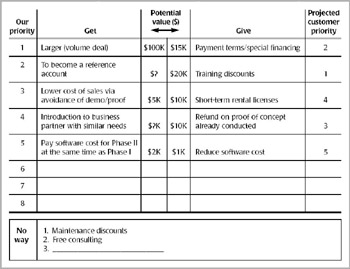
Figure 13.1: Give/Get List—Example
There are four things you want to plan for before you negotiate: (1) what you want to get, (2) what you’re willing to give, (3) what you definitely will not give during the negotiation, and (4) the values behind your gets and gives. You should attempt to associate value with each get and give, as well as determine the ranking of importance for each give to the buyer and each get for you. I think it’s important here to be flexible and try to understand the interests behind the issues to be negotiated. Naturally, each party will try to maximize its own self-interest.
For several years, I dealt with a software buyer who oversaw the implementation of new software applications. His tolerance for risk was very low because he had lived through several failed implementations with other suppliers. Minimizing risk was more important to this buyer than getting the lowest price. I knew that he had a good relationship with one of our implementation specialists, Roger Owens.
Because of the software buyer’s concerns over implementation, I planned ahead before each negotiation with this buyer. I checked into Roger Owens’s schedule to make sure that he would be available when the implementation was scheduled to occur. This is one of the gives that I was preparing to possibly use. I figured that it would be one of the buyer’s interests. I also calculated how many hours of Roger Owens’s time would be required, so that I would be prepared to share the value of his time with the buyer. I developed other gives too, but I ranked implementation risk as the highest priority.
Remember the principle don’t give without getting. Don’t give up something without getting something in return when making concessions. For instance, you might want an earlier close date or to combine multiple phases of the project, or you might want to add to the project and increase the amount of the sale.
Give Reluctantly and Slowly (If Necessary)
This is easier said than done. However, it’s easier if you know the real value your solution brings to the customer. That knowledge is very powerful.
Be Prepared to Resist Buyer Squeezes Anticipate at least four squeezes by the negotiator. In turn, be prepared to make four stands. I suggest that your stands center around four of the five variables in the formula that helps win sales: pain, vision, value, and control (P x V x V x C).
Don’t Give Without Getting I’ve already discussed this, but just as a reminder: get something of equivalent value for what you’re being asked to give up and learn to say, “The only way I can do something for you is if you can do something for me first.” Buyers almost automatically reply, “Like what?” The psychology has changed. Now the salesperson gets to put forth the gets before anything is conceded.
Be Willing to Walk Away In the same way buyers are trained to take away a potential sale from salespeople, salespeople too must learn sometimes to walk away. The better your Value Proposition, the easier it is for you to do this.
For salespeople who are below quota, this isn’t so easy. In such cases, I suggest that sales managers go along and help out. Desperate salespeople can’t negotiate from a position of strength.
Risk Assessment
Risk is a bigger factor in buying decisions and negotiations than most salespeople realize. I know a retired bank CEO whose bank grew past its computer systems capabilities. He was in the market for a mainframe-based system. The bank asked four suppliers to pitch their wares, one of which was IBM. After all was said and done, the bank’s buying committee, chaired by the CEO, ranked the four suppliers and IBM ranked third.
However, the CEO started having nightmares, and it was always the same bad dream: he dreamed of banknotes (what else?), except that the banknotes had legs, and every time he reached for the banknotes, they ran away out of his reach. Then he would wake up. Eventually, he began to wonder what bad thing would happen to him if the winning supplier went bankrupt or important technical personnel changed jobs. To make a long story short, IBM won the contract—not with the best price or the best technology, but with risk management. For the CEO in my story, value was for him personal job risk management.
Find out what is the highest priority in your power buyer’s mind. If you were to flip back to Figure 2.4 (page 24) you’d see Shifting Buyer Concerns. Keep in mind that in Phase III, price is not the most important concern, risk is. So what is the message? As salespeople, we should first recognize that risk is normal, and second, that mitigating it can be one of our strongest negotiating tactics versus focusing on price concessions. Sometimes dropping price can even scare a buyer and throw him or her into further risk.
The Negotiation Worksheet
In Solution Selling, we’ve developed a Negotiation Worksheet to help salespeople anticipate buyer demands and to help them withstand their buyers’ demands for concessions. When I first saw this worksheet being developed, I asked, “Will experienced salespeople use this job aid? Why do they need it?”
The answer to the first question has been a resounding yes. And the answer to the second question is that the deals are too big and too important to wing it. As salespeople, we have good intentions to stand our ground, but in the heat of negotiations, we often lose our intention to battle for our positions. A prepared, written document is harder to dismiss when the going gets tough (see Figure 13.2).
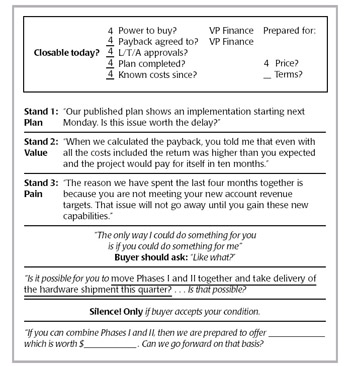
Figure 13.2: Negotiation Worksheet—Example
For example, the dialogue during negotiation could sound something like the following:
Salesperson: Are you ready to sign the contract and get started with this implementation?
Buyer: I am, but I do think you need to come down on price. You don’t expect us to pay full price for software and hardware.
Salesperson: [Using Stand 1: Plan Stand] I don’t understand. Our published plan shows an implementation starting next Monday. Is this issue worth the delay?
Buyer: Look, I don’t want to delay the project, but I don’t pay full price to anyone.
Salesperson: [Using Stand 2: Value Stand] When we calculated the payback, you told me that even with all the costs included, the return was higher than you expected and the project would pay for itself in ten months.
Buyer: We’re now looking at next year’s budgets, and I need to save a little more this year to carry over.
Salesperson: [Using Stand 3: Pain Stand] We’ve spent the last four months together because you’re not meeting your new account revenue targets. That issue will not go away until you gain these new capabilities. Don’t you think solving that problem is well worth the investment?
Buyer: I need you to do something here so I can go back to my committee and tell them I got something out of this negotiation.
Taking stands, or drawing lines in the sand, are psychological messages to the buyer that you’re not giving easily—at least not without getting something of equivalent value in return. It’s important to follow up your stands with a conditional offer.
Salesperson: [Realizing a conditional offer will need to be made] The only way I could do something for you is if you could do something for me.
Buyer: Like what?
Salesperson: [The salesperson’s first Get] Is it possible for you to move Phases I and II of this project together and take delivery of the hardware shipment this quarter?
Buyer: Yes, that’s possible.
Salesperson: [Only if the buyer accepts your conditional offer] If you’ll combine Phases I and II, then we’re prepared to offer two hundred extra implementation support hours of Roger Owens’s time, which is worth $27,000. Can we go forward on that basis?
This dialogue is meant only to give you an introduction to strategies and tactics involved in negotiating. In our example, the salesperson traded services (which usually have lower markups in technology markets) for bottom-line advantages.
In closing (not a pun), when it comes time to reach a final agreement, I encourage you to: (1) Prepare and use Evaluation Plans that incorporate the event of closing. (2) Build a Give/Get List—know what you’re empowered to give, know what you want, and know the values of each. (3) Think through your negotiating stands and your conditional offer. (4) Build strong pipelines—have enough sales opportunities in the pipeline to allow you to negotiate from a position of strength rather than one of weakness.
Part One - Solution Selling Concepts
Part Two - Creating New Opportunities
- Chapter Four Precall Planning and Research
- Chapter Five Stimulating Interest
- Chapter Six Defining Pain or Critical Business Issue
- Chapter Seven Diagnose Before You Prescribe
- Chapter Eight Creating Visions Biased to Your Solution
Part Three - Engaging in Active Opportunities
Part Four - Qualify, Control, Close
- Chapter Eleven Gaining Access to People with Power
- Chapter Twelve Controlling the Buying Process
- Chapter Thirteen Closing: Reaching Final Agreement
Part Five - Managing the Process

EAN: N/A
Pages: 106
