Flylib.com

Books Software


Setting Up a Service Location Policy PackageThe ZENworks Database Policy

Setting Up a Service Location Policy Package—The ZENworks Database Policy

Many of the agents in the system want to record information into the ZENworks database that is installed on your system. The ZENworks for Servers 3 agents record logging and other information directly to the database and do not rely on the SNMP system to record events. For these agents to discover in which database they should place their information, they walk the tree from the object representing the system they are supporting until they find an active ZENworks Database Location policy in an associated Service Location Policy Package, or as far up the tree as their effective Search Policy allows.

The Database Location policy then refers to a ZENworks database object in the directory (which was created at installation time), which in turn contains the DN or the IP address of the server that is supporting the database. The system also uses other information in the database object.

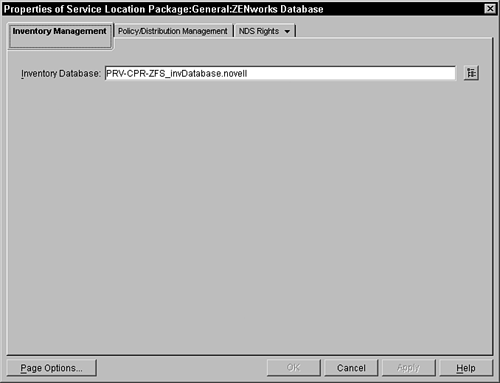
The Database Location page enables you to browse to the database object in the directory that represents the database that you want to use. All policy engines and distributor agents associated with this policy then log information into this database. Figure 5.14 is a snapshot of this page.

Figure 5.14. Database Location page of the Database Location policy in a Service Location Policy Package.

graphics/05fig14.gif

In ZENworks for Desktops 3, only the inventory agent for the server looks for this policy. Other agents must be given this policy through the Distributed Policy Package.

NDS Rights, Other, and Rights to Files and Folders pages are described earlier in the chapter in the "Setting Up a Container Policy Package" section.

To set the Inventory Management database, you must go to the Inventory Management Database tab, click the Browse button to the right of the field, and then browse to and select the database object that you want. This places the DN of the database object into the field.

To set the Policy/Distribution Management database, you must go to the Policy/Distribution Management Database tab, click the Browse button to the right of the field, and then browse to and select the database object that you want. This places the DN of the database object into the field.

NOTE

ZENworks for Servers 3 cannot use the database until a database location policy is set and found by the policy engines and distributor agents. Remember that Service Location Packages can be associated only with containers, not directly with servers or with server groups.


Setting Up the Server Policy Package—The NetWare Set Parameters Policy

This policy is a plural policy, which means that you can create multiple instances of this policy in a single policy package. You create this policy by clicking the Add button at the bottom of the main Server Policy Package screen. When you click the Add button, you are prompted to select a policy and to name the policy. You need to select NetWare Set Parameters for the policy and type a unique policy name .

After you add the policy, you are guided through a wizard to collect potential parameters. Because the set parameters on NetWare are dynamic and can be enhanced by various sets of NLMs, there isn't a known set of set parameters. Consequently, ZENworks for Servers 3 walks you through a wizard that goes to an identified NetWare server (the server must be running the ZENworks for Servers Policy engine) and queries the server for the set of parameters. This list is then transmitted back to the wizard.

To complete the wizard and to administer the policy, follow these steps:

  1. Click the Add button and select the NetWare Set Parameters policy. Give your policy a name and click OK. When you are back at the policy page, select your new policy and click the Properties button. Click the Add button in the Set Commands window to activate the wizard. The Wizard screen appears, as shown in Figure 5.15.

    Figure 5.15. In the ZENworks for Servers Wizard, select server page for set commands in a Service Location Policy Package.

    graphics/05fig15.jpg

  2. Click the Browse button and browse the NDS tree to the server that has a representative set parameter list. Select that server. Click the Next button. This causes the wizard to query the server and retrieve all possible set parameters. The screen shown in Figure 5.16 is displayed with the list of potential parameters.

    Figure 5.16. In ZENworks for Servers Wizard, select parameters for set parameters policy in a Service Location Policy Package.

    graphics/05fig16.jpg

  3. Select the set of parameters that you want to have contained in the policy. You can select an entire category by clicking the check box next to the category, or you can open the category and select individual set parameters. After you select the set of parameters you want to administer the policy, click the Finish button.

  4. You are placed back in the policy with the list of only the categories and/or the parameters that you selected in the wizard. To administer an individual parameter, select the parameter and click the Edit button.

  5. When you click the Edit button, you are presented with a dialog box that is unique for each parameter type. From this dialog box, you may administer the value of the parameter. You may also select one of the following choices: console, autoexec.ncf, and startup.ncf. These choices administer how the parameter is given to the server. Each of these choices is defined as follows :

    • Console . The command is passed to the server console by the policy engine.

    • Autoexec.ncf . In addition to passing the command to the console for immediate activation, the set parameter is placed into the autoexec.ncf file so that, following a reboot, the server sets the parameter.

    • Startup.ncf . In addition to passing the command to the console for immediate activation, the set parameter is placed into the startup.ncf file so that, following a restart, the server sets the parameter.

  6. Complete the list of parameters and click the OK button to apply the policy. The policy engine, on its next refresh cycle, collects this policy and applies it to the servers that are associated with this policy.