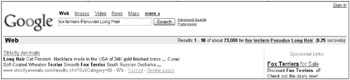
There are times when Google returns far too many results to search by hand. You can go back and create a more focused search by using the Advanced Search page or by using search operators, or you can simply type new search terms that only search within the results of a Google search.
Following a standard Google search, the Search within results link appears at the bottom of the results page. Clicking this link launches a new search page listing the number of results from your previous search, as shown in Figure 2.7.
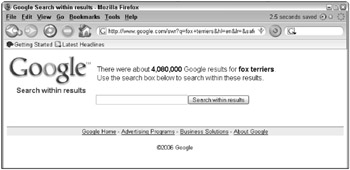
Figure 2.7:
Type new search terms to search within results.
Do not type the search terms you used previously when searching within the results; this does not help to further focus your results. Think of new terms that might help limit the results. For example, in the example shown in Figure 2.7, the number of results for the search
Figure 2.8:
The new query is performed including terms you used in the original search, narrowing the results.
You may notice that when viewing the results of your new search, your original search terms are included in the text box where you type Google search terms. Google simply
Using Search within results saves you a little bit of time by not requiring you to remember or type the original search terms. Try using some of the operators discussed in this chapter when searching within results. This helps you achieve the greatest amount of focus for your search.
For many people, Google search is simply the word or phrase typed into a Google search text box. The power of Google searching far exceeds this simple capability. This chapter showed how you can:
Build focused queries using search operators
Perform special number searches
Look up the definition of words
Find specialized information such as movie guides, financial information and the weather
Perform specialized queries to find similar or past versions of pages
Search through Google services such as Google News, Froogle and Google Groups
Perform advanced page-specific and topic-specific searches
Find U.S. government-
Learn to find information about Linux
Locate information about the BSD operating system
Learn about the Macintosh topic search
Discover the Microsoft special topic search
Add special Google Site Search to your Public Service Web site
Find out about university Web page searching
Find historic news articles in Google’s News Archive
Google has created special topic areas to help focus your searches. At the moment, the number of topics is still small, but we expect it to grow over time. When you do a Google search using these special topic areas, your query is limited to just that topic, which highly refines your search.
Google has simplified the process of finding information in complex areas such as the U.S. government, university Web sites, and topics on the Web where it may be difficult to narrow your search using a normal Web search. For example, Linux, Mac, and Windows are commonly used operating systems. These terms appear on many Web pages not directly
The number of U.S. Government Web pages is staggering. Finding U.S. government information can be difficult. Google makes this simpler by limiting the number of Web pages you may have to look through to find your information by creating a U.S. Government topic search, as shown in Figure 3.1. To take advantage of this enhanced search capability, point your Web browser to www.google.com/ig/usgov.
Figure 3.1:
Locate U.S. government information using the U.S. Government Search.
You will find that the topics listed on the Google U.S. Government Search page include many topics you might not expect to find on a U.S. Government Search page. They are included so you can use this as a type of “Home” page loaded by your Web browser by default.
The topics within the U.S. Government Topic Search page have both an edit link and an X to remove the topic. Click the edit link to set special customizing features. In each of the topics described throughout this chapter, the special edit features are covered in more detail.
If you are wondering about the weather in the nation’s capital or
The edit link features include
_C _F: Allowing you to switch the temperature display between Celsius and Fahrenheit.
Country/Region: Select a country or region from the drop-down list.
Add a city: Type a city, state, or Zip code in this text box and click Add.
Click Save to save your changes or click the cancel link to cancel editing and return to the previous settings.
Most of the other sections are created from news postings. Each of these sections can be removed by clicking the small X across from the section title. The edit link feature allows you to customize how many items are listed in the section. Select a number between 1 and 9; the default is 3. Click Save. New sections can be added by clicking the Add content link at the top left of the page. (See the section “Add Content” for more information.) The default sections include:
American Forces Information Service
White House News
Government Executive
Google News
Washington Post
Clicking the
Add content
link, shown in the
Figure 3.2:
Add Content allows you to customize your U.S. Government Search page.
Each of the sections listed in the menu on the left side of the page is expandable. When the right-facing arrow appears, click the arrow and additional menu items appear, and the arrow changes to a downward-
The sections include
My Stuff: Google Tips, Bookmarks, Gmail, and Stockmarket
Government: White House, Defense and International Relations, Environment, Health, Science & Technology, which includes NASA, DOE, FERC and CERT news, Business, Education & Employment
News: Includes a long list of government-related news sources including Google News.
Business: Financial news sources such as CNN Money and Forbes
Technology:
A number of government-related technology news and information sites including
Sports: Sports sources such as CBS Sportsline and Sports Illustrated
Lifestyle: Includes information from People magazine
Fun: Several fun information sites including “How To” of the Day from wikihow.com, Reuters Oddly Enough, Word of the Day, Ziff Davis 1UP
Create a Section: Make your own sections by including RSS feeds and topic searches. A search box is included to simplify this process.
The Advanced Search features allow you to use all the same advanced features discussed in Chapter 2 except that in the Advanced Search page, you can choose to search only government Web sites, or choose to search the entire Web by clicking the associated search button located in the upper-right portion of the search page.
Searching for information on operating systems and computer companies through Google can be a difficult task because the
Linux is the
Point your Web browser to www.google.com/linux to learn more about Linux, or to search for Linux-related information, use the special Google topic search shown in Figure 3.3.
Figure 3.3:
Find Linux-related information in the Linux topic search.
BSD, the short
Today’s Internet communications are based largely on BSD TCP/IP and BIND communications technology. For more information about BSD history, these technologies, or anything related to BSD, use Google’s special topic search (see Figure 3.4) and point your Web browser to www.google.com/bsd.
Figure 3.4:
Find BSD-related information using the BSD topic search.
The brainchild of Apple’s Steve Jobs, the Macintosh computer was first announced in a single television commercial running on a single station in 1983. This computer became the biggest advancement in home computing and became the standard computer in
Figure 3.5:
Search for Apple Macintosh-related information in the Apple Macintosh topic search.
| Note |
There is no Advanced Search on the Apple Macintosh topic search page. |
It’s difficult to think of computers without thinking of Microsoft and Bill Gates. The history of the Intel-based personal computer is closely linked to the history of its first operating system, DOS, MS-DOS, and later the graphic Windows operating system. For more information about Microsoft, Windows, Office, or the many other things Microsoft is involved in, visit www.google.com/microsoft.html.
The special Google topic search area for Microsoft-related topics is shown in Figure 3.6.
Figure 3.6:
Search for Microsoft-related information in the Microsoft topic search.
| Note |
There is no Advanced Search on the Microsoft topic search page. |