Flylib.com

Books Software


Seeing an Instant Slide Show


Seeing an Instant Slide Show

If you want to see a quick slide show of a collection or currently selected photos in the Organizer, it's pretty much just a two-click process. Later in this book, I show you how to create rich, fully featured slide shows using an entirely different feature of Elements 4.0, but for now we'll just look at how to create a quickie slide show with minimum time and effort.

Step One

SCOTT KELBY

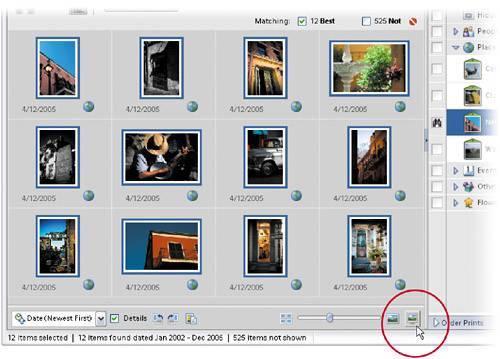
Open the Organizer and make sure the Photo Browser window is active by clicking the Photo Browser button in the top right of the Organizer. Now hold the Control key and click on each photo you want to appear in your slide show (if the photos are contiguous, you can click on the first photo, hold the Shift key, click on the last photo, and all the photos in between will be selected). Once the photos you want are selected, click on the Full Screen View icon (it looks like a little monitor) at the bottom right of the Browser window.

Step Two

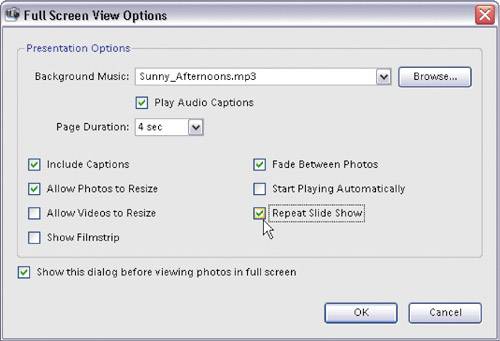
This brings up the Full Screen View Options dialog, which contains presentation options for your slide show. You can choose music that will play during your slide show from the Background Music pop-up menu. You can also choose how long each photo will appear onscreen. By default, it assumes you want any captions included, but you can turn that off by clicking the Include Captions checkbox, and you can also have your slide show loop when it reaches the end by clicking on the Repeat Slide Show checkbox. Now click OK to begin your slide show.

Step Three

Once you click OK, you'll enter Full Screen View mode, where you'll see a floating slide show control palette on the top-left side of your screen. Your slide show won't actually start advancing until you click the Play button (or press the shortcut F5). To stop your slide show from advancing (to pause it), click the Pause button in the control palette (the Play button toggles to the Pause button while the slides are in motion), and then to resume the slide show, just click Pause one more time.

Step Four

Besides the standard Previous, Play, Next, and Pause buttons that appear in the control palette, you'll also see other controls on the right. These extra controls are for comparing still images and are not for use during your slide show. To hide these other controls, click on the tiny left- facing arrow on the far-right side of the control palette and it will collapse down to just display the slide show controls.

Step Five

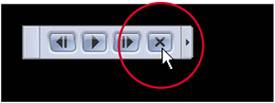
To quit your slide show and return to the Photo Browser, press the Escape key on your keyboard or click the Stop (X) button on the control palette.


Comparing Photos

Let's say you've just shot a bike show, and now you're looking at 14 close-up shots of the prize-winning Harley-Davidson. The Organizer has a great feature that lets you compare two images onscreen (either side by side or one above the other) to help you narrow down your choice to the best possible photo.

Step One

Open the Organizer and make sure the Photo Browser window is active by clicking the Photo Browser button in the top right of the Organizer. To compare (or review) photos side by side, first hold the Control key and click on all the photos you want to compare. Then click the Full Screen View icon at the bottom left of the Photo Browser window (or just press the F11 key on your keyboard). This brings up the Full Screen View Options dialog, which presents options for a slide show. You can ignore those slide show options and just click OK to enter Full Screen View mode, which can be used to compare images.

SCOTT KELBY

Step Two

The photo you selected first will appear in Full Screen View mode, and you'll see a floating control palette at the top-left side of your screen. Click on the Side by Side View button (it looks like two boxes), which puts the first and second photos you selected side by side onscreen. The first photo (on the left) has the number 1 in its upper-left -hand corner, and the second photo (the one being compared) is noted as number 2.

Step Three

Now visually compare these two photos. You'll want the one that looks best to remain onscreen so you can compare other selected photos against it, right? To do that, click on the "bad" photo, and a blue highlight will appear around that photo, indicating that this is the one that will change. In this example, I thought the second photo looked better, so I clicked on photo number 1 (the one on the left).

Step Four

Now go to the control palette, click on the Next Photo button, and the first photo will be replaced with your next photo in that series. Again, review which of these two looks the best, then click on the photo that looks worst (that way, you can replace it with another photo you want to compare). Click the Next Photo button to compare the next photo (and so on). To back up and review a previous photo, click the Previous Photo button in the control palette.

Step Five

Besides this side-by-side mode, there's also an option that lets you see your photos stacked one on top of the other (which you might like for comparing photos in landscape orientation). To change to that mode, click on the down- facing arrow to the immediate right of the Side by Side View button, and from the pop-up menu that appears, choose Above and Below. Cycle through the images as you did beforejust repeat Steps 3 and 4 until you find the photo you like best. When you're finished, press the Escape key on your keyboard or click the Stop (X) button in the control palette.