Microsoft Office PowerPoint 2007 On Demand
Authors: Johnson S.
Published year: 2006
Pages: 20-22/348
Buy this book on amazon.com >>


Arranging Windows

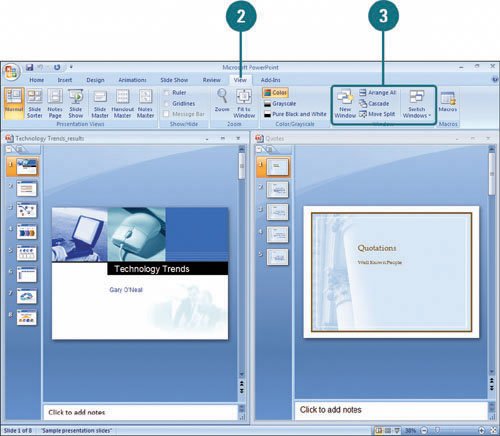
PowerPoint presentations open inside a window, which contains a title bar and a work area. This is where you create and edit your presentations. Most often, you'll probably fill the entire screen with one window. But when you want to move or copy information between programs or documents, it's easier to display several windows at once. You can arrange two or more windows from one program or from different programs on the screen at the same time. However, you must make the window active to work in it. You can also click the document buttons on the taskbar to switch between open documents.

Resize and Move a Window
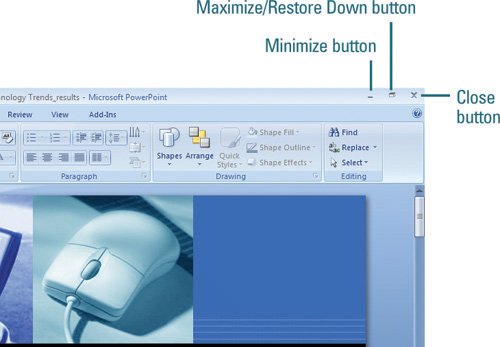
  • Maximize button. Click to make a window fill the entire screen.

  • Restore Down button. Click to reduce a maximized window to a reduced size .

  • Minimize button. Click to shrink a window to a taskbar button. To restore the window to its previous size, click the taskbar button.

  • Close button. Click to shut a window.

Arrange or Switch Between Windows


Open the presentations you want to arrange or switch between.

Click the View tab.

In the Window group , click:

  • Switch Windows , and then click the presentation name you want.

  • Arrange All to fit the windows on the screen.

  • Cascade Windows to arrange windows diagonally.

  • New Window to open a new window containing a view of the current presentation.


Using Task Panes and Window Panes

Task panes are separate windows that appear when you need them, such as Document Recovery, or when you click a Dialog Box Launcher icon ( New! ), such as Office Clipboard and Clip Art. A task pane displays various options that relate to the current task. Window panes are sections of a window, such as the Slides and Outline pane and Notes pane in Normal view. If you need a larger work area, you can use the Close button in the upper-right corner of the pane to close a task or window pane, or move a border edge (for task panes) or splitter (for window panes) ( New! ) to resize it.

Work with Task and Window Panes

  • Open a Task Pane. It appears when you need it or when you click a Dialog Box Launcher icon.

  • Close a Task or Window Pane. Click the Close button in upper-right corner of the pane.

  • Resize a Task Pane. Point to the Task Pane border edge until the pointer changes to double arrows, then drag the edge to resize it.

  • Resize a Window Pane. Point to the window pane border bar until the pointer changes to a double bar with arrows, then drag the edge to resize it.

    Important

    To open the Slides and Outline pane after you close it, drag the border edge near the left edge of the PowerPoint window to the right .


Did You Know?

You can resize window panes using the keyboard. Click the View tab, click the Move Split button ( New! ) in the Window group , use the arrow keys to move the splitters and then press Enter to return to the document.


Understanding PowerPoint Views

To help you during all phases of developing a presentation, PowerPoint provides three different views: Normal, Slide Sorter, and Slide Show. You can switch from one view to another by clicking a view button located on the Status bar or by using the buttons in the Presentation Views group on the View tab. In any view, you can use the Zoom feature on the Status bar to increase and decrease the page view size and display the slide to fit the screen.

Normal view

Use the Normal view to work with the three underlying elements of a presentationthe outline, slide, and noteseach in its own pane. These panes provide an overview of your presentation and let you work on all of its parts . You can adjust the size of the panes by dragging the pane borders. You can use the Outline pane to develop and organize your presentation's content. Use the Slide pane to add text, graphics, movies, sounds, and hyperlinks to individual slides, and the Notes pane to add speaker notes or notes you want to share with your audience.

Outline pane

Use the Outline pane in Normal view to develop your presentation's content. Individual slides are numbered and a slide icon appears for each slide.

Slides pane

Use the Slides pane in Normal view to preview each slide. Click the slide you want to view. You can also move through your slides using the scroll bars or the Previous Slide and Next Slide buttons. When you drag the scroll box up or down on the vertical scroll bar, a label appears that indicates which slide will be displayed if you release the mouse button.

Slide Sorter view

Use the Slide Sorter view to organize your slides, add actions between slidescalled slide transitionsand apply other effects to your slide show. The Animations tab helps you add slide transitions and control your presentation. When you add a slide transition, you see an icon that indicates an action will take place as one slide replaces another during a show. If you hide a slide, you see an icon that indicates the slide will not be shown during the presentation.

Slide Show view

Slide Show view presents your slides one at a time. Use this view when you're ready to rehearse or give your presentation. To move through the slides, click the screen, or press Enter to move through the show.


Microsoft Office PowerPoint 2007 On Demand
Authors: Johnson S.
Published year: 2006
Pages: 20-22/348
Buy this book on amazon.com >>

Similar books on Amazon