Flylib.com

Books Software


Fixing Spelling Errors


Fixing Spelling Errors

Spelling errors are common when creating any sort of text. Regardless of where errors came from, you'll want to catch them in your presentation before it goes in front of an audience.

The text that you copied has a few spelling errors. They were placed there on purpose for this exercise.

1.

Click slide 5 in the slide organizer. Look closely at the text block; words underlined in red are misspelled .

2.

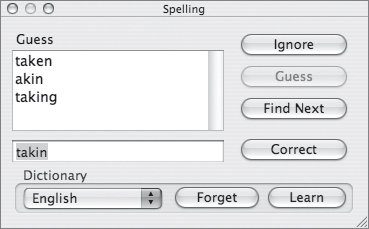
Choose Edit > Spelling > Spelling.

The Spelling window opens. It allows you to browse spelling errors and suggests replacement words.

3.

The first spelling error on slide 5 is "takin." Select "taking" from the Guess list and click Correct.

4.

The next spelling error is "seefood." Select "seafood" from the Guess list and click Correct.

5.

The next highlighted word is "Ripley's." This word is spelled correctly. Click the Ignore button.

6.

The next spelling error is "Maratime." Select "Maritime" from the Guess list and click Correct.

When Keynote finishes checking the active slide, it goes to the next slide in the document that it thinks contains errors.

7.

There are no additional errors in this document, so you can close the Spelling window.

8.

You can check your work by comparing it to 01Presentation1_Stage5.key.


Lesson Review

1.

How do you choose a theme?

2.

Where are master slides located?

3.

How should text be formatted for pasting into the slide organizer when in outline view?

4.

How do you change the functionality of the Inspector window?

5.

How do you activate the Spelling window?

Answers

1.

Themes can be chosen from the Theme Chooser window. This window opens automatically when you create a new document or when you choose File > Choose Theme.

2.

You can access master slides by clicking the Masters button in the toolbar. The available master slides will be shown in the list that appears.

3.

Text that you want to copy from your word processor into Keynote should be saved as a plain text file (.txt).

4.

The inspectors serve many purposes (from graphic editing to object and text alignment). At the top of the Inspector window is a row of buttons that you can use to switch from one inspector to another.

5.

Choose Edit > Spelling > Spelling to open the Spelling window.


Lesson 2. Adding Media to Your Presentation

Lesson Files

Lessons > Lesson 02 > 02Presentation1_Stage1.key


Lessons > Lesson 02 > GarageBand > San Francisco Music Bed. band


Lessons > Lesson 02 > iMovie Project > SF Tourism.iMovieProject, SF Tourism Finished.iMovieProject


Lessons > Lesson 02 > iPhoto Images

Time

This lesson takes approximately 1 hour to complete.

Goals

Understand supported media types


Create an album in iPhoto


Export a GarageBand song


Create an MP3 file in iTunes


Export a video file from iMovie


Optimize a video for playback in Keynote


Add photos, audio, and video from the Media Browser window


Although text is often the most important part of a presentation, it is the supporting media that can truly make a presentation special. Keynote supports a wide variety of media formats, including formats for graphics, sound, and movies. The heart of this graphic support is QuickTime, the versatile media player on your Mac. In fact, if you can open a file in QuickTime, you can use it in Keynote. This great flexibility makes it easy for you to design enhanced presentations.

While Keynote supports several formats, some work better than others. Also, by optimizing your files, you can make your presentation files smaller, allowing smoother playback and easier portability. Fortunately, preparing your files is easyyou have all the tools you need on your Mac by default. By harnessing the friendly, flexible iLife applications, you can get the job done.

Keynote allows you to browse your iLife media libraries.