Chapter 26: Interview: Doug Church
Overview
In an industry increasingly intent on delivering a more cinematic, highly orchestrated, and largely scripted experience to gamers, some developers have continued to buck the trend. These mavericks insist that it is not the game designer alone who should create a game experience, but instead the designer and player in collaboration. By creating games where players make meaningful and complex choices, these designers endeavor to emphasize the interactivity that, among all art forms, only games can provide. It is interesting to note that most of these developers are somehow tied to the history of Boston-based developer Looking Glass Studios, which in the 1990s created a string of uniquely compelling games that were far ahead of their time. One of the original small band of designer/programmers there at the start of Looking Glass, Doug Church was one of the primary design visionaries of the studio. In particular, his three games Ultima Underworld , System Shock , and Thief all pushed the boundaries of what an immersive and systems-based game could be, all while blending in innovative storytelling techniques. Church is that rare designer who has fully abdicated the authorship of the gameplay experience to his players, counting on their creativity to complete the equation that leads to a truly compelling interactive experience.
What was your driving motivation to get into game development?
I worked on some little games in college with some friends , and so I was sort of interested in gaming then. I fell in with some friends and started writing some online games on the side, nothing too sophisticated, but it was fun to do little three- to four-person creative projects. My first gig wasn t games, though, it was network simulations. But then when I heard that a friend of a friend was starting a games group , I thought, Well sure, that sounds like more fun. I don t know, driving motivation might be a little strong, but I was definitely into it. And I definitely had been looking for opportunities to do games.
What about game development attracted you to it?
I had always played games. The whole idea of being in an interactive experience is really compelling and the idea to author that and let people try things was always something that seemed cool. I ve always enjoyed reading fiction , and games just seemed like a natural step in some ways. Different in other ways too.
What were the origins of the Ultima Underworld project?
Paul Neurath and Ned Lerner had gone to Wesleyan together, and afterward they did a game called Deep Space for Sir Tech. Then Paul went off and did Space Rogue for Origin and Ned went off and did an early Chuck Yeager for EA, and then he did Car & Driver . Space Rogue had already been half RPG but with a very, very low polygon count 3D flight engine. And so in that same vein he had this idea of doing a dungeon simulator. And so he assembled a little team of four of us in May of 1990, and using some of the assembly code from Car & Driver , some of Paul s old math code, plus a bunch of code we hacked together, we wrote a demo in May, which he then took to CES in June of 1990 to show to Origin. And he said to them, Hey look, we ll do a 3D dungeon simulator; it ll be great. And they basically said, Sure, whatever, tell us when it s done.
So then we kind of worked on it for a year, getting the basic tech going, and then pitched them a couple story concepts. And then the one that one of the other guys and I wrote caught enough that they were comfortable with it as an Ultima , and so we then just went ahead and built that, basically. We only went to Texas twice on that project, once at the ten-month point and once at the sixteen-month point. Warren [Spector] was the third producer on the project, but he was the one who stuck to it. He came in about halfway through the project, and then in the final quarter he started coming up to Boston a lot.
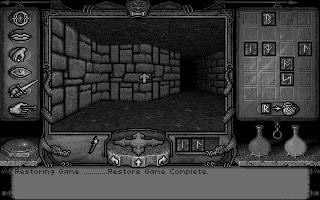
Ultima Underworld: The Stygian Abyss
Origin wasn t overly protective of the Ultima franchise?
Well, the first story that was written, that I didn t write but one of the other guys wrote, was a little too traditional fantasy and not enough Ultima elements, and they said, Well, this doesn t feel very Ultima . Try again. I was a huge Ultima fan, and Dan Schmidt, who was the other guy who wrote the story to Underworld , was maybe not as big an Ultima fan as I was, but still a pretty big fan. So we didn t approach it as what story did we want to write but instead what was a cool Ultima story we could tell. We certainly thought it was fun and interesting, but we were very conscious of how do we write an Ultima story here. We certainly didn t write the best or most amazing Ultima story ever written ” we wrote it in about two days or whatever ” but we were definitely thinking There should be the eight virtues, and it s an Ultima story. And they were basically Well, seems pretty Ultima , go for it.
Ultima Underworld seems to have been pretty ambitious in how it blended genres, combining simulation-style technology with an RPG. How did that come about?
You ve got to give Paul a lot of credit there first off, simply because he had the initial idea. And if you look back at Space Rogue , that was a 2D tile map Ultima- style RPG, but then you d get in your ship and fly around in 3D and shoot pirates or not and shoot cops or not. It was a very early, fairly open -ended story RPG with a space flight 3D element. Which was definitely a very hybrid genre , because the space stuff was pretty glitzy, where there were wormholes where you had to follow these 3D rings through space, and there were battles and trading, and yet there was also this little story-based walk-around the tile map, talk to people, and so on game. So I think it came pretty naturally to Paul.
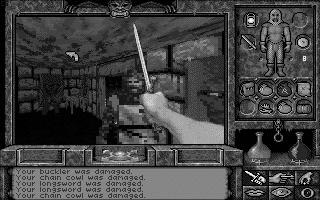
Ultima Underworld II: Labyrinth of Worlds
Of the original guys that were hired , there were a couple of people who had a tiny bit of game experience. One of them we got rid of fairly early because he wasn t appropriate for what we were doing, and then the other two guys we got were friends of mine from school who I recruited. So three of the four of us building the tech and all of us doing the design, none of us had any game experience and we were all twenty. In college in the late 80s the consoles weren t nearly as big a deal. I had actually played Space Rogue because one of my friends had a Mac, but the clusters were all Unix boxes so I ran X-Trek and Net Hack and things, but I hadn t played a PC game in five years or something. So we just said, Let s do a really cool dungeon game in 3D, let s go. It s interesting, because a lot of people talk about how we were doing such a Dungeon Master game, but as far as I know none of us had ever played Dungeon Master. It was a very much Hey, let s go for it. We didn t have any idea that we were doing anything that wasn t just obvious in some sense, because we had no context and the last time any of us had played a game was back when we were fourteen. We played games in college, but they were very different; you re playing networked X-Trek or something, it doesn t feel like a home computer game. For Underworld we wrote four movement systems and we wrote three combat systems, because we d just write something: Oh, this seems cool, let s go for it. We d get it half done, and we d say, Eh? That s not working. Which is nice in a lot of ways; it let us do a lot of things we probably wouldn t have done otherwise . But it also meant that we worked a lot. All the time, basically, for a long time. We spent a lot of time and a lot of energy to make it work.
Given all that, it is pretty impressive it turned out as well as it did.
It was kind of amazing it ever got done. I remember my first thought when I saw it in a store was, Don t they know we re not professionals? We never got a license to do this! If people buy that, they ll realize... It s pretty weird to see your thing shrink-wrapped. It s just very odd, you get that moment of, Wait a second, I guess I just go do what I want to do with my life.
It s interesting. Paul was very day to day at the beginning of the project. Later he got more involved in running Looking Glass, which was Blue Sky at the time, starting up new projects and dealing with business stuff and money and all that. But I have to say he was a huge help at the beginning, just giving us a grounding framework that was very open. He was very good at painting a picture of where to go. He brought this idea of games as this awesome, creative, open thing and you can do all these amazing things, and what do we want to do? And I m not sure it would work right now with an eighty-person for $12 million or whatever we do games for these days, but for three, four people in a tiny rented office space in New Hampshire, most of us twenty years old and not particularly being paid piles of money, it was awesome .
Paul set a very good example by finding the right staff. And a bunch of us had been at school together, so we had that You re in college, and you re an engineer, and you go figure things out. Which, once again, often leads to a lot of thrashing and hard work and trying and retrying . It s sort of like we were always a preproduction team, because at our largest we were five. I knew every line of code, I knew every level, I wrote conversations, I wrote a bunch of the editor. You could hold the whole game in your head and that let you iterate and improvise in a way that s a lot harder now. So I think Paul set a really good agenda of You re a programmer/designer, you ve got to care about creativity, you ve got to get it done, you ve got to know your computer, you ve got to be smart, you ve got to write fast code.... And for the final part of the game when Warren got really involved, not only was he great creatively to help us put finishing touches on it and clean it up and make it real, but he also knew how to finish projects and keep us motivated and on track. He had that ability to say, Guys guys guys, you re focused in totally the wrong place. Working on Underworld II and System Shock with him, when I was project leading more full time, it was nice to have Warren there to say, Hey Warren, here s what I m thinking, I m trying to do this, this, and this... in our weekly phone call, or once a month when he would come down to Boston. His ability to say, Yeah, Doug, I hear all that stuff you re saying, but fifty percent of it you shouldn t even care about now. And twenty-five percent of it will be fine however you go; just pick something. The other twenty-five percent is pretty scary; we re going to need to figure that out. And you know there s this other twenty-five percent you re not even talking about and I don t know why. Tome that s the scary stuff. He had that ability to help me and the rest of the guys reset, from the big-picture view of someone who has done it before and was really creative, but who also understood getting games done. It was a huge, huge win.
So we got really lucky, between Paul andWarren as our two experienced vets. The other programmer who wasn t from the school gang was an ex-Infocom guy who had done a ton of tools programming, and he just said, Hey guys, come in to work and do the work, and get it done. So we had a decent balance early on to learn from, so that we didn t just get obsessed and be college kids flailing forever and trying to be super creative. But we also had enough pushing us that we didn t just try to get the code written as fast as possible and call it done. So we got pretty lucky in the people we had around us to learn from, look up to, and get ideas from.
Was there ever a worry from Origin that the Underworld gameplay was too much of a departure from the previous Ultimas ?
I would say for the first year they didn t really think it was ever going to get done. They didn t pay any attention at all, frankly. We had two producers , one of whom quit without anyone there telling us. We called the switchboard after two months and asked, Hey, we haven t heard from our producer in a while. Oh, he doesn t work here anymore. Awesome. I m sure that s good news for our project. And then the next producer didn t really get it either. I think we were very lucky to find Warren who was like My God, first-person 3D immersive play simulation indoors! This is totally new and amazing! Warren really believed in it. I think we had the advantage that our inventory panel looked very much like an Ultima inventory, and on some level things were just simpler then. There were fewer products and you collected swords and your points went up and you had some skills and, you know, rock and roll! That s somewhat glib, obviously; it was something we worked on for twenty hours a day for two years. Paul had done a couple of games with them, they were busy doing their games, and they thought the demo looked cool, and Oh, you can move around and it s textured! The first demo they saw had no lighting or anything; it was just a very simple wall texture, something that we did in three and a half weeks or something, so it was not exactly the most advanced piece of software ever written. I think they basically thought it was never going to work, it would never be fast enough, or it would never come together. And then, by the time Warren picked it up and got excited about it, we had the play experience already there. You could move around, you could fight, you could swing your weapon, and your stats moved around and that kind of thing. We pitched a couple of stories and they bought into it. And so they said, OK, Warren, why don t you take care of it?
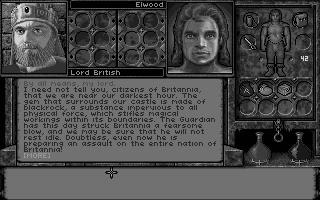
Ultima Underworld II: Labyrinth of Worlds
We had a huge advantage in that even though we were trying to make a hybrid game and we were trying to figure out what a dungeon simulator was, we had all the Ultima -ness of it to fall back on. Sure, we were inventing how to move and how to swing your sword and all that stuff, but at the end of the day it was an Ultima . You talk, you get, you drop, you combine reagents, you use runes. We made up that spell system with the tiles because that worked better, but even there we used the Ultima runes. I was a huge Ultima fan. The first time I got to meet Richard, which was a year into the project, it was awesome. It was like, wow, it s Richard Garriott, rock and roll! I was so excited when I got my Ultima VII beta copy because we were working on an Ultima at the same time. We just really thought Ultimas were cool on some level, and it was cool to be working on it. I think they could tell that: OK, these guys are trying to do the right thing. And the second story we brought was very Ultima , and they were like OK, these guys want to do an Ultima . Once Warren got involved they obviously felt that Warren could help make sure things stayed on track, and it was pretty casual. There s a reason it s called UW, because it wasn t Ultima at first, it was just Underworld . We did a lot of work on our own assuming that that was what it was going to be but knowing we had to prove our mechanics. And then hey, there it was . . .
It seems like Ultima Underworld was very much designed around the technology, instead of the other way around. How did the game design process work?
We d all played Wizardry I . It s not like we had nothing in mind. I had played tons of Bard s Tale 1 when I was in junior high school, and we d played the early, early dungeon games. And we were obviously incredibly conscious of the technology. When you re sitting there timing all your assembler loops and trying to figure stuff out, there you are, right? And it s not like it was fast enough even with all our attempts to make it fast. Game making is a lot different when your programmers are your designers and you have one artist. It s just a very different thing. You re conscious of everything. You run the game, and you hit the hotkey to switch into editor mode and then you attach the trap and oh, the trap doesn t really have the parameter you want. So you exit, change the code, change the parameter, go back in, change the trap, go back into the game, hey that worked, and so on. Because who are you going to talk to about it? Obviously, the three of us who did most of the programming on the second half talked all the time, but even so, we all built levels, we all wrote conversations, we all worked on the editor, we all worked on the game. It s a very different thing. Back then, one person could easily have the whole game in their head. All disciplines, all elements, all content. Maybe not easily, that s probably a little glib, but they can do it. And then five years later you probably couldn t have the whole game in your head but you probably could have a whole discipline in your head, or the story, or how it s structured. And nowadays, if you re a project leader your job is to get the eight or ten managers all seeing vaguely the same thing. Because what you have to do is get those eighty people to all act like they re seeing the same thing. That s hard, because the fact that humans communicate at all is sort of magical , as far as I can tell. And when you re talking about creative collaboration, creative collaboration s really, really hard. I really do think as a project leader these days your job is to Vulcan mind meld your team.
How did System Shock originate? Did you have more of a formalized plan than with Ultima Underworld ?
Probably a little . Underworld II was initially going to ship in February, but then we all tried to pull it in for Christmas. So inevitably we signed off on December 30th with everyone working overtime over Christmas, in that classic, genius game development way. So we shipped that in January, and I actually went down to Origin in Texas for a couple of weeks for that, while the guys were still up in Boston. And finally the final two guys in Boston and I would get on the phone and make sure I had all the new code and modem it back and forth and all that kind of excitement we had back then, reading hex checksums of all the files over the phone to make sure we were building the same thing. There s nothing like, three in the morning, reading off two hundred sets of hex numbers . Awesome, totally awesome. Underworld was at zero bugs for a week and a half, Underworld II actually was at close to zero bugs for a while but there was actually one bug in it that we failed to catch, so we were all embarrassed by that. Back then, your final couple of weeks there really were almost no bugs, you were trying to be at zero bugs for several weeks in a row with no new bugs found. So you had a fair amount of time, and you d try to play your game to break it, but really, with your own game, there s only so many hours you can spend a day playing it before you completely burn out. So we started talking then about doing an immersive simulation game but taking it out of the fantasy space. We talked a little bit about going modern versus going sci-fi, but the only problem with going modern is it will just beg so many questions: why can t I pick up the phone, why can t I get on the train, and so on. So we did a bunch of talking, and we probably did three or four high-level designs for sci-fi games.
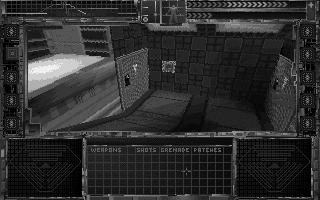
System Shock
Do you mean you and Warren?
MostlyWarren and I, but Paul Neurath back in Boston along with Austin Grossman who was one of the writer/designer guys on Underworld II . So we all bounced some ideas around, and I think Paul came down for a couple of days, and then Paul and I came back up to Boston, and Paul, Austin, and I bounced some ideas around and came up with a couple of little meta-settings. The abandoned spaceship or the abandoned moon base kind of things. And frankly the most important thing that came out of all of that was
Austin, Warren, Paul, and I wrote up a bunch of minutes of gameplay. Just sort of Here s what a minute of playing this game is going to feel like. You know, You hear the sound of a security camera swiveling, and then the beep of it acquiring you as a target, so you duck behind the crate and then you hear the door open so you throw a grenade and run out of the way... We had a couple of little docs like that which Austin and I took and revised. And in a lot of ways those became the game design. Obviously we put real story around it and all that kind of thing. So that was pretty important for Shock .
We kind of wanted to do something different with it. Underworld was designed by a screenshot that Doug Wike had done with Paul before Paul even hired any programmers. Doug was the artist who had worked on Paul s older games and had worked at Origin. Doug was the main artist on Underworld . A guy named Carol Angell also did a bunch of work in the second half of the project, but Doug was there at the beginning, and he did this screenshot, which was a screen layout and a little twenty-frame animation of an orc walking down the hall at you and you swinging your sword. On some level, whenever we had a design question on Underworld , we would just pick up that screenshot and go, Well, I guess there s a little ˜lips icon over there, I guess that s how you talk. OK, better write some code. And obviously we had to make a lot of actual design decisions about combat and game mechanics and spells and all that, but you could still come back to that screenshot about how the game was supposed to feel. And so for Shock the minute of gameplay served a very similar purpose.
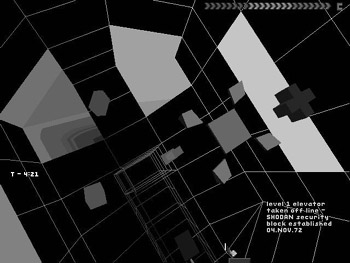
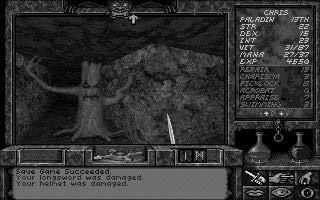
On Underworld we had stats and inventory and talking and movement, and in Shock we really wanted to unify that. I felt that Underworld was sort of three different games you played in parallel. There was the stats-based game with the experience points, the inventory collecting and management game, the 3D moving around game, and there was the talking game, the conversation branch game. And much as the world was very low-fi, it was still way more hi-fi than any of the actual characters were. Branching conversation trees do not represent human interaction very well. Even worse than moving a mouse around represents walking. So for Shock we really wanted to get rid of some of that, and that s why Shock has the full-screen mode with the HUD. Everything was an overlay; the auto-map was an overlay, the inventory was an overlay, and so on.
One of the reasons we wanted all the audio for the voice-overs was because the whole idea of killing everyone on the station and then making all the people only accessible through their data logs was that you could keep playing the game. You wouldn t have to stop to have a conversation or stop to read or stop to choose, you d just be moving around and, if you wanted to, you could listen to a log from the person there and they d be describing a scene that had happened in this very room you were in. We felt that Underworld did a good job of exploring. You explored spaces, and people really remembered the spaces, they talked about them, they d been there. They d say, There was that room where there was that fight between the trolls and the knights and there was all that blood and that s where I did this thing. They had a very visual memory of their exploration, and they had a very clear sense of exploring the inventories and what you could do and pick up. So we wanted to make the plot and the story development of System Shock be an exploration as well, and that s why it s all in the logs and the data, so then it s very tied into your movement through the spaces and to the world. The floppy disk version had only text and no voice-over and should never have been released. I fought against that and lost. The voice version is just so much better because you never have to take your eyes off the world: Here I am and moving around and hearing all this creepy stuff.
So it doesn t interrupt your play experience.
Exactly. It just felt much more integrated. I think in Shock we did do a good job of integrating everything into one piece a little better. The tone of the whole game was a little more consistent, a little more scary and alone, and the systems were much simpler. There were no stats any more. In Underworld , there was all this dice rolling going on off-screen basically, and I ve always felt it was kind of silly. Dice were invented as a way to simulate swinging your sword to see if you hit or miss. So everyone builds computer games where you move around in 3D and swing your sword and hit or miss, and then if you hit you roll some dice to simulate swinging a sword to decide if you hit or miss . How is anyone supposed to understand unless you print the numbers? Which is why I think most of the games that really try to be hard- core RPGs actually print out You rolled a 17! In Warhammer when you get a five percent increase and the next time you roll your attack you make it by three percent, you re all excited because you know that five percent increase is why you hit. In a computer game you have absolutely no idea. And so we really wanted to get rid of all that super- opaque , I have no idea what s going on stuff. We wanted to make it so you can watch and play and it s all happening. So that was really the driving force for Shock . And, as I said, those minutes of gameplay describing this tense experience, with the computer looking for you with security systems and cyborgs. Everything s gone horribly wrong and you re trying to figure it out. Those two or three little documents were the things we referred back to.
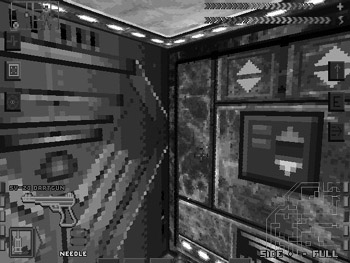
System Shock
It s interesting you used the game minute technique, since that lays out just one way events can take place in a given location. With a game that tries to be as non-linear and player-choice oriented as System Shock , how do you make sure the game minutes don t lead to a very linear experience?
I think you have two things you can do. One is, you do a couple of them, to illustrate some different possibilities, not necessarily for the same room. Actually on the project I m working on now one of the things we re doing is taking a specific scenario and we re doing two or three walk-throughs of it, specifically for that reason. But, even back then, I think the main thing we would do is write it so you would have your character check out the other options in some sense. Your minute of gameplay says, She thought of running for the door, but realized it would be a hard fight. Instead... And you hint at the systems and you hint at the sorts of things that matter. And then you count on setting up a development culture that s all about What else could I do? not Let s go implement this. But I think it s a good point. We re a non-linear medium ” at least I think the best examples of us are usually non-linear ” and yet much as I m sure hypertext is the most wonderful thing ever, it really isn t the solution. A linear medium isn t the solution really either, and so what do you do to express gameplay in a systemsbased world? The reason it s interesting is because it is a simulation and it is open ended, but it s hard to write down that simulation in a doc file. So a lot of it is expressing possibilities and what the player decided to do and making it very clear that they had choices. And a lot of it is doing different examples to express different types of things. But yeah, it s easy to do it wrong, like so many things.
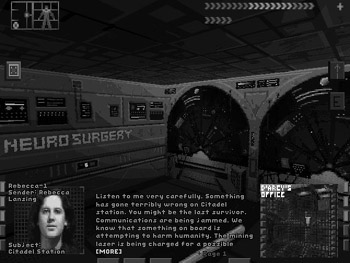
System Shock
It seems like you designed System Shock around how you could tell a story better than in Ultima Underworld . Was improving your storytelling one of your primary goals?
I think we obviously always cared about story ” we were definitely interested in fantasy/sci-fi possibilities. On some level I think we stumbled into a nice villain, in the fact that the villain could speak to you from anywhere and set these ambushes up and actually affect your game. One thing that worked really well that we didn t understand at the beginning but that we learned to somewhat take advantage of by the end was that having the computer and the station be the enemy meant that on some level you could interact with your nemesis fairly regularly and fairly often in non-final ways. You had a recurring, consistent, palpable enemy, who mattered to you because she could lock doors or sabotage you. And that helped the story a lot. The voice-over was nice, especially when you actually had audio as opposed to text, for the logs, because you could put in Foley and all that stuff, and I think that s a huge part of what makes the game work. I don t think the floppy version works nearly as well, because rather than just reading the text you re hearing the explosions in the background and the desperation in someone s voice. There s a lot of text in that game ” it s not short on story. But even so, it s not like every room you go into you re in this endless conversation you have to walk back and forth through. We were forced to tell this story and boil it down into bite-sized chunks . And there are some that are too long; we didn t catch all of them. But the bite- sized chunks meant that we had to make them a little more digestible. And that s not why we did logs, we didn t do logs to say Hey, let s have all these little bite- size pieces of story so you don t get overwhelmed but you feel like you re really putting the mystery together and it all ties together and we can have great Foley to make it seem more emotional and blah blah blah. But at the end of the day that s kind of what it did. And that was a huge help. I don t think the story itself is so awesome or spectacularly outrageous . I mean, it s fine, but I don t think if you wrote the novel it would fly off the shelves .
It s the way it was told.
I think the bite-sized chunks plus the Foley and ambience plus the continual pervasive enemy. Even when you weren t interacting with Shodan, you d see a security camera you had to take out. All those little actions become part of the story in some sense. And the fact that you re exploring the story as opposed to having the story force fed to you, I think was a huge help as well. The fact that it s not You have to talk to me now. Instead you pick up this log but maybe you don t read it right away or maybe you want to think back on something so you can go back and bring the log up again and explore it. It s all smoke and mirrors, but I think it makes the player feel more central. And I think that makes people take more possession of it and feel that it s theirs more.
It seems like System Shock went out of its way to blend different game genres together even more than Ultima Underworld . Was that intentional?
In all honesty I don t think any of us really thought about that stuff very much, which has been something that has always gotten us in trouble. But I think on some level, it was Hey, let s make this game. Obviously, for us, we said, Hey, Underworld was fun but all that conversation stuff was kind of a pain and those stats seemed to be distracting you and all that number and detail stuff. Can t we streamline this a little bit? Can t we make it a little more action and a little more immediate? And that was pretty much it. I don t think we were specifically thinking, Hey, let s do an action-RPG or whatever. I think it was more an evolution of Underworld more than anything else.
Since the first Underworld , Wolfenstein 3D had come out and had become a huge hit with a much more simple, action-oriented experience. Did you guys deliberately try to avoid the visceral shooter gameplay they had staked out?
No, I think we were just doing our own thing, frankly. We knew the id guys and obviously their stuff was awesome ” we all were fans in the sense that we thought it was cool. But by the time Wolf had come out we were pretty much done with Underworld so it wasn t like we were looking at them to get ideas, per se. They were kinda doing their thing and we were kinda doing our thing. I don t know if they respected our stuff or liked it; we certainly respected and liked their stuff. But we weren t like, more of that! We certainly talked about how it was better and faster and cleaner than Underworld , far more than we talked about any other game that was out. That was probably one of our weaknesses at the time, that we were pretty introverted, and pretty much doing our own thing in almost everything we were doing. We were doing Terra Nova , which was obviously a weird hybrid game. And we were doing Flight Unlimited , which in some sense was a weird hybrid game; non-shooting yet non-big commercial flight simulator. We were kinda just doing our own stuff.
So you tried to avoid comparing yourself to whatever else was going on in gaming?
It s not that we didn t play and like other games. We did. And we certainly thought about what we did and didn t like about them, and we certainly talked about games a lot. But I don t remember being in meetings and people saying, Make it more like this other thing. We were kinda just doing the game we thought we should do. And, for good or for bad, that was pretty much in reference to the games we had done already. And obviously we were seeing all the Origin stuff that was in development, and we were sort of influenced by that RPG/story aesthetic that Chris [Roberts], Richard, and Warren had been building up down there.
System Shock , like Ultima Underworld before it, was a pretty non-linear game experience. Was that one of your primary design goals?
I think on both Underworld and Shock , we didn t want to build games where you clear out every square on this level and then you go on to the next level. Underworld had lots of things that would cut you off and you had to come back to later, or at least you should come back to later. For example, now that you ve reached level seven, you re going to have to go back to areas that you couldn t get to before. Both games had their four or five major checkpoints, but we d always believed that player choice was pretty central to what made it fun for people. And that player-centric stuff was what you remember. You remember the clever little thing you did more than you remember some cut-scene. To us, giving players the ability, even if they don t think of it as such, to go their own way is where they re going to be more likely to do something they remember and care about. In Shock we certainly tried to build some systems like upgrades or the security cameras where you had a fair amount of freedom in which order you did it and how you did it, where it wasn t just Go do this sequence of four things. It was Well, there are going to be twelve cameras here and you gotta take out eight of them. Figure it out. We gave you that option of Well, that one seems like a mess or I don t want to fight that guy. OK, maybe I can find another way...
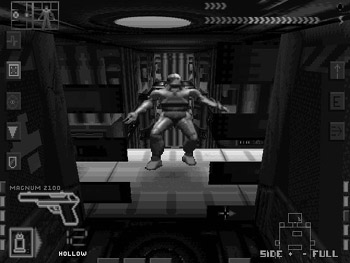
System Shock
I think that was our philosophy of design. We were very state-based as opposed to event-based . We didn t do a very good job on those early games, but we tried to do as many things state-based as we could. Those cameras are a good example. It wasn t a matter of saying, If you ve destroyed these eight cameras in this order, then do this. It was much more a case of When we are in this state, the following thing happens. And that way you give the player ability to get into that state however they want. Obviously back then, with our incredibly remedial physics and so on, there was a limited amount of that we could do, and obviously as we get worlds where you can do more stuff and more interactions that becomes more powerful. But even back then we were thinking about it that way, as much as we could at least.
System Shock seemed to be one of the earliest games of its type to use physics, even in a pretty primitive form.
I think we saw that in Underworld , where we had this incredibly remedial physics but people still had fun throwing things and bouncing the superball around and trying to hit targets with things. And we said, Hey, let s do more of that because worlds have physics. On some level it s still just a dungeon simulator, and we re still just trying to evolve that idea. I really do think System Shock is just the somewhat obvious evolution of Underworld . We rewrote it all for 32 bit with Watcom, as opposed to the old 16-bit stuff, and that gave us some more power and some more possibilities. But philosophically it was a refinement and a focusing of the previous thing.
It always seemed to me like a pretty significant step forward.
I think we certainly were attempting to refine and focus. This was the stuff we thought we d done OK on, which was primarily this idea of exploration, and how much players liked doing their own thing and remembered spaces and places and stories that we told. Some of the best stuff I think in Underworld was where there was no dialog. The story was all told through what was on screen. A lot of people at the time remembered the troll/ knight battle. There was this room where we set up a bunch of debris and decals and objects to make it look like there had been this big fight: skulls , broken swords, and stuff were left all over the place. And you could talk to testers or people at trade shows who had played the game or whatever, and they d say, Man, there was that big fight! And they d tell you about the fight between the trolls and the knights even though we never said anything about it, because they d seen it. So we really thought that the exploration and the visual context was really important to people. So in Shock we really tried to focus on that, to do what we could to come up with other ways to let people explore, and not do so much where we tried to tell them or force them. I thought it worked pretty well. There s obviously stuff one would change in retrospect, like with anything one ever does, but I think we did a decent job of focusing. There s still a lot more focusing to do.
I always thought the idea of having the separate cyberspace mode in System Shock was pretty interesting. What were the motivations behind adding that?
We thought it just fit from a conceptual standpoint: you re a hacker, shouldn t you hack something? We thought it would be fun to throw in a different movement mode that was more free-form, more action. In retrospect we probably should have either cut it or spent more time on it. There is some fun stuff in it, but it s not as polished as it should be. But even so it was nice because it at least reinforced the idea that you were the hacker, in a totally random, arcade-y, broken sort of way. But at least it suggested that you re something other than a guy with a gun. Like I said, we were pretty intro-focused then. We were looking at ourselves and said, Oh, of course we should have cyberspace. We re a cyberpunk game, we gotta have cyberspace. Well, what can we do without too much time? What if we do this crazy thing? Off we went . . .
Though the Looking Glass games did pretty well commercially, they never were massive hits like the id games that came out around the same time, despite using similarly impressive technology. Was the company ever distressed by this?
I don t know about distressed... In general, I think we were doing things which were technically more aggressive . I certainly don t mean to say in any sense we were technically better because it s hard to imagine how one would write an engine that was more efficient or powerful than one of Carmack s engines. And John s an incredibly bright and amazingly talented guy. But if you look at Wolfenstein , it was walls, no lighting, no floors and ceilings, no look up and down, all flat, period, while Underworld had slopes, and lighting, and floor and ceiling textures, and jumping, and little physics stuff, and so on. Now, does that make it a better game? Of course not. It has nothing to do with whether the game is good or not. I think we were trying to do a little more than the machines probably were ready to do or even that we were ready for. I think we were pretty good programmers, but who knows , maybe someone else could have done it a lot faster than we did. The fact that in general most people got to it a couple of years later when the machines could actually do it was probably them being a little smarter about the market, and us being a little dippier. But, A, we were trying to do a little more than we could handle and reach a larger audience, and B, we were into these games that were a little more complicated and required a little more investment. That s just a different thing. Even if we d been using literally identical technology I think it s easier to express what was going on in Wolfenstein or Doom. It s easier to say, Hey, here s what you re doing: you ve got this gun and you have to keep yourself alive with all these crazy things coming after you. Go for it. It s really spooky, it s really fast, it looks great. Awesome. They did a great job. We were a nichier product, we just were.
System Shock
So selling more copies wasn t too much of a concern?
There was some discussion about it: Wow, gosh, it d sure be nice if we were making more money and selling more copies so we can do crazy games of the type we want as opposed to having to worry about how we re going to sell more. Hey, I d love it if the public was more into what I like to do and a little less into slightly more straightforward things. But I totally get that they re into straightforward things. I don t have any divine right to have someone hand me millions of dollars to make a game of whatever I want to do. If the market wanted a bunch more Underworlds , they would have bought them. At some fundamental level, everyone has a wallet, and they vote with it.
Was there ever talk of making your games play more like the id games to make them sell better?
id was doing a great job at doing that game. And more power to them. I think you want to do things that connect with the market and you want to do things that people like and you want to do things that get seen. But you also want to do things you actually believe in and that you personally want to do. Hey, if you re going to work twenty hours a day and not get paid much money, you might as well do something you like. And, I love Mario 64 , and lord knows I m probably not talented enough to build it. But even if I was I wouldn t do it because I love the game and I love playing it, but I have no interest in building it. And we were building the games we were interested in; we had that luxury. We didn t have spectacular success and a huge win, but we had enough success that we got to do some more. And at some level, at least for me, sure I d love to have huge, huge success and be able to take five years and do ten indie games and do whatever the hell I want. But if I get to do another game that I find interesting, that s pretty hard to complain about. People certainly discussed it, it s not like we weren t aware of it. And every so often someone would come in and say, Why don t we just do Doom with this? But as a team I think we were pretty into the stuff we were doing.
Ultima Underworld II: Labyrinth of Worlds
The Flight Unlimited project seemed to be a pretty big departure from what Looking Glass had been doing up to that point.
When Shock finished, Flight and Terra Nova were in development. Most of the Shock team ended up on Flight for a little while to help it ship and then they moved on to Terra Nova and whatever else was going on at the time. Looking Glass was going through this period of trying to do a lot of things at once and sort of overreaching itself and being a little overambitious and a little cocky. The company was trying to establish itself as a publisher at a time when that was very, very hard to do. All the other mid-sized publishers were mostly going out of business or getting bought, while we were trying to branch into new genres and do more things and start up an affiliate label and self-publish Flight and all this other craziness. No one in the management chain of the company really paid any attention to System Shock because Flight was going to be the first self-published product, and fair enough. From a company standpoint, Flight was the product that had to be the hit, because it was the self-published title. Ned and Paul had merged to become Blue Sky Research, which became Looking Glass, and Ned had obviously been into flight simulators, having worked on Chuck Yeager . And Seamus [Blackley] obviously was into the whole flight simulator thing. The company s focus was the attempt to self-publish and get out of the treadmill of waiting for advances and get a chance to get some solidity behind things so one can make forward-looking decisions instead of just focusing on the short term . Obviously it did not work, but it s easy to criticize in retrospect, in that hindsight way. I think there was plenty of clarity up front on some of the mistakes, but some of the mistakes were quite honest and quite reasonable. You look at them and say, Well, yeah, I can see why they did that.
How did the Thief project originate?
We had a bunch of high-concept ideas about game design which, in practice, very few of actually happened in the final game. We had a lot of thoughts about having different factions. As I discussed, we felt that character and conversation were something that was hard, to put it mildly. So we had conceived of factions of people in the world being a better foil for the player because you can interact with a group in a slightly more iconic and abstract way than you can interact with an individual. Because someone can come and say, I speak for these people and we think you re a bad guy or whatever. And they can do that in a way that s a little less personal and direct and therefore has a little less requirement on the AI and conversation engine. It was this idea of having factions who you could ally with or oppose yourself with or do things for or not.
Thief
The other big idea was that these same factions would help you in off-screen ways, because we didn t want to have actual teammates. We didn t want to write AI that you would have to pay attention to and worry about whether they leapt the chasm when you leapt the chasm and all that kind of mess you get when you put a second character in an actually interactive environment as opposed to a big fat plane where you just fight. So, the initial ideas were along those lines, where we set up a couple of game worlds where there were a lot of different factions and you were primarily interacting with them and they had lots of opportunities to help. You d see the evidence of their help, such as an arrow would come shooting in from off screen or something, but we weren t going to have to actually do all the AI work required to do real allies . So we had a couple of designs along those lines. Also, most of the designs we were trying to do were a little more interesting, a little less standard.
You mean in terms of the game fiction?
In terms of fiction and structure. We had a post-ColdWar zombies proposal called Better Red than Undead in which you were fighting off zombies in a communist Cold War era and running around and having different groups ” communist spies and communist government and Western government and all these different spy groups. Meanwhile, the zombies were trying to take everyone over so you had to pick which groups you were going to ally with and go against while everyone had this common enemy of the zombies. But of course no one gets along so you had to play this delicate game of getting everyone on your side or enough people on your side to get the job done.
And then we had this reverse-Arthurian fiction where you were Mordred and your advisor was Morgan le Fey, who was sort of a good person. Lancelot was this evil jerk and Merlin was a time-traveling marketing guy from the future. All the Knights of the Round Table wore jerseys with logos and numbers, and the Holy Grail was this fake thing that they didn t think existed but they were using it as a way to continue to oppress the masses and take all their money and treat them poorly. The excuse was that they needed all the money to go find the Holy Grail and they d just sit around and have parties. So you as the Black Knight had to break into Camelot. And Guinevere was this butch lesbian who would help you by betraying Lancelot because she really hated him and all that sort of thing. Actually our marketing department wasn t really into that one. Not too surprising, I suppose. But we had a bunch of random ideas we were playing around with and we did storyboards and initial setup and stuff.
But they were all still immersive simulation, first-person games?
Yeah, yeah. Once again, in Better Red there were all these spy groups and in Dark Camelot there were all these different groups of outcasts you could work with to try to get into Camelot and mess things up. But as we started worked on some of the Dark Camelot stuff, A, we were having infinite challenges trying to convince anyone it was marketable, and B, the missions that we had the best definition on and the best detail on were all the breaking into Camelot, meeting up with someone, getting a clue, stealing something, whatever. As we did more work in that direction, and those continued to be the missions that we could explain best to other people, it just started going that way. With the faction thing we never got whatever we needed to actually make time to make a prototype. The thing about that is it requires a lot of play mechanics until it starts working, whereas the basic stealth model was something you could kind of get the basic idea of by having the guard looking the other way and you going past pretty quickly. So Paul had been pushing for a while that the thief side of it was the really interesting part and why not you just do a thief game. And as things got more chaotic and more stuff was going on and we were having more issues with how to market the stuff, we just kept focusing in on the thief part. We went through a bunch of different phases of reorganizing the project structure and a bunch of us got sucked on to doing some other project work on Flight and stuff, and there was all this chaos. We said, OK, well, we ve got to get this going and really focus and make a plan. So we put Greg [LoPiccolo] in charge of the project and we agreed we were going to call it Thief and we were going to focus much more. That s when we went from lots of playing around and exploring to Let s make this thief game.
It seems like at the time there were not a lot of other stealth games.
Not that we knew of, at least. Right before we shipped, Tenchu came out in Japan, and I think it came out in the States shortly thereafter. So we certainly looked at Tenchu when it came out, but by that point our game was mostly done other than tuning, and they were much more an action-y arcade game. They were a lot more about killing people in cool ninja ways. Tenchu was a cool game, but it was a different focus than our game.
It s interesting to me that you considered Thief the more bankable game concept, even though its game mechanics were in a lot of ways totally new and original.
I think it was more that we believed in it. I mean, Eidos never really believed in it and until the end told us to put more monsters in the levels and have more fighting and exploring and less stealth and I m not sure there was ever a point they got it. I mean, the trailers Eidos did for Thief were all scenes with people shooting fire arrows at people charging them. So you can derive from that how well they understood or believed in the idea.
Yet they still funded it...
Certainly. If they hadn t done that, we wouldn t have done the game. So very thankful for that. I m not sure we ever got to a point where they said, Oh yeah, this is gonna work. I think they at least had OK, we re selling this anti-hero cynical thief guy, maybe we can do that, in a way that selling reverse Camelot or whatever was just not appealing to anyone.
How did you convince people internally that Thief was promising ?
We got some very early prototypes that were super, super-rough and only tiny bits of that code were used in the shipping game. But that was just guys on patrol, noticing you or not, and you ducking out of the way. And we did do a bunch of mission write-ups for the Dark Camelot stuff, not that we used them in the real game, but we thought, yeah, that would be kinda cool. You d sneak in and do this and this guy would do this, and in the end you could make this happen. I think we had a critical mass of cool little elements. That said, it wasn t until right when we shipped that it all came together into something that worked at all in a way that players might actually want to play as opposed to intellectually this could work way. We had a habit by that point of pulling games that were lots of different elements together so that you had to connect the dots in your mind until near the end, which isn t exactly how the industry likes to work these days.
Would it have been better to be more cohesive earlier?
Well, certainly it would have been great to be more cohesive earlier, though I m not sure what we would have had to sacrifice to do that. Obviously, these days in the industrywe try to get a lot more working early on, but I think that means it s harder to take as many risks. More to the point, it s much harder to do games that require a lot of systems. And in a way that s good because super-overcomplicated games rarely work. But if you do it right I think you can have a lot of systems that work together in a very elegant and transparent way, but that s the kind of thing that s very hard to show right now because you re told, All right, well, before we do any real development, we need a prototype that works, and that means you re only going to be able to do a few new things at a time built upon whatever you did last. I think that makes it very hard to do something as simple as Thief , which is an incredibly focused game, but it still requires light and shadows that work, and shadow detection that works, and AI that can understand shadows, and a speech system so that the AIs can communicate to you about the shadows. It s not rocket science, but it s a lot of stuff. Like I said, we hacked together some stuff at the beginning to give us an idea that, OK, this could probably work, but I m not sure it would have ever convinced a publisher it was going to work; obviously it generally didn t convince Eidos. It convinced them enough to fund it, and hey that s great, but I m not sure that would be true any more. I think the stuff we used back then would be hard to use as proof now. And maybe that means you should have a year of preproduction with a small team where you write tons of stuff, but most publishers aren t thinking that way at the moment. It s more, take an engine, add a couple of features, and then you re safe and can go forward. And that s certainly more stable. I think you want a lot of that, but you certainly don t want all your products to be like that.
Thief
Aside from the publisher side of it, with a truly innovative game, how do you convince the development team the game is going to work and how do you keep them on track with the vision?
Yeah, that s a super hard one. Part of it is you ve got to get a team that s comfortable with the degree of ambiguity. There are some people who are comfortable in that environment and others who aren t. And it s not good or bad in either case; it s just how people are. But I think that s a huge part of it right there, whether you get people who say, OK, that sounds kind of interesting. I m not sure I get it, but I think I get it pretty well so I ll go off and start trying to figure it out. Or whether you get people who say, I m just not seeing that, and I ll have a hard time building it or doing work toward it until I really understand it. So I think the attitude of the people you have is a huge piece of it, and I think that s where minutes of gameplay and storyboards and trying to describe the experience is so important; ways to communicate what you re trying to build before you ve built it. For Thief we had a huge advantage because at the end of the day we could say, well, is it making the character more thief-y? Hmm, that looks like it makes him stronger and brawnier, probably don t need that. Hmm, that looks like it makes him cooler and stealthier, let s do that. Not all games that try to innovate have such an easy focus, but I think that was a crucial part of Thief . You could always go Is the thing I m typing going to make him stealthier?
Did you use game minutes on the project?
Yeah, we definitely did some of that on Thief . Not as much, I think, because we did a couple at the beginning and then it was pretty clear that, OK, we want this idea of guards trying to find you but not if you re hidden in the shadows and not if you re sneaking up behind people and conking them on the head. Once again, the idea of Thief is a lot more transparent than the idea of System Shock . The name System Shock doesn t tell you what the gameplay is like, whereas Thief does. Now that certainly leaves you with a lot of detail to work out and a lot of role-playing where, now if I shot the rope arrow at the ceiling and climbed up, what s the guard going to have to do to react and that kind of thing. There was less of a need to set an overall high-concept direction on Thief because the high concept was so clear. And so Thief was a lot more about mechanics and systems and tuning and what parameters you need to tune, and how will you make it so the guard can detect you and not look stupid but not detect you so well that you never win, and so forth. Whereas on the other games it was more about setting the high-concept goals, not just the low-level goals.
Thief
For a game like Thief , how do you balance the pure systems side of the game with specific scripting?
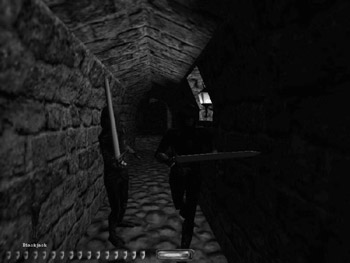
The goal is certainly to minimize the scripting in something like Thief , because not only does the scripting take forever, but it also means that you re likely to have situations where the AI reacts differently in different places, which is the death knell for a game like that because the player can t plan or understand and then nothing is repeatable and then the player is driven insane. So in Thief there were some places that had heavy scripting, but they had more to do with playing out story events: When this happens you re going to have to make these four AIs go over here because story-wise this event happens. So there s some of that scripting but not a lot. We spent a while where we had some fairly sophisticated scripting systems, but it was fairly complicated and really no one but the programmers ever used it. And then Tom Leonard, who was our main AI guy, took the key elements of the scripting stuff you wanted to do with the AIs and built this pseudo-script interface which was this Mad Lib-like Windows dialog where you could say, Oh, on these sort of messages or these sort of events, do these sort of things and go to this object or figure out what s on the other side of this link and go over there or try to grab that thing. And as soon as Tom did that, designers were doing a lot more improvisation and a lot more Oh, I want this specific AI when this alarm goes off to go over here and then say this thing. So they would script a lot of the reacting to major events. That said, the minute-to-minute play was almost all systems-based, where the lead designers would go and decide how the vision cone works and how sensitive the guy was and how likely he was to fight or run for help or whatever. The designers would place some waypoints and say, Well, you should go to the kitchen, and then you should go to the upstairs hall, and then stand around the staircase for a couple of minutes and then go back to the kitchen or whatever. But all the actual moving and detecting and turning and all the detail of the AI and when they detected you and what they do when they did was all pretty much sense systems and generic code.
Did you need to enforce a rule with the design team about how much or how little to script?
I think everyone got it pretty well. Most of the time the scripting was just for the story stuff as I said. I think everyone got the idea that it was going to be systems-y just because it was clear that so much of the game was going to depend on you getting a visceral sense of how the AI behaved so that you could then elude them. And everyone knew that meant they had to be pretty repeatable and systems-based. And so for the designers it was a lot more about building spaces where you had good lines of sight where you could see the AI s path . A lot of that game comes down to how do you get closure moments and how do you get scope.
What do you mean by closure moments?
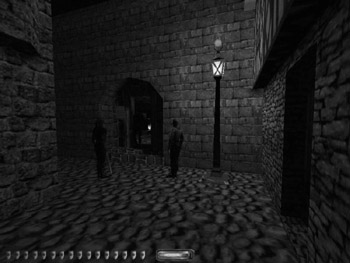
In most games you re killing everyone, so you get nice moments of closure when you win each battle, whereas in Thief you re going past people. Which means all those encounters are open-ended. It s like all the sentences start but they don t end. So a lot of time was spent on how do you get closure from these encounters that didn t really have closure. And a lot of that had to do with building spaces where the player can really see what s going on. If it gets too claustrophobic, the player doesn t really have any idea. In a lot of the early levels the AIs were on these incredibly interesting and complex paths which looked great on the overhead map but when you were playing the game it felt like it might as well be random. Because you d just have no idea what was going on: a guy would show up and then he d be gone and then he d show up some other place and you d forget to hide a body but you d have no idea if someone was going to find it. Because the player only had a very local sense of what was going on, we had to change the scope of the AI behaviors to be very local as well. Otherwise it just felt like randomness. And so a lot of the designers challenge came down to how do you build these spaces that can run in the engine fast enough, which certainly had a whole set of constraints about size and so forth, but at the same time big enough with clear enough line of sight or clear enough iconography. You had to be able to say, Oh, this is that main hallway and it looks just like that other main hallway so I bet the guard s on this rotating patrol through this hallway. OK, I get it. I better go hide the body off the hallway. Ways for the designers to make it possible for the player to make rational plans, given that the player couldn t bring up a radar or switch to the God s eye view and go, Oh, I see. How to keep that first-person immersion of Here I am, what s going to happen without making it so opaque that you might as well flail around randomly and hope you win.
As with your previous games, was having fairly non-linear environments one of your primary design goals?
Yeah, definitely. There s no question that we were always about maximizing the player choice as much as possible and I think that in Underworld in particular we had a lot of watching people do things we hadn t expected or be clever in ways we hadn t expected. Or just watching where a couple of systems would come together in interesting ways. You know, I m being chased by a guy and I run into a locked door and now I have to pick the lock but the guy s behind me trying to shoot me and I finally get through the locked door just as I m about to die but, oh my god, there are enemies in here so I jump in the water and try to swim away but... Just these little sequences that were not scripted or planned out in any way, they were just players in the space improvising. And so in Thief , though obviously it was a much more focused game, we wanted to keep that sense of do whatever you want to do and do it however you want to do it so you can kill people or not, you can try to evade them or take them out, you can use your gear to sneak around or you can go straight in the front. We very consciously wanted to maximize the players ability to do it their own way.
Thief
It s interesting that the systems approach to game design is more rare in the industry. Among its supporters, such as yourself, it seems so clearly the right way to go, yet so few games actually use it.
I think you can point to some examples in the industry. GTA is very systems-based in some ways, so I think there are a couple of examples of people doing systems-based work.
But they re still definitely in the minority.
Oh, I agree. I think there s a couple of things. One, I think it s just generally harder to do, which makes it a risk. I also think it s easy in systems-based games to get distracted by the big things and just build something that s confusing or obscure. And certainly our games, I m proud of them all, but I think there are times we overdid things, in some sense. And also, I think one of the problems with systems-based gaming in general is it s easy to get games that feel very flat. It s very hard to moderate the emotional curve of a systems-based game. We did not do that nearly as well as we should have partially because I think we weren t looking at it that way enough.
What do you mean by moderate the emotional curve?
You know the beauty of a systems-based game is the player can take it as they want. The beauty of a purely scripted, Medal of Honor -style roller coaster is that you re guaranteed players are going to have this intense experience and then they re going to have a little bit of rest and then something really cool is going to happen visually and then there s going to be a challenge. You can build more tension and an emotional arc. In the stupidest sense, you can build more of a random reinforcement schedule for the player that gets them hooked and makes them feel that they re getting this tense entertainment experience. And I think in systems-based games it s easy to end up with a lot of systems that are kind of interesting but a little cold or a little flat. It s easy to end up playing a game that doesn t have that many highs or lows.
When you get the memorable moment in a systems-based game it s usually much more powerful, because it s something that you did on your own. I think players really do remember things that they did more than they remember things that we write. I think when you talk to players about their game experience, the things they remember are mostly the clever thing they did or the cool way they approached a problem or the amazing thing that they didn t think was going to work but that they pulled out at the last second. They don t tell you about Oh, in the thirty-seventh cut-scene, the guy on the right was really cool because he had spiky hair and a cool shirt on. He was my fave. Even the plot twists ; they have that emotional moment of Oh wow, I never would have guessed, and then they forget about it because it s passive. And gaming s an active media.
I think moving forward for the people who care about systems-based work, we ve got to figure out how to get some of the emotional pacing and strong emotional reactions and so on that a scripted game has while keeping the player freedom and player choice that a pure systems-based game has. There s a lot from the scripted and more pre- constructed experiences that the systems people needs to think about and understand how you do. That said, personally I find the systems stuff more interesting because I do think it s more about the player and if you want to write novels or movies, why do them in a game? There certainly is an appeal to playing through the movie experience. Even just having a combat system that lets you turn the pages of the book is kind of interesting and does make you invest a little more and certainly brings something that either one by itself does not. Tekken by itself or a book by itself are different experiences than a book where you have to play Tekken every so often to turn the page, which is what a lot of story/fighting scripted games are. There s nothing wrong with those games, I think they re fine, I like some of them. I just think that in gaming we can do more than that.
So you think emotional pacing is the key to why pure systems-based games haven t been as commercially successful as more scripted games?
I don t know if that s the only key, but I think that s certainly part of it. I think for us in particular we ve always built games that were a little harder to get into or we didn t do a good job on selling players on the fantasy and why they wanted it. We haven t done a great job on our ramp-up at the beginning of getting the players involved in an elegant way in terms of telling them why they want it and in terms of telling them how to do it. It s one of those things: how do you show something where the interest is Hey, after you play it for a while you start developing your own style and all of that? When you have two or three minutes of someone s time before they re like Yeah, whatever.
Thief
And I think a big challenge for the games industry is that some of the coolest games are games that take a while to get into. I think the people who are making those games have to think about what to do to make them more accessible so that we don t end up with only games that are fun in the first second. It would be great if every game were fun right away and could clearly distinguish itself from the rest of the market right away. In practice I think we are going to make games that are easy to get into and I think almost everything will get to the point where people can just pick it up and play it and have fun. The question then is how you distinguish which has more depth and if that is the depth that you as a player are interested in. And that s where at the moment as an industry we have no real way of communicating any of that. If it was five dollars a game, who would care? You d just pick it up because it sounded interesting and you d see if you like it. But at fifty dollars a pop, we have a bit of the McDonald s syndrome where people say, I ll go to McDonald s because I know what it tastes like even though maybe it s not the best food in town, but I don t have to risk seeing if that sub place on the corner is any good. We get some of that in our industry, where it s Well, that sounds interesting, but I don t know. I ll just go buy that game I know about already where I know exactly what it is and I won t be disappointed. The answer is changing. Fifteen years ago something like Underworld sold pretty well but it was selling to a very different market than the console market. People were going into that with expectations about role-playing and how much time they were going to have to invest to get a handle on it. Whereas now there are still some games like that but in general most people are thinking more about entertainment and a little less about a challenging mechanic .
I ve always thought it was pretty impressive that Looking Glass had such a good success rate with some pretty innovative titles.
It s kind of weird. The thing about Looking Glass is that Paul and Ned had obviously done a few games each before, but in a lot of ways the bulk of the company over the years was always new to games. A lot of people were just out of school, even on the design and programming side of it, and there were a lot of people who had an interest in gameplay and game mechanics and hadn t been at a lot of companies. We didn t have much context I guess; we hadn t worked other places. There wasn t anything to compare it to, so it wasn t Hmm, how are we doing and how are those other guys doing? It was more Well, gotta make some more games, let s go!
The fact that you were all so green makes your success even more surprising.
Sort of, except the advantage there is that you have a lot of people who believe they are going to work really hard and make it work. As opposed to Oh, I already know how to do it, we re just going to do it the same way or Oh, that will never work, we don t have time or Oh, it should have sold better so now I m disappointed. Instead it was just Let s go! Which is nice. Projects were smaller, budgets were smaller, which makes it much easier. I m not sure how you get that vibe on a hundred-person team.
Were you sad to see Looking Glass finally go under?
Obviously, yes, in some sense. It had a pretty good run. I left five or six months before Looking Glass went away, and I had a degree of frustration with how things had gone over the last couple of years. And some of the changes, some of them were inevitable I think given the scale the company had grown to. And some of them were probably not inevitable, but hey, they happened, so be it. At some level I had personally been like OK, well, that s over. I obviously wished those guys the best and would have liked them to stay around and continue to do cool things. Certainly when I left I didn t think the company sucked or wasn t cool. I know a lot of people there who I really liked and there were some really good games being worked on. But for me, on some level I had already said this is a cool company but a very different one, and I think ten years is enough and there s enough things that frustrate me that I don t want to be here at the moment. But even so, yeah, obviously Looking Glass was a cool group and a lot of us put a lot of time and energy and a large part of our lives into it and it s sad when that doesn t work out. So there s some part ofme that says, oh that sucks, that s not fair, but it s the real world and it had a pretty good run.
The next thing you worked on was Deus Ex . What was your involvement with that?
I did very, very little, a tiny, tiny amount.
Obviously Warren and I talk all the time so I d seen design docs whenever I was down visiting and I would play the game and give them some feedback. But I was only down there for a couple of months, near the end, where I tried to do a little bit of work in making the AI a little more forgiving . I tried to point out some of the lessons of Thief . I d say, Hey, I don t think you guys should do the same thing we did, but guys on sniper towers fifty meters away shooting you in the back that you ve never seen? Reality yes, fun no. I did a little bit of that, I did some miscellaneous code cleanup, debugging, tried to help out with a couple of the systems a little bit in terms of a few things that hadn t come together or things that were really broken in terms of performance. Obviously the game had some performance problems when it shipped, but we did a little bit of work on that. Mostly I was just down there hanging out and talking with Warren and reporting a ton of bugs and fixing a little bit here and there and trying to improve some things and debug some things. But mostly it was just I ll go hang out with Warren for a couple months and help out with whatever he s working on.
It seemed that, to some extent, Deus Ex popularized a lot of the concepts you had pioneered with System Shock years earlier. How did you think it developed those ideas?
Deus Ex
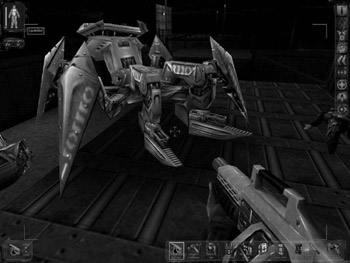
Looking Glass had gone on the focus focus focus track. Get something really deep even if it s narrow, whereas DX was exactly the opposite . It was incredibly broad but incredibly shallow . Tons of scripting, tons of special cases, attempt to do conversation and inventory and other things. And I think the cool side of that is it gave people a lot more epic scale and a lot more possibilities and people who were willing to buy in, there was a lot there. There was a lot to invest in and care about. And fictionally I think they set it in a good timeline that people could get into pretty easily. Starting it out at a destroyed Statue of Liberty was a nice way to set a tone early and connect it to the real world yet give yourself enough freedom to do interesting things. I think they provided a pretty accessible game-space, and they provided enough systems stuff that you could play around but not so much that it was distracting. Personally, I thought maybe it was a little too easy to find yourself poking behind the curtain, a little too easy to go Oh, wait, that wasn t real, I can t really do that. They react to that in this one case but in these other ten cases they re not going to. But I think that s fairly inevitable given the type of game they did. I don t think it s because they did a bad game, I think it s because they took on an incredibly ambitious, hard problem. But I think DX was a pretty cool achievement, definitely. I personally feel that in the long run you re more likely to get to where we want to be ten, twenty years from now by doing a Thief where you make something incredibly focused and small but it works. Then you keep growing and growing and adding to it, until you get the breadth you need but you keep the depth the whole way. Whereas obviously the Deus Ex approach is to get all the breadth right away with none of the depth but then go back and start adding the depth. Is either right?
Whatever, who knows. It s just a different approach, and in practice I m sure twenty years from now is going to look different than any of us expect anyway.
So the next thing you worked on was Frequency . What was your involvement with that?
Greg LoPiccolo was the project leader on Thief and had done the music for System Shock and had been audio director at Looking Glass for a while after that. Greg left to go to Harmonix. And Dan Schmidt had done the music on Underworld II and was project leader on Terra Nova and so on and so forth. Dan was on Thief for three or four months but then decided he d rather be at Harmonix. Dan s double major had been computer science and music and he was a singer /songwriter so Harmonix was a perfect fit for him, and so obviously he was missed at Looking Glass but we all understood why he had gone there. After I d left LG and done some work on DX and was back in Cambridge, obviously Looking Glass wasn t around any more at that point and that was right when the Harmonix guys were beginning to talk to Sony about moving Frequency over to PS2. So I said, Hey, I ve always wanted to write some PS2 code in order to understand the system, so I ll come in and write a little demo of what your game might look like on the PS2 if you ll let me play with your dev kits. And they were all busy doing their PC stuff to hit some milestones and get some stuff working, so I just came in for a month playing around with writing a bunch of PS2 examples, getting up to speed on it, and thinking what would we have to do and so on. And then when they got the deal and decided to go ahead and make it a PS2 game, they asked me, Hey, if you want to stay around and write some code and sit in on design meetings and talk about games, that d be great. Which is awesome. I really like the guys there, they re some of my favorite people in the industry, I think they do really, really interesting stuff. I think they have a pretty strong vision for what they want to accomplish, which is great and which is really different from what other people are doing. And I ve always liked music and music games, so, hey, good time.
I mostly wrote code; I did some graphics work for a while and then I actually wrote all the sound code for Freq , all the low-level IOP sound engine, and then I went to a bunch of design meetings. Obviously the game was fairly well along before I got there, so certainly in no way at all was I one of the main designers on that game. I was a coder who helped out and then sat in on some meetings. I certainly, as I always do, talked a lot about design and suggested things and this, that, and the other, but I was more just a guy hanging out and helping and suggesting some stuff and trying some stuff. I mean, Alex and Greg had a pretty clear idea, Hey, we want this to be about trying to emulate the experience of live performance, with the whole multi-track thing. They had a pretty strong vision for where they were going. The rest of us just did a lot of How do we make that real, and when it doesn t work, what do we do to fix it? and Oh maybe we need to try this other mechanic and that sort of thing.
Working on Frequency must have been a pretty big departure from all of your reality and simulation-based games. Was that a nice change of pace?
Yeah, I m not sure I d want to do it for fifteen years or whatever but it was certainly very interesting to work on essentially an arcade game. To work on something where a game lasts for three minutes and you have a score. One of the biggest differences there was on almost everything else I ve worked on you can work on how you make it easier on the player. Do you make the AIs easier? Do you make the player do more damage? Here you are on Freq and you think, Hmm, the player has no rhythm. What do we do about that? And there s only so much you can do. You can make the windows bigger and you can slow the song down, but at some point either they can hit the notes in sequence or they cannot hit the notes in sequence. So that was interesting, it was definitely very different.
Almost all the games you have worked on have been first-person perspective games. Was that a deliberate design choice for you? Do you think first-person is clearly the best perspective to use?
I think for Underworld it was because we were doing a dungeon simulator and it was OK, well, we re going to take a flight simulator and put it in a dungeon. Hey, guess what, first-person. Going back to the talk about fidelity and how good a conversation system is, five, ten years ago third-person characters looked pretty bad. Maybe a Mario looks awesome because he s iconic, but doing an up close video of a human is not something that the PlayStation 1 or the early PC was very good at. I think that s changing now. I think if you look at Splinter Cell , Thief 3 , and Prince of Persia: The Sands of Time , I think the characters look pretty good. I think we still haven t quite mastered the animation as well as we should, so there s still times where the fact that you re third-person forces things to either look bad or to not allow you to do a move you want to do. And that s still when I personally get the most frustrated with third-person games: I know the only reason I can t do that is because the game doesn t have an animation for it. And I still think in a lot of ways first-person has a lot of very compelling advantages.
Personally I think we re now at the point where graphics and technology mean we can do third-person to a fidelity that makes it worthwhile and really robust, even in realistic games. We ve always been able to do it for platformers or non-realistic games. But I think in realistic games we re getting to the point where the fidelity of the third-person experience is strong enough that it s OK. Thief 3 does a seamless first-third transition whenever you want dynamic. and I think it works pretty well. I think they made that decision a little late in the development process, so I think the third-person stuff s a little dodgier than maybe it should be; if they d known at the beginning they were going to do that I m sure it would look a little better. But even as it is, I think, given the timeline they had, they did a pretty good job of doing a third-person. So I think it s more about whether it lets the player have the experience they want. In something like Thief , in a way it s better because it s that whole fantasy of sneaking around and being in the shadows, which is almost enhanced by being in third-person because you can see all the shadows on yourself. In a weird way you re almost a little more disconnected from your character in first-person in Thief because you re always trying to understand how well hidden you are, which actually kind of hurts the experience, despite the fact that you re first-person and therefore a little more immersed because you re right there. So I think it s game by game and technology by technology. I certainly don t think that first-person should go away and I certainly don t think that first-person is only relevant for shooters, though obviously that s where you mostly see it at the moment. But I certainly think the fidelity and increased quality of third-person means that third-person s a lot easier to integrate into a realistic, systems-based modern game than it was five or ten years ago.
It s interesting to hear you say that, sinceWarren always seemed to be making the choice of doing first-person from a game design and immersion perspective, whereas you were more concerned with the aesthetic consequences.
Well, I think we were saying that first-person lets us do a lot more right now. So we do increase the immersion, but simply because it works better, because if I go to third-person and look at these third-person games I feel like this kind of weird robot. And in first-person it s very natural to look around and interact with things, I don t have to have some weird arm that s trying to motion blend and looks horrible, all that kind of stuff. And as I said I still think that s somewhat true, depending on your game design and whether you can support third or not. But I think if you look at something like Thief where the player only does a limited number of things with the environment and you can do that fairly robustly in third-person, I think in that case you can immerse almost as well if not better in different ways. I personally still think that first-person is pretty exciting and pretty compelling in a way that other modes often aren t. But I don t think it s the only way to get a player fully involved. It s just always hard when you re looking at a character to be the character at the same time. Are you puppeteering or are you the character? And I think that s a weird thing. That s not yet at the point where we understand it so well that we have an answer.
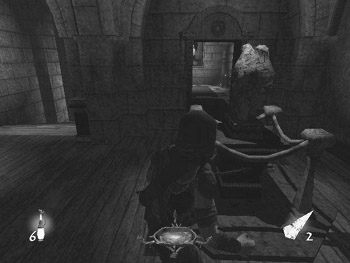
Thief: Deadly Shadows
Despite all your first-person games, you ve always deliberately stayed away from making a shooter, which many seem to find to be the most obvious thing to do with that particular viewpoint. What are your motivations for avoiding it?
I don t dislike them. Personally it s just not all that interesting to me. I don t really play FPSs very much, I mean I do, every couple of years I play something. I played Call of Duty last year, I m sure I ll play Halo 2 and Half-Life 2 this year, assuming they come out. It s not that I dislike them, it s just that they re not what gets me most excited as a creator. It just feels to me that there s a lot of interesting stuff to do that isn t that. In some sense, shooters have ultimate player choice, because they re all about systemsbased damage dealing and damage avoiding. They re incredibly choice based. But on the other hand, that choice is incredibly limited. A role-playing game where I get to decide whether I m the guy who kills people with axes or the guy who kills people with fireballs, that is a choice, but it s just not that compelling to me. So I guess for me I always feel that I ve always tried to think about what can we let the player do that s cool and different and more about their own choices. And it just seems like FPSs are a slightly limited palette for that.
I ve seen you discuss the concept of game developers abdicating authorship to the player. What exactly do you mean by that?
It s basically the same player stuff, in that we re the media where the player can be on stage, and the consumer of the media can be the one that s at the center of the experience. It s not like in a painting you don t bring yourself to the painting, but that s a slightly different experience than being the person moving around. And so when you think about the unique DNA of gaming and the unique things that we can do that other media can t, that idea of empowering the player and making the player the center of the experience is really pretty compelling to me. As I said, when players remember things, a lot of the stuff they remember is the stuff they did, not the stuff they read about. You talk to Miyamoto and he talks about Hey, I started with the controller. And a lot of designers talk about verbs and the interactions and what are we going to let the player do. It s not that you re not authoring an experience ” you re very clearly authoring an experience ” but you re authoring a set of systems which generate an experience with the player. My hope would be that fifteen or twenty years from now that idea of player-centric mechanics is going to be in more of our games. I hope more of our stuff will be clearly a game that wants to be a game and is empowering the player to show off, and less games that are cool because they ve got someone from a movie or the cut-scenes are great or the explosions are extra-special. Not that those things aren t great; hopefully we ll have all that stuff too, but hopefully we ll also have a player that s a little more involved.
Despite your goal to make your games offer players choices, they re almost all focused on physical conflict and players killing something or avoiding getting killed themselves . And certainly the rest of the industry is even more focused on killing and not getting killed. How long to you think until games offer players really more meaningful verbs to work with?
Yeah, I think we re still a ways off though we re making slow, slow progress. Right now the issues are just at some level those are the interactions that are easiest to explain to people and easiest to implement. Those are the emotions that are easiest to be definite about. People don t necessarily want gray or detail, and as I said, the closure moment of killing someone or knocking them off the cliff is pretty clear: Yup, I got my score, OK great, next. Whereas when it s more about negotiating a truce or whatever, it suddenly gets a lot more vague, and I think that s why games are like they are. Twenty years ago, the question was whether the pixel was on or not. Hey, you have one bit, that bit is alive or dead. It doesn t seem like we ve made as much progress as we should have in the last twenty-plus years.
Are you fairly pessimistic about the state of the industry?
Oh yeah, definitely. I find the industry incredibly frustrating, but yet incredibly compelling as well. There s good and bad.
For the last couple of years you ve been fairly involved with the Indie Game Jam, where a bunch of programmer/designer types get together in a central location and crank out a bunch of unique games in three days, without really any regard for commercial viability. Do you see more hope for innovation in game design coming from something independent like that?
It s a couple of things. Part of it is just, hey, it s fun. On one hand those things are cool and do make a statement, but on the other hand it shouldn t be overlooked that part of their value is just a bunch of people getting together and having some fun. There s no real law against that. That said, there s only so much interesting risky stuff one can do in the industry, mysteriously, despite the fact that games now cost five or ten million dollars or more. That seems to constrain us more than it helps us at times. And I think as an industry we ve got to learn how to deal with that. I don t literally think that we re going to do Indie Game Jams and then some year it s suddenly going to revolutionize the industry, and Bing Gordon will go to an EA stock announcement and talk about how, using the model of the Indie Game Jam, EA has restructured North American development. That seems somewhat unlikely . I don t think those things are there to say, Here s exactly what the result was, but I do think hopefully they at least get individuals in the industry thinking Oh yeah, that s cool, or That s really crazy, or Boy, you really could stay up all night for a couple of days in a row and write some crazy little demo. It can remind people about all the stuff that s left to go explore and all the ways you can play around and do little things. Even if they re not shipping commercial products, they can still remind us of why games are cool and remind us of all the things there are still to figure out.
The gaming press is sort of horrifying and marginally relevant at best anyway, but I think if you honestly rated games they d all get a .05 or something. That s not true; there are certainly games that do a pretty good job at giving you a pretty cool experience that is relevant. NBA Street is a fine little street basketball game or whatever. But when you start talking about realistic games or games with characters, I think you right away notice, Well, if that s a 9.6, then what are we going to be doing for the next 100 years? Because I think there s a lot more than .4 left to go. So it s just good to keep an eye on the big picture occasionally and all the craziness that s out there to explore that isn t a street racing game, a thug-based shooting game, or whatever.
In general, you seem to balance your time working on games with being active in the game development community. What s your motivation for that?
I think games are really interesting and I certainly have a lot of opinions about them and some degree of frustration that we haven t done as much as we maybe should have or could have. And I think that as a community we re obviously a much bigger community than we were ten or fifteen years ago but it s still a fairly small group of people, big-picture wise. So I think we have a responsibility to try to understand our media and do interesting stuff. On some level we re clearly a commercial media, fair enough, and at the end of the day either we stay in business or we don t, so that s clearly top concern and I don t see anything wrong with that. But I don t think that s the be-all and end-all. I don t think there s any reason not to also think about what the industry will look like in five or ten years or think about where we could push and try to innovate or think about what s possible. So that we can all keep our eyes on what s out there and stay excited and stay involved. It just seems like the right thing to do.
Doug Church Gameography
Ultima Underworld: The Stygian Abyss , 1992
Ultima Underworld II: Labyrinth of Worlds, 1993
System Shock, 1994
Flight Unlimited , 1995 (Consultant)
Thief, 1998 Deus Ex, 2001 (Consultant)
Frequency, 2001 (Consultant)

EAN: 2147483647
Pages: 189