1.2 Overview
| < Day Day Up > |
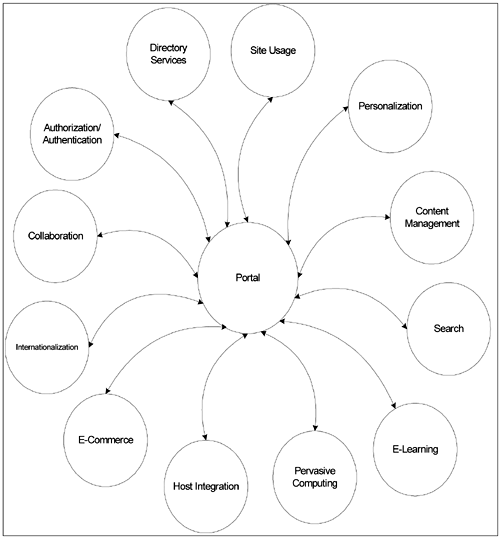
| The primary purpose of implementing an Enterprise portal is to enable a working environment that integrates people, their work, personal activities and supporting processes and technology. Investment in portal technology will remain high amidst economic adjustments. The reason for the sustained growth is that enterprise portals deliver immediate tangible cost savings, enhance productivity, increase efficiency and generates revenue for the clients . Most companies have developed their Business to Consumer (B2C), Business to Business (B2B) and Business to Employee (B2E) strategies. A lot of times, the challenge is to tie them together via a comprehensive strategy that is extendable to employees , business partners and customers. Customers are often faced with issues of integrating with legacy systems. Companies are often faced with the decision of whether to build or to buy. Portal solutions such as IBM WebSphere Portal are proven and shorten the development time. Pre-built adapters and connectors are available so that customers can leverage on the company's existing investment by integrating with the existing legacy systems without re-inventing the wheel. 1.2.1 What is a portal?Portals are the next -generation desktop, delivering e-business applications over the Web to all kinds of client devices. Portals provide site users with a single point of access to multiple types of information and applications. Regardless of where the information resides or what format it is in, a portal aggregates all of the information in a way that is pleasing and relevant to the user . A complete portal solution should provide users with convenient access to everything they need to get their tasks done. 1.2.2 Enablement for portalsA portal represents a comprehensive approach to delivering Web supported tools and enabling services to employees, customers and business partners. A portal enables services that should be available through Web-enabled devices, on a 24x7 basis. Authentication/authorizationAuthentication provides different mechanisms that can be used to validate the identity of all portal users. Authorization determines whether a user has the necessary privilege to request a service. Directory servicesThe Lightweight Directory Access Protocol (LDAP) infrastructure provides a foundation for deploying comprehensive identity management and advanced software architectures such as Web services. Content managementContent management provides a way for the company to manage and leverage the enterprise's intellectual assets. Knowledge assets may include business intelligence and competitive intelligence data. CollaborationCollaboration enables employees, customers and business partners to work with, interact with, and develop or maintain content with others who share activities or interests. SearchThe portal offers a search service that supports distributed, heterogeneous searches across different data sources. Search and indexing allows users to solve problems quickly, since users often need to make ad-hoc queries to gather new information. PersonalizationPersonalization provides the user the ability to establish preferences and profiles. In addition, value-added services for users increase the stickiness of the portal. e-learningA portal can provide just-in-time training and development of skills or expertise for work. It allows the individual to select the time and place of learning activities in their own time. InternationalizationThere is an increasing need for providing globalization. As business is getting more global, workplaces are decentralized, often with thousands of individuals working in shifting locations. Pervasive computingPortal provides access to applications and systems to mobile, remote users at any time and any place. It provides personalized delivery of integrated content through multiple channels: portal, wireless, kiosk, etc. e-commerceMost of the time, the return on investment (ROI) of implementing a portal may accrue through direct savings in self-service as well as reduced transaction costs. Integrating the portal with e-commerce applications can generate revenue and add tangible value that contributes to enterprise competitiveness . Host integrationThese capabilities provide a single point of entry to applications including legacy systems. This allows processes and data from multiple applications through a single workspace. Most of the time, companies have invested substantially in the legacy systems and the investment can be leveraged. Site usageSite analytics provide comprehensive Web site analytics to improve the overall effectiveness of Web initiatives and campaigns and to ensure a high quality, high-availability, error-free Web experience for visitors and customers. 1.2.3 The WebSphere Portal frameworkWebSphere Portal's extensible framework allows the end user to interact with enterprise applications, people, content, and processes. They can personalize and organize their own view of the portal, manage their own profiles, and publish and share documents. WebSphere Portal provides additional services (see Figure 1-2 on page 8) such as Single Sign-On, security, directory services, content management, personalization, search, collaboration, search and taxonomy, support for mobile devices, accessibility support, internationalization, e-learning, integration to applications, and site analytics. Clients can further extend the portal solution to provide host integration and e-commerce. Figure 1-2. Portal context diagram IBM WebSphere Portal provides a single, secure, interactive point of access to dynamic applications, information, people and processes to help build successful Business to Business (B2B), Business to Employee (B2E) and Business to Consumer (B2C) portals. WebSphere Portal:
WebSphere Portal is a framework that lets you plug in new features or extensions called portlets . In the same way that a servlet is an application within a Web server, a portlet is an application within WebSphere Portal. Developing portlets is the most important task in providing a portal that functions as the user's window to information and tasks. Portlets are an encapsulation of content and functionality. They are reusable components that combine Web-based content, application functionality and access to resources. Portlets are assembled into portal pages which, in turn , make up a portal implementation. Portlets are similar to Windows applications in that they present their contents in a window-like display on a portal page. Like a Windows application, the portlet window has a title bar which contains controls, allowing the users to expand (maximize) and shrink (minimize) the application. Portlets function within the Portal framework where Windows applications function in the Windows framework. From the portal user's perspective, a portlet is a window on a portal site which provides access to a specific service or resource. The portal also provides the runtime environment for the portlets that make up the portal implementation. This runtime environment is the portlet container . The portlet container, in the J2EE sense of a container, is responsible for instantiating, invoking and destroying portlets. The portlet container provides the life cyle infrastructure for the portlets. Portlets rely on their container to provide the necessary infrastructure to support a portal environment. The portal infrastructure provides the core sets of services required by the portlets, including:
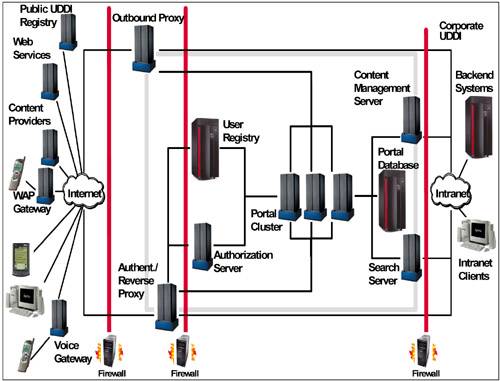
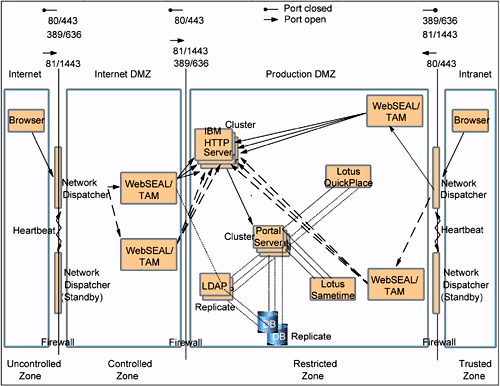
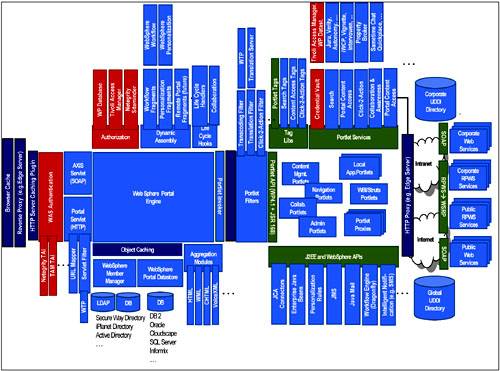
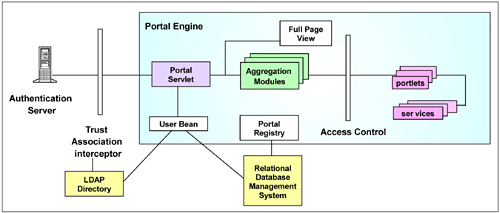
1.2.4 WebSphere Portal architectureThe WebSphere Portal platform is positioned to enhance the WebSphere family of products, providing tooling for aggregating and personalizing Web-based content and making that content available via multiple devices. WebSphere Portal takes advantage of the strong platform provided by WebSphere Applications Server. WebSphere Portal finds its roots in Apache Jetspeed. Jetspeed is an Open Source implementation of an Enterprise Information Portal, using Java and XML. Jetspeed was created to deliver an Open Source Portal that individuals or companies could use and contribute to in an Open (Source) manner. Soon after creation, it became apparent that Jetspeed was going to become an "engine" for Web applications. That, however, was far beyond the scope of the original project. Around that time, there were many discussions on the mailing list that spawned the Turbine project based on technology donated by Jon Stevens/Clear Ink. Turbine is now the Web application framework that Jetspeed shares with many other Web applications. Typical topologyBuilding on the Jetspeed implementation, WebSphere Portal provides an architecture for building and running portal applications. The overall WebSphere Portal Architecture can be seen in Figure 1-5 on page 15. WebSphere Portal provides services for Authentication and Authorization though the WebSphere Member Services. Figure 1-3. Distributed Portal system The core of WebSphere Portal architecture is composed of the Presentation Services, the portal infrastructure, and the portal services. Distributed solutionWebSphere Portal can run in a single, two, three, or n- tier environment. This, combined with the delegation capabilities from WebSphere Portal, provides you with a structured management in a distributed environment. WebSphere Portal can be part of an open, architected, and extensible end-to-end geographically distributed solution. The scalable solution incorporates redundancy with high availability design and is proven for a geographically distributed infrastructure. Additional optional components in the Portal Server architecture include a load balancer (WebSphere Edge Server-Network Dispatcher), integration to intrusion detection, and translation (WebSphere Translation Server) within the Demilitarized Zone (DMZ). Secure demilitarized zone configurationAs shown in Figure 1-4 on page 14 depicted a sample architecture of deploying portal in a multi-tier Demilitarized Zone (DMZ) configuration with high availability. This configuration can be used for an Internet/extranet portal solution. Figure 1-4. High availability portal solution SSL supportIBM WebSphere Portal supports SSL. SSL support for secure transactions is one of the main reasons to use the IBM HTTP Server as part of your Web development process. The SSL encryption system is used on servers to ensure privacy when information is sent across the Internet. An SSL-enabled server enables clients to verify a server's identity, and ensures that information transmitted between client and server remains private. Reverse proxy security serverAs shown in this configuration, Tivoli WebSEAL is used to shield the Web server from unauthorized request for external facing users. This approach is desirable when the Web server may contain sensitive data and direct access to it is not desirable. WebSEAL is a Reverse Proxy Security Server (RPSS) that uses Tivoli Access Manager (TAM) to perform coarse-grained access control to filter out unauthorized requests before they reach the domain firewall. WebSEAL uses Tivoli Access Manager (TAM) to perform access control as illustrated in the diagram. The reverse proxy acts as an authentication gateway node and sits between the browser and the Web servers it protects. It actually acts as a stand-in for these Web servers. The authentication gateway intercepts all requests to the protected resources as well as the responses from the Web servers. To the browser submitting requests, the authentication gateway appears to be the actual Web server, to the Web server responding to requests, the authentication gateway appears to be the client. Load balancingIn this particular example of integrating with WebSEAL, you can configure WebSphere Application Server to use the LDAP user registry, which can be shared with WebSEAL and TAM. Replicated front end WebSEAL provides the portal site with load balancing during periods of heavy traffics and fail over capability. The load balancing mechanism is handled by a Network Dispatcher such as an IBM WebSphere Edge Server. If the Network Dispatcher fails for some reason, the standby Network Dispatcher will continue to provide access to the portal. In our sample configuration, HTTP Servers and Portal Servers are clustered to provide additional redundancy. Directory serviceThe Directory and Security Services provide support for a directory of users accessible through LDAP. These services are used for authentication and can also control and verify the resource access privileges or permissions granted to users. The Directory Server can be replicated to one or more replica LDAP servers to provide redundancy. WebSphere Application Server uses LDAP to perform authentication. The client ID and password are passed from WebSphere Application Server to the LDAP server. Database serviceThe database server component is not accessed directly by portal users or administrators. No application-specific tables are created. Database Server is used by WebSphere Application Server, WebSphere Portal, TAM and Directory Server to store the data they need for their operation. Replication can be turned on on the database server which is used by the portal. Intranet clientsIn this configuration, it is optional to use a separate WebSEAL for the internal users for better performance. Open standardsIBM WebSphere Portal is based on open standards. IBM is leading efforts to standardize the application programming interfaces between portals and other applications. In particular, the Java Community Process (JCP) and the Organization for the Advancement of Structured Information Standards (OASIS) are working cooperatively to standardize the Java and XML technology needed to link portals to disparate applications. OASIS recently announced the formation of the Web Services for Remote Portals (WSRP) Technical Committee. Chaired by IBM, the WSRP committee has the charter to create an XML and Web services standard that will allow the interoperability of visual, user-facing services with portals or other Web applications. Syndicated contentIBM WebSphere Portal provides a framework for pre-built, real-time news and syndicated content portlets from third party vendors such as Financial Times, Pinnacor, YellowBrix, Factiva (Dow Jones and Reuters Company), Moreover, CoreMedia, divine, FatWire, Autonomy, ScreamingMedia, X-Fetch, Atomica, Knowmadic and Quiver, just to name a few. The integration is pre-built and seamless. End users and administrators can easily subscribe to the portlets and customize the preference personally to enhance the user experience. Companies are embracing syndication concepts and standards to automate the publishing of electronic catalogs and other internal information, and to make this information available to workers through enterprise portals. A popular and useful format for syndicated news and entertainment content is Rich Site Summary (RSS). Content can be published directly from the content management system into Rich Site Summary and Open Content Syndication (OCS) channels, where it can easily be displayed by the Portal Server's built-in RSS portlet. This self-syndication concept defines a procedure for editing, managing, and publishing your own sources of content. Logical architectureWebSphere Portal finds its roots in Apache Jetspeed. Jetspeed is an Open Source implementation of an Enterprise Information Portal, using Java and XML. Jetspeed was created to deliver an Open Source Portal that individuals or companies could use and contribute to in an Open (Source) manner. Soon after creation, it became apparent that Jetspeed was going to become an "engine" for Web applications. That, however, was far beyond the scope of the original project. Around that time, there were many discussions on the mailing list that spawned the Turbine project based on technology donated by Jon Stevens/Clear Ink. Turbine is now the Web Application framework that Jetspeed shares with many other Web applications. Building on the Jetspeed implementation, WebSphere Portal provides an architecture for building and running portal applications. WebSphere Portal V5 provides a modular, easily extensible architecture. It is designed as a product that can run stand-alone if required, but allows plugging in alternative implementations for those components that may already be set in customer environments. The main components of the WebSphere Portal V5 architecture are shown in Figure 1-5. The core of WebSphere Portal architecture is composed of the presentation services, the portal infrastructure, and the portal services. Figure 1-5. WebSphere Portal architecture Presentation servicesWebSphere Portal presentation services provide customized and personalized pages for users though aggregation. Page content is aggregated from a variety of sources via content and applications. The portal presentation framework simplifies the development and maintenance of the portal by defining the page structure independent the portlet definition. Portlets can be changed without impact to the overall portal page structure. The Portal engineWebSphere Portal provides a pure Java engine whose main responsibility is to aggregate content from different sources and serve the aggregated content to multiple devices. The Portal engine also provides a framework that allows the presentation layer of the portal to be decoupled from the portlet implementation details. This allows the portlets to be maintained as discrete components. Figure 1-6 shows the WebSphere Portal Engine Components. Figure 1-6. WebSphere Portal engine The Authentication Server is a third-party authentication proxy server that sits in front of the Portal engine. Access to portlets is controlled by checking access rights during page aggregation, page customization, and other access points. The Portal Servlet is the main component of the Portal engine. The portal servlet handles the requests made to the portal. The portal requests are handled in two phases. The first phase allows portals to send event messages between themselves . In the second phase, the appropriate Aggregation Module for the requesting device renders the overall portal page by collecting information from all the portlets on the page and adding standard decorations such as title bars, edit buttons , etc. Portlet containerPortal Services are components WebSphere Portal uses to extend the portal functionality. Key functionality is provided with WebSphere Portal for personalization, search, content management, site analysis, enterprise application integration collaboration and Web services. Portlets can access these services via their container. Portal infrastructureThe WebSphere Portal infrastructure is the framework that provides the internal features of the portal. Functionality such as user and group management via self registration, as well as portal administration, are provided by the Portal infrastructure. User and group managementThe WebSphere Portal infrastructure provides facilities to allow user self management along with enterprise integration with user directories such as LDAP or database structures. Security servicesSince WebSphere Portal runs within the WebSphere Application Server platform, it makes use of the standard Java Security APIs to provide authentication. The WebSphere Portal is configured so that incoming requests pass through an authentication component such as WebSphere Application Server, WebSEAL or other proxy servers. A user's authorization for a particular resource such as page or a portlet is handled by the portal engine. User Beans are provided to allow programmatic access to the User information for use within portlets. Page transformationWebSphere Transcoding Technology is integrated with WebSphere Portal to transform the portal markup produced by WebSphere Portal to markup for additional devices such as mobile phones and PDAs. Portal servicesPortal services are built-in features the WebSphere Portal provides to extend and enhance the full portal solution. These services are provided via the Portlet container as seen in Figure 1-5 on page 15. Among the services are the following:
1.2.5 WebSphere Portal toolingWebSphere Portal and WebSphere Portal Toolkit, along with their prerequisite products, provide the basic tooling for developing and deploying portals and their associated portlets. WebSphere PortalWebSphere Portal contains built-in support for portlet deployment, configuration, administration and communication between portlets. WebSphere Portal provides the framework for building and deploying portals and the portal components, portlets. Portlet content is aggregated by the WebSphere Portal to provide the desired portal implementation. WebSphere Portal makes use of the WebSphere Application Server technology to provide a portal platform. WebSphere Portal ToolkitThe WebSphere Portal Toolkit is provided with WebSphere Portal and provides an environment for developing portal using WebSphere Portal. The WebSphere Portal Toolkit is a plug-in for WebSphere Studio Application Developer (WSAD) or WebSphere Studio Site Developer (WSSD) which adds the portal development environment. The WebSphere Portal Toolkit provides the ability to quickly create complete, MVC-compliant portlet applications. It also provides intuitive editors for working with the deployment descriptors required by your portlet applications. Furthermore, it allows you to dynamically debug your portlet applications. The WebSphere Portal Toolkit is explored in detail in Chapter 3, "Portal Toolkit" on page 125. |
| < Day Day Up > |

EAN: 2147483647
Pages: 148