Flylib.com

Books Software


4.2 The History of Relational Databases

 < Day Day Up > 


4.2 The History of Relational Databases

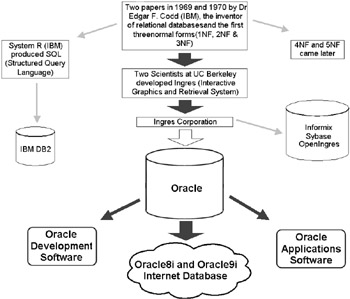
The diagram in Figure 4.6 shows the evolution of relational databases. Notice on the left how SQL was first devised as being a data access language with the development of System R from IBM, used today as SQL or Structured Query Language.
click to expand
Figure 4.6: The Evolution of the Relational Databases

Tip 

Arrows in Figure 4.6 represent both a flow of development and a flow of people and their skills. Oracle Corporation created Oracle software. Ingres Corporation did not create Oracle Database. However, the skills and personnel were passed between the different database vendor software companies. Ingres Corporation is now defunct and owned by Computer Associates.


 < Day Day Up > 
 < Day Day Up > 


4.3 The History of the Oracle Database

Now let's take a more detailed look at the history of the Oracle Database. Examine the diagram in Figure 4.7. Many of the items listed are relevant to tuning Oracle installations. Many items are specifically relevant to SQL code tuning, some physical and configuration tuning, some both.

click to expand
Figure 4.7: The History of Oracle Database

  • Most of the hardware distribution elements such as clustering, client/server, thin client, and multiple- tier environments, using application servers, helped performance with respect to distribution of processing.

  • 4GL and PL/SQL programming tools and languages helped with creation of better, more efficient, and more maintainable source code. It could be said that the easier that code is to write then the more time will be available for tuning. However, in relation to coding of fast-performing C code this theory is probably complete hogwash! Then again planning and coding efficiency may very well be relative to how much time is spent building code. C code development is notoriously slow and complex.

  • Cost-based optimization and statistics helped with SQL code tuning in relation to actual data space utilization. Statistics allows for two aspects of physical tuning. Firstly, better use of space. Statistics help to assess space usage and storage structure from datafiles down to the block-level. Secondly, better analytical information for using in capacity planning. Capacity planning is the process of estimating physical space usage and growth rates.

  • There are a multitude of aspects introduced in both the Oracle8 i Database and Oracle9 i Database, Internet versions of Oracle Database software. These releases helped the performance of modern-day Internet and Intranet database environments.

    Note 

     Oracle Database 10 Grid     Oracle Database 10 g has better performance, scalability, is more highly available, is easier to manage, is better automated, has tighter security, amongst other aspects.


 < Day Day Up > 
 < Day Day Up > 


4.4 The Roots of SQL

Why are we going backwards in time looking at data models and relational databases that are no longer in use? In order to tune SQL code effectively we need to understand the most basic forms of SQL and why newer data modeling techniques are better. In short, database access coding (SQL coding in the case of a relational database) has evolved with data modeling techniques. Object database data access coding has been called ODQL. ODQL stands for Object Definitional Query Language. ODQL was developed for object database access.

SQL in actuality stems from an idea of a reporting language devised in theory by the inventor of the relational database. It is very important to remember that the roots of SQL lie in retrieval of sets of data. In other words, SQL is intended as a language to retrieve many rows from one or many tables at once, as a result set. Retrieval of sets or groups of rows is consistent with the original relational data model. SQL was not originally intended to retrieve individual rows from a relational database as exact row matches. SQL can now be used to do exactly that, and fairly efficiently .

The next chapter is the first chapter in Part II of this book, SQL code tuning. We will begin the process of explaining SQL code tuning by introducing the very basics of SQL. In subsequent chapters of Part II we will progress onto the most fundamental aspects of SQL code tuning, then later to specifics of using and tuning Oracle SQL.


 < Day Day Up >