3.5 Controls Against Program Threats
| < Free Open Study > |
| The picture we have just described is not pretty. There are many ways a program can fail and many ways to turn the underlying faults into security failures. It is of course better to focus on prevention than cure; how do we use controls during software development the specifying, designing, writing, and testing of the programto find and eliminate the sorts of exposures we have discussed? The discipline of software engineering addresses this question more globally, devising approaches to ensure the quality of software. In this book, we provide an overview of several techniques that can prove useful in finding and fixing security flaws. For more depth, we refer you to texts such as Pfleeger's [PFL01] and [PFL01a]. In this section we look at three types of controls : developmental, operating system, and administrative. We discuss each in turn. Developmental ControlsMany controls can be applied during software development to ferret out and fix problems. So let us begin by looking at the nature of development itself, to see what tasks are involved in specifying, designing, building, and testing software. The Nature of Software DevelopmentSoftware development is often considered a solitary effort; a programmer sits with a specification or design and grinds out line after line of code. But in fact, software development is a collaborative effort, involving people with different skill sets who combine their expertise to produce a working product. Development requires people who can
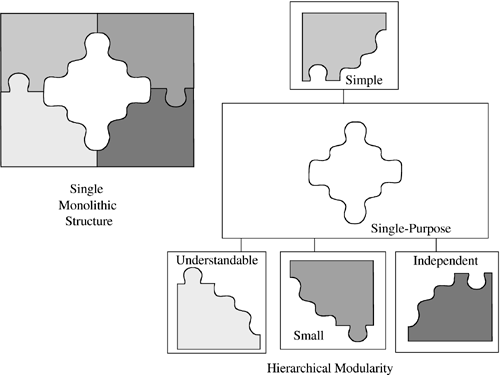
One person could do all these things. But more often than not, a team of developers works together to perform these tasks. Sometimes a team member does more than one activity; a tester can take part in a requirements review, for example, or an implementer can write documentation. Each team is different, and team dynamics play a large role in the team's success. We can examine both product and process to see how each contributes to quality and in particular to security as an aspect of quality. Let us begin with the product, to get a sense of how we recognize high-quality secure software. Modularity, Encapsulation, and Information HidingCode usually has a long shelf-life, and it is enhanced over time as needs change and faults are found and fixed. For this reason, a key principle of software engineering is to create a design or code in small, self-contained units, called components or modules ; when a system is written this way, we say that it is modular . Modularity offers advantages for program development in general and security in particular. If a component is isolated from the effects of other components, then it is easier to trace a problem to the fault that caused it and to limit the damage the fault causes. It is also easier to maintain the system, since changes to an isolated component do not affect other components. And it is easier to see where vulnerabilities may lie if the component is isolated. We call this isolation encapsulation . Information hiding is another characteristic of modular software. When information is hidden, each component hides its precise implementation or some other design decision from the others. Thus, when a change is needed, the overall design can remain intact while only the necessary changes are made to particular components. Let us look at these characteristics in more detail. ModularityModularization is the process of dividing a task into subtasks . This division is done on a logical or functional basis. Each component performs a separate, independent part of the task. Modularity is depicted in Figure 3-16. The goal is to have each component meet four conditions:
Figure 3-16. Modularity. Often, other characteristics, such as having a single input and single output or using a limited set of programming constructs, help a component be modular. From a security standpoint, modularity should improve the likelihood that an implementation is correct. In particular, smallness is an important quality that can help security analysts understand what each component does. That is, in good software, design and program units should be only as large as needed to perform their required functions. There are several advantages to having small, independent components.
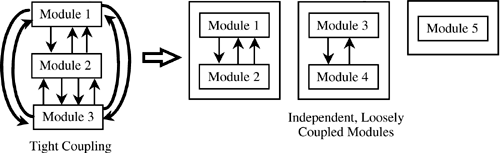
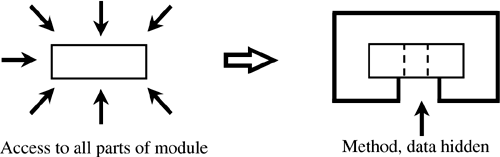
Security analysts must be able to understand each component as an independent unit and be assured of its limited effect on other components. A modular component usually has high cohesion and low coupling. By cohesion , we mean that all the elements of a component have a logical and functional reason for being there; every aspect of the component is tied to the component's single purpose. A highly cohesive component has a high degree of focus on the purpose; a low degree of cohesion means that the component's contents are an unrelated jumble of actions, often put together because of time-dependencies or convenience. Coupling refers to the degree with which a component depends on other components in the system. Thus, low or loose coupling is better than high or tight coupling, because the loosely coupled components are free from unwitting interference from other components. This difference in coupling is shown in Figure 3-17. Figure 3-17. Coupling. EncapsulationEncapsulation hides a component's implementation details, but it does not necessarily mean complete isolation. Many components must share information with other components, usually with good reason. However, this sharing is carefully documented so that a component is affected only in known ways by others in the system. Sharing is minimized so that the fewest interfaces possible are used. Limited interfaces reduce the number of covert channels that can be constructed . An encapsulated component's protective boundary can be translucent or transparent, as needed. Berard [BER00] notes that encapsulation is the "technique for packaging the information [inside a component] in such a way as to hide what should be hidden and make visible what is intended to be visible." Information HidingDevelopers who work where modularization is stressed can be sure that other components will have limited effect on the ones they write. Thus, we can think of a component as a kind of black box, with certain well-defined inputs and outputs and a well-defined function. Other components' designers do not need to know how the module completes its function; it is enough to be assured that the component performs its task in some correct manner. This concealment is the information hiding, depicted in Figure 3-18. Information hiding is desirable, because developers cannot easily and maliciously alter the components of others if they do not know how the components work. Figure 3-18. Information Hiding. These three characteristicsmodularity, encapsulation, and information hidingare fundamental principles of software engineering. They are also good security practices because they lead to modules that can be understood , analyzed , and trusted. Peer ReviewsWe turn next to the process of developing software. Certain practices and techniques can assist us in finding real and potential security flaws (as well as other faults) and fixing them before the system is turned over to the users. Of the many practices available for building what they call "solid software," Pfleeger et al. recommend several key techniques: [PFL01a]
Here, we look at each practice briefly , and we describe its relevance to security controls. We begin with peer reviews. You have probably been doing some form of review for as many years as you have been writing code: desk-checking your work or asking a colleague to look over a routine to ferret out any problems. Today, a software review is associated with several formal process steps to make it more effective, and we review any artifact of the development process, not just code. But the essence of a review remains the same: sharing a product with colleagues able to comment about its correctness. There are careful distinctions among three types of peer reviews:
A wise engineer who finds a fault can deal with it in at least three ways:
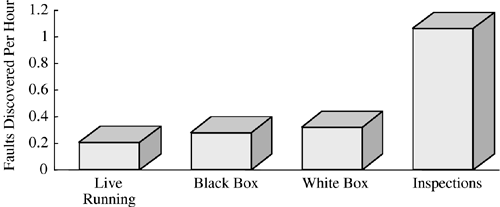
Peer reviews address this problem directly. Unfortunately , many organizations give only lip service to peer review, and reviews are still not part of mainstream software engineering activities. But there are compelling reasons to do reviews. An overwhelming amount of evidence suggests that various types of peer review in software engineering can be extraordinarily effective. For example, early studies at Hewlett-Packard in the 1980s revealed that those developers performing peer review on their projects enjoyed a very significant advantage over those relying only on traditional dynamic testing techniques, whether black-box or white-box. Figure 3-19 compares the fault discovery rate (that is, faults discovered per hour ) among white-box testing, black-box testing, inspections, and software execution. It is clear that inspections discovered far more faults in the same period of time than other alternatives. [GRA87] This result is particularly compelling for large, secure systems, where live running for fault discovery may not be an option. Figure 3-19. Fault Discovery Rate Reported at Hewlett-Packard. The effectiveness of reviews is reported repeatedly by researchers and practitioners . For instance, Jones [JON91] summarized the data in his large repository of project information to paint a picture of how reviews and inspections find faults relative to other discovery activities. Because products vary so wildly by size , Table 3-6 presents the fault discovery rates relative to the number of thousands of lines of code in the delivered product. Table 3-6. Faults Found During Discovery Activities.
The inspection process involves several important steps: planning, individual preparation, a logging meeting, rework , and reinspection. Details about how to perform reviews and inspections can be found in software engineering books such as [PFL01] and [PFL01a]. During the review process, it is important to keep careful track of what each reviewer discovers and how quickly he or she discovers it. This log suggests not only whether particular reviewers need training but also whether certain kinds of faults are harder to find than others. Additionally, a root cause analysis for each fault found may reveal that the fault could have been discovered earlier in the process. For example, a requirements fault that surfaces during a code review should probably have been found during a requirements review. If there are no requirements reviews, you can start performing them. If there are requirements reviews, you can examine why this fault was missed and then improve the requirements review process. The fault log can also be used to build a checklist of items to be sought in future reviews. The review team can use the checklist as a basis for questioning what can go wrong and where. In particular, the checklist can remind the team of security breaches, such as unchecked buffer overflows, that should be caught and fixed before the system is placed in the field. A rigorous design or code review can locate trapdoors , Trojan horses, salami attacks, worms, viruses, and other program flaws. A crafty programmer can conceal some of these flaws, but the chance of discovery rises when competent programmers review the design and code, especially when the components are small and encapsulated. Management should use demanding reviews throughout development to ensure the ultimate security of the programs. Hazard AnalysisHazard analysis is a set of systematic techniques intended to expose potentially hazardous system states. In particular, it can help us expose security concerns and then identify prevention or mitigation strategies to address them. That is, hazard analysis ferrets out likely causes of problems so that we can then apply an appropriate technique for preventing the problem or softening its likely consequences. Thus, it usually involves developing hazard lists, as well as procedures for exploring "what if" scenarios to trigger consideration of nonobvious hazards. The sources of problems can be lurking in any artifacts of the development or maintenance process, not just in the code, so a hazard analysis must be broad in its domain of investigation; in other words, hazard analysis is a system issue, not just a code issue. Similarly, there are many kinds of problems, ranging from incorrect code to unclear consequences of a particular action. A good hazard analysis takes all of them into account. Although hazard analysis is generally good practice on any project, it is required in some regulated and critical application domains, and it can be invaluable for finding security flaws. It is never too early to be thinking about the sources of hazards; the analysis should begin when you first start thinking about building a new system or when someone proposes a significant upgrade to an existing system. Hazard analysis should continue throughout the system life cycle; you must identify potential hazards that can be introduced during system design, installation, operation, and maintenance. A variety of techniques support the identification and management of potential hazards. Among the most effective are hazard and operability studies ( HAZOP ), failure modes and effects analysis ( FMEA ), and fault tree analysis ( FTA ). HAZOP is a structured analysis technique originally developed for the process control and chemical plant industries. Over the last few years it has been adapted to discover potential hazards in safety-critical software systems. FMEA is a bottom-up technique applied at the system component level. A team identifies each component's possible faults or fault modes; then, it determines what could trigger the fault and what systemwide effects each fault might have. By keeping system consequences in mind, the team often finds possible system failures that are not made visible by other analytical means. FTA complements FMEA. It is a top-down technique that begins with a postulated hazardous system malfunction. Then, the FTA team works backwards to identify the possible pre cursors to the mishap. By tracing back from a specific hazardous malfunction, we can locate unexpected contributors to mishaps, and we then look for opportunities to mitigate the risks. Each of these techniques is clearly useful for finding and preventing security breaches. We decide which technique is most appropriate by understanding how much we know about causes and effects. For example, Table 3-7 suggests that when we know the cause and effect of a given problem, we can strengthen the description of how the system should behave. This clearer picture will help requirements analysts understand how a potential problem is linked to other requirements. It also helps designers understand exactly what the system should do and helps testers know how to test to verify that the system is behaving properly. If we can describe a known effect with unknown cause, we use deductive techniques such as fault tree analysis to help us understand the likely causes of the unwelcome behavior. Conversely, we may know the cause of a problem but not understand all the effects; here, we use inductive techniques such as failure modes and effects analysis to help us trace from cause to all possible effects. For example, suppose we know that a subsystem is unprotected and might lead to a security failure, but we do not know how that failure will affect the rest of the system. We can use FMEA to generate a list of possible effects and then evaluate the trade-offs between extra protection and possible problems. Finally, to find problems about which we may not yet be aware, we can perform an exploratory analysis such as a hazard and operability study. Table 3-7. Perspectives for Hazard Analysis (adapted from [PFL01]).
We see in Chapter 8 that hazard analysis is also useful for determining vulnerabilities and mapping them to suitable controls. TestingTesting is a process activity that homes in on product quality: making the product failure free or failure tolerant. Each software problem (especially when it relates to security) has the potential not only for making software fail but also for adversely affecting a business or a life. Thomas Young, head of NASA's investigation of the Mars lander failure, noted that "One of the things we kept in mind during the course of our review is that in the conduct of space missions, you get only one strike, not three. Even if thousands of functions are carried out flawlessly, just one mistake can be catastrophic to a mission." [NAS00] This same sentiment is true for security: The failure of one control exposes a vulnerability that is not ameliorated by any number of functioning controls. Testers improve software quality by finding as many faults as possible and by writing up their findings carefully so that developers can locate the causes and repair the problems if possible. Testing usually involves several stages. First, each program component is tested on its own, isolated from the other components in the system. Such testing, known as module testing, component testing, or unit testing , verifies that the component functions properly with the types of input expected from a study of the component's design. Unit testing is done in a controlled environment whenever possible so that the test team can feed a predetermined set of data to the component being tested and observe what output actions and data are produced. In addition, the test team checks the internal data structures, logic, and boundary conditions for the input and output data. When collections of components have been subjected to unit testing, the next step is ensuring that the interfaces among the components are defined and handled properly. Indeed, interface mismatch can be a significant security vulnerability. Integration testing is the process of verifying that the system components work together as described in the system and program design specifications. Once we are sure that information is passed among components in accordance with the design, we test the system to ensure that it has the desired functionality. A function test evaluates the system to determine whether the functions described by the requirements specification are actually performed by the integrated system. The result is a functioning system. The function test compares the system being built with the functions described in the developers' requirements specification. Then, a performance test compares the system with the remainder of these software and hardware requirements. It is during the function and performance tests that security requirements are examined, and the testers confirm that the system is as secure as it is required to be. When the performance test is complete, developers are certain that the system functions according to their understanding of the system description. The next step is conferring with the customer to make certain that the system works according to customer expectations. Developers join the customer to perform an acceptance test , in which the system is checked against the customer's requirements description. Upon completion of acceptance testing, the accepted system is installed in the environment in which it will be used. A final installation test is run to make sure that the system still functions as it should. However, security requirements often state that a system should not do something. As Sidebar 3-6 demonstrates , it is difficult to demonstrate absence rather than presence. The objective of unit and integration testing is to ensure that the code implemented the design properly; that is, that the programmers have written code to do what the designers intended. System testing has a very different objective: to ensure that the system does what the customer wants it to do. Regression testing, an aspect of system testing, is particularly important for security purposes. After a change is made to enhance the system or fix a problem, regression testing ensures that all remaining functions are still working and performance has not been degraded by the change. Each of the types of tests listed here can be performed from two perspectives: black box and clear box (sometimes called white box). Black-box testing treats a system or its components as black boxes; testers cannot "see inside" the system, so they apply particular inputs and verify that they get the expected output. Clear-box testing allows visibility. Here, testers can examine the design and code directly, generating test cases based on the code's actual construction. Thus, clear-box testing knows that component X uses CASE statements and can look for instances in which the input causes control to drop through to an unexpected line. Black-box testing must rely more on the required inputs and outputs because the actual code is not available for scrutiny.
The mix of techniques appropriate for testing a given system depends on the system's size, application domain, amount of risk, and many other factors. But understanding the effectiveness of each technique helps us know what is right for each particular system. For example, Olsen [OLS93] describes the development at Contel IPC of a system containing 184,000 lines of code. He tracked faults discovered during various activities, and found differences:
Only 0.1 percent of the faults were revealed after the system was placed in the field. Thus, Olsen's work shows the importance of using different techniques to uncover different kinds of faults during development; it is not enough to rely on a single method for catching all problems. Who does the testing? From a security standpoint, independent testing is highly desirable; it may prevent a developer from attempting to hide something in a routine, or keep a subsystem from controlling the tests that will be applied to it. Thus, independent testing increases the likelihood that a test will expose the effect of a hidden feature. Good DesignWe saw earlier in this chapter that modularity, information hiding, and encapsulation are characteristics of good design. Several design- related process activities are particularly helpful in building secure software:
We describe each of these activities in turn. Designs should try to anticipate faults and handle them in ways that minimize disruption and maximize safety and security. Ideally, we want our system to be fault free. But in reality, we must assume that the system will fail, and we make sure that unexpected failure does not bring the system down, destroy data, or destroy life. For example, rather than waiting for the system to fail (called passive fault detection ), we might construct the system so that it reacts in an acceptable way to a failure's occurrence. Active fault detection could be practiced by, for instance, adopting a philosophy of mutual suspicion. Instead of assuming that data passed from other systems or components are correct, we can always check that the data are within bounds and of the right type or format. We can also use redundancy , comparing the results of two or more processes to see that they agree before using their result in a task. If correcting a fault is too risky, inconvenient, or expensive, we can choose instead to practice fault tolerance : isolating the damage caused by the fault and minimizing disruption to users. Although fault tolerance is not always thought of as a security technique, it supports the idea, discussed in Chapter 8, that our security policy allows us to choose to mitigate the effects of a security problem instead of preventing it. For example, rather than install expensive security controls, we may choose to accept the risk that important data may be corrupted. If in fact a security fault destroys important data, we may decide to isolate the damaged data set and automatically revert to a backup data set so that users can continue to perform system functions. More generally, we can design or code defensively, just as we drive defensively, by constructing a consistent policy for handling failures. Typically, failures include
We can build into the design a particular way of handling each problem, selecting from one of three ways:
This consistency of design helps us check for security vulnerabilities; we look for instances that are different from the standard approach. Design rationales and history tell us the reasons the system is built one way instead of another. Such information helps us as the system evolves, so we can integrate the design of our security functions without compromising the integrity of the system's overall design. Moreover, the design history enables us to look for patterns, noting what designs work best in which situations. For example, we can reuse patterns that have been successful in preventing buffer overflows, in ensuring data integrity, or in implementing user password checks. PredictionAmong the many kinds of prediction we do during software development, we try to predict the risks involved in building and using the system. As we see in depth in Chapter 8, we must postulate which unwelcome events might occur and then make plans to avoid them or at least mitigate their effects. Risk prediction and management are especially important for security, where we are always dealing with unwanted events that have negative consequences. Our predictions help us decide which controls to use and how many. For example, if we think the risk of a particular security breach is small, we may not want to invest a large amount of money, time, or effort in installing sophisticated controls. Or we may use the likely risk impact to justify using several controls at once, a technique called "defense in depth." Static AnalysisBefore a system is up and running, we can examine its design and code to locate and repair security flaws. We noted earlier that the peer review process involves this kind of scrutiny. But static analysis is more than peer review, and it is usually performed before peer review. We can use tools and techniques to examine the characteristics of design and code to see if the characteristics warn us of possible faults lurking within. For example, a large number of levels of nesting may indicate that the design or code is hard to read and understand, making it easy for a malicious developer to bury dangerous code deep within the system. To this end, we can examine several aspects of the design and code:
The control flow is the sequence in which instructions are executed, including iterations and loops . This aspect of design or code can also tell us how often a particular instruction or routine is executed. Data flow follows the trail of a data item as it is accessed and modified by the system. Many times, transactions applied to data are complex, and we use data flow measures to show us how and when each data item is written, read, and changed. The data structure is the way in which the data are organized, independent of the system itself. For instance, if the data are arranged as lists, stacks, or queues, the algorithms for manipulating them are likely to be well understood and well defined. There are many approaches to static analysis, especially because there are so many ways to create and document a design or program. Automated tools are available to generate not only numbers (such as depth of nesting or cyclomatic number) but also graphical depictions of control flow, data relationships, and the number of paths from one line of code to another. These aids can help us see how a flaw in one part of a system can affect other parts . Configuration ManagementWhen we develop software, it is important to know who is making which changes to what and when:
We want some degree of control over the software changes so that one change does not inadvertently undo the effect of a previous change. And we want to control what is often a proliferation of different versions and releases. For instance, a product might run on several different platforms or in several different environments, necessitating different code to support the same functionality. Configuration management is the process by which we control changes during development and maintenance, and it offers several advantages in security. In particular, configuration management scrutinizes new and changed code to ensure, among other things, that security flaws have not been inserted, intentionally or accidentally . Four activities are involved in configuration management:
Configuration identification sets up baselines to which all other code will be compared after changes are made. That is, we build and document an inventory of all components that comprise the system. The inventory includes not only the code you and your colleagues may have created, but also database management systems, third-party software, libraries, test cases, documents, and more. Then, we "freeze" the baseline and carefully control what happens to it. When a change is proposed and made, it is described in terms of how the baseline changes. Configuration control and configuration management ensure we can coordinate separate, related versions. For example, there may be closely related versions of a system to execute on 16-bit and 32-bit processors. Three ways to control the changes are separate files, deltas, and conditional compilation. If we use separate files, we have different files for each release or version. For example, we might build an encryption system in two configurations: one that uses a short key length, to comply with the law in certain countries , and another that uses a long key. Then, version 1 may be composed of components A 1 through A k and B 1 , while version 2 is A 1 through A k and B 2 , where B 1 and B 2 do key length. That is, the versions are the same except for the separate key processing files. Alternatively, we can designate a particular version as the main version of a system, and then define other versions in terms of what is different. The difference file, called a delta , contains editing commands to describe the ways to transform the main version into the variation. Finally, we can do conditional compilation , whereby a single code component addresses all versions, relying on the compiler to determine which statements to apply to which versions. This approach seems appealing for security applications because all the code appears in one place. However, if the variations are very complex, the code may be very difficult to read and understand. Once a configuration management technique is chosen and applied, the system should be audited regularly. A configuration audit confirms that the baseline is complete and accurate, that changes are recorded, that recorded changes are made, and that the actual software (that is, the software as used in the field) is reflected accurately in the documents. Audits are usually done by independent parties taking one of two approaches: reviewing every entry in the baseline and comparing it with the software in use or sampling from a larger set just to confirm compliance. For systems with strict security constraints, the first approach is preferable, but the second approach may be more practical. Finally, status accounting records information about the components: where they came from (for instance, purchased, reused, or written from scratch), the current version, the change history, and pending change requests . All four sets of activities are performed by a configuration and change control board , or CCB. The CCB contains representatives from all organizations with a vested interest in the system, perhaps including customers, users, and developers. The board reviews all proposed changes and approves changes based on need, design integrity, future plans for the software, cost, and more. The developers implementing and testing the change work with a program librarian to control and update relevant documents and components; they also write detailed documentation about the changes and test results. Configuration management offers two advantages to those of us with security concerns: protecting against unintentional threats and guarding against malicious ones. Both goals are addressed when the configuration management processes protect the integrity of programs and documentation. Because changes occur only after explicit approval from a configuration management authority, all changes are also carefully evaluated for side effects. With configuration management, previous versions of programs are archived, so a developer can retract a faulty change when necessary. Malicious modification is made quite difficult with a strong review and configuration management process in place. In fact, as presented in Sidebar 3-7, poor configuration control has resulted in at least one system failure; that sidebar also confirms the principle of easiest penetration from Chapter 1. Once a reviewed program is accepted for inclusion in a system, the developer cannot sneak in to make small, subtle changes, such as inserting trapdoors. The developer has access to the running production program only through the CCB, whose members are alert to such security breaches.
Lessons from MistakesOne of the easiest things we can do to enhance security is learn from our mistakes. As we design and build systems, we can document our decisionsnot only what we decided to do and why, but also what we decided not to do and why. Then, after the system is up and running, we can use information about the failures (and how we found and fixed the underlying faults) to give us a better understanding of what leads to vulnerabilities and their exploitation. From this information, we can build checklists and codify guidelines to help ourselves and others. That is, we do not have to make the same mistake twice, and we can assist other developers in staying away from the mistakes we made. The checklists and guidelines can be invaluable, especially during reviews and inspections, in helping reviewers look for typical or common mistakes that can lead to security flaws. For instance, a checklist can remind a designer or programmer to make sure that the system checks for buffer overflows. Similarly, the guidelines can tell a developer when data require password protection or some other type of restricted access. Proofs of Program CorrectnessA security specialist wants to be certain that a given program computes a particular result, computes it correctly, and does nothing beyond what it is supposed to do. Unfortunately, results in computer science theory (see [PFL85] for a description) indicate that we cannot know with certainty that two programs do exactly the same thing. That is, there can be no general decision procedure which, given any two programs, determines if the two are equivalent. This difficulty results from the " halting problem," which states that there is no general technique to determine whether an arbitrary program will halt when processing an arbitrary input. In spite of this disappointing general result, a technique called program verification can demonstrate formally the "correctness" of certain specific programs. Program verification involves making initial assertions about the inputs and then checking to see if the desired output is generated. Each program statement is translated into a logical description about its contribution to the logical flow of the program. Finally, the terminal statement of the program is associated with the desired output. By applying a logic analyzer, we can prove that the initial assumptions, through the implications of the program statements, produce the terminal condition. In this way, we can show that a particular program achieves its goal. Sidebar 3-8 presents the case for appropriate use of formal proof techniques. We study an example of program verification in Chapter 5. Proving program correctness, although desirable and useful, is hindered by several factors.
Program verification systems are being improved constantly. Larger programs are being verified in less time than before. As program verification continues to mature, it may become a more important control to ensure the security of programs. Programming Practice ConclusionsNone of the development controls described here can guarantee the security or quality of a system. As Brooks often points out [BRO87], the software development community seeks, but is not likely to find, a "silver bullet": a tool, technique, or method that will dramatically improve the quality of software developed. "There is no single development in either technology or management technique that by itself promises even one order-of-magnitude improvement in productivity, in reliability, in simplicity." He bases this conjecture on the fact that software is complex, it must conform to the infinite variety of human requirements, and it is abstract or invisible, leading to its being hard to draw or envision. While software development technologiesdesign tools, process improvement models, development methodologieshelp the process, software development is inherently complicated and, therefore, prone to errors. This uncertainty does not mean that we should not seek ways to improve; we should. However, we should be realistic and accept that no technique is sure to prevent erroneous software. We should incorporate in our development practices those techniques that reduce uncertainty and reduce risk. At the same time, we should be skeptical of new technology, making sure each one can be shown to be reliable and effective. In the early 1970s Paul Karger and Roger Schell led a team to evaluate the security of the Multics system for the U.S. Air Force. They republished their original report [KAR74] thirty years later with a thoughtful analysis of how the security of Multics compares to the security of current systems [KAR02]. Among their observations were that buffer overflows were almost impossible in Multics because of support from the programming language, and security was easier to ensure because of the simplicity and structure of the Multics design. Karger and Schell argue that we can and have designed and implemented systems with both functionality and security. Operating System Controls on Use of ProgramsDevelopment controls are usually applied to large development projects in a variety of software production environments. However, not every system is developed in the ways we described above; sometimes projects are too small or too resource constrained to justify the extra resources needed for reviews and configuration control boards , for example. Although not the most desirable situation, the lack of proper controls is often a reality of development life. Even when development controls are incorporated in an organization's standard development process, it is difficult to ensure that each developer or user has followed official guidelines or standards. For these reasons, some of the software security enforcement is implemented by the operating system. We examine operating systems in some detail in Chapters 4 and 5, in which we see what security features they provide for their users. In this chapter, we outline how an operating system can protect against some of the design and implementation flaws we have discussed here. Trusted SoftwareWe say that software is trusted software if we know that the code has been rigorously developed and analyzed, giving us reason to trust that the code does what it is expected to do and nothing more. Typically, trusted code can be a foundation on which other, untrusted, code runs. That is, the untrusted system's quality depends, in part, on the trusted code; the trusted code establishes the baseline for security of the overall system. In particular, an operating system can be trusted software when there is a basis for trusting that it correctly controls the accesses of components or systems run from it. For example, the operating system might be expected to limit users' accesses to certain files. We look at trusted operating systems in more detail in Chapter 5. To trust any program, we base our trust on rigorous analysis and testing, looking for certain key characteristics:
Trusted software is often used as a safe way for general users to access sensitive data. Trusted programs are used to perform limited (safe) operations for users without allowing the users to have direct access to sensitive data. Mutual SuspicionPrograms are not always trustworthy. Even with an operating system to enforce access limitations, it may be impossible or infeasible to bound the access privileges of an untested program effectively. In this case, the user U is legitimately suspicious of a new program P. However, program P may be invoked by another program, Q. There is no way for Q to know that P is correct or proper, any more than a user knows that of P. Therefore, we use the concept of mutual suspicion to describe the relationship between two programs. Mutually suspicious programs operate as if other routines in the system were malicious or incorrect. A calling program cannot trust its called subprocedures to be correct, and a called subprocedure cannot trust its calling program to be correct. Each protects its interface data so that the other has only limited access. For example, a procedure to sort the entries in a list cannot be trusted not to modify those elements, while that procedure cannot trust its caller to provide any list at all or to supply the number of elements predicted . ConfinementConfinement is a technique used by an operating system on a suspected program. A confined program is strictly limited in what system resources it can access. If a program is not trustworthy, the data it can access are strictly limited. Strong confinement would be helpful in limiting the spread of viruses. Since a virus spreads by means of transitivity and shared data, all the data and programs within a single compartment of a confined program can affect only the data and programs in the same compartment. Therefore, the virus can spread only to things in that compartment; it cannot get outside the compartment . Access LogAn access or audit log is a listing of who accessed which computer objects, when, and for what amount of time. Commonly applied to files and programs, this technique is less a means of protection than an after-the-fact means of tracking down what has been done. Typically, an access log is a protected file or a dedicated output device (such as a printer) to which a log of activities is written. The logged activities can be such things as logins and logouts, accesses or attempted accesses to files or directories, execution of programs, and uses of other devices. Failures are also logged. It may be less important to record that a particular user listed the contents of a permitted directory than that the same user tried to but was prevented from listing the contents of a protected directory. One failed login may result from a typing error, but a series of failures in a short time from the same device may result from the attempt of an intruder to break into the system. Unusual events in the audit log should be scrutinized. For example, a new program might be tested in a dedicated, controlled environment. After the program has been tested, an audit log of all files accessed should be scanned to determine if there are any unexpected file accesses, the presence of which could point to a Trojan horse in the new program. We examine these two important aspects of operating system control in more detail in the next two chapters. Administrative ControlsNot all controls can be imposed automatically by the computing system. Sometimes controls are applied instead by the declaration that certain practices will be followed. These controls, encouraged by managers and administrators, are called administrative controls. We look at them briefly here and in more depth in Chapter 8. Standards of Program DevelopmentNo software development organization worth its salt allows its developers to produce code at any time in any manner. The good software development practices described earlier in this chapter have all been validated by many years of practice. Although none is Brooks's mythical "silver bullet" that guarantees program correctness, quality, or security, they all add demonstrably to the strength of programs. Thus, organizations prudently establish standards on how programs are developed. Even advocates of agile methods, which give developers an unusual degree of flexibility and autonomy, encourage goal-directed behavior based on past experience and past success. Standards and guidelines can capture wisdom from previous projects and increase the likelihood that the resulting system will be correct. In addition, we want to ensure that the systems we build are reasonably easy to maintain and are compatible with the systems with which they interact. We can exercise some degree of administrative control over software development by considering several kinds of standards or guidelines.
Standardization improves the conditions under which all developers work by establishing a common framework so that no one developer is indispensable . It also allows carryover from one project to another; lessons learned on previous projects become available for use by all on the next project. Standards also assist in maintenance, since the maintenance team can find required information in a well-organized program. However, we must take care so that the standards do not unnecessarily constrain the developers. Firms concerned about security and committed to following software development standards often perform security audits . In a security audit, an independent security evaluation team arrives unannounced to check each project's compliance with standards and guidelines. The team reviews requirements, designs, documentation, test data and plans, and code. Knowing that documents are routinely scrutinized, a developer is unlikely to put suspicious code in a component in the first place. Separation of DutiesBanks often break tasks into two or more pieces to be performed by separate employees. Employees are less tempted to do wrong if they need the cooperation of another employee to do so. We can use the same approach during software development. Modular design and implementation force developers to cooperate in order to achieve illicit results. Independent test teams test a component or subsystem more rigorously if they are not the authors or designers. These forms of separation lead to a higher degree of security in programs. Program Controls in GeneralThis section has explored how to control for faults during the program development process. Some controls apply to how a program is developed, and others establish restrictions on the program's use. The best is a combination, the classic layered defense. Is one control essential? Can one control be skipped if another is used? Although these are valid questions, the security community does not have answers. Software development is both an art and science. As a creative activity, it is subject to the variety of human minds, but also to the fallibility of humans . We cannot rigidly control the process and get the same results time after time, as we can with a machine. But creative humans can learn from their mistakes and shape their creations to account for fundamental principles. Just as a great painter will achieve harmony and balance in a painting, a good software developer who truly understands security will incorporate security into all phases of development. Thus, even if you never become a security professional, this exposure to the needs and shortcomings of security will influence many of your future actions. Unfortunately, many developers do not have the opportunity to become sensitive to security issues, which probably accounts for many of the unintentional security faults in today's programs. |
| < Free Open Study > |

EAN: 2147483647
Pages: 129