Flylib.com

Books Software


62 Attach a Note to a Cell

 <  Day Day Up  >  

62 Attach a Note to a Cell

You've seen the yellow sticky notes that some people plaster all over their desks. The reason for their popularity is that these notes work well for reminders. You can put them on just about anything, and although they stick for a while, they come right off without removing what's underneath and without leaving sticky gunk behind.

Before You Begin

46 Print a Spreadsheet

47 Find and Replace Data


See Also

64 About Calc Styles and Templates


Calc offers the electronic equivalent of these notes. You can attach notes to cells inside your spreadsheets. The notes can remain yours alone, meaning you don't print them when you print the sheets, or you can print the notes for others to see when you print the spreadsheet's contents.

TIP

graphics/tipbw_icon.gif

Suppose you notice an anomaly in a report, such as a division's forecast is lower than expected. You can attach a note to that cell to follow up and find out where the problem lies.


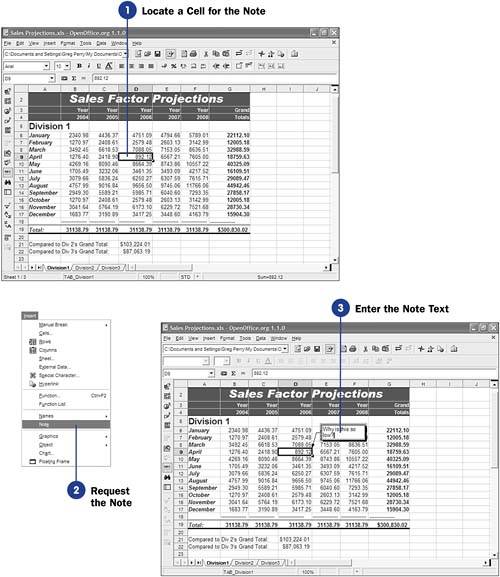
  1. Locate a Cell for the Note

    When you want to attach a note to a cell, click to select the cell.

  2. Request the Note

    Select Note from the Insert menu to request a note. Calc then displays the yellow note box beside the cell with a callout pointing to the cell the note goes with.

    NOTE

    graphics/notebw_icon.gif

    You can attach a note to a single cell only, not a range of cells.

  3. Enter the Note Text

    The text cursor appears inside the note so that you can type the note's text. As you type, the note expands to make more room if needed. You can also drag the note's edges to expand or contract the size of the note.

    graphics/08inf08.jpg graphics/08inf09.jpg

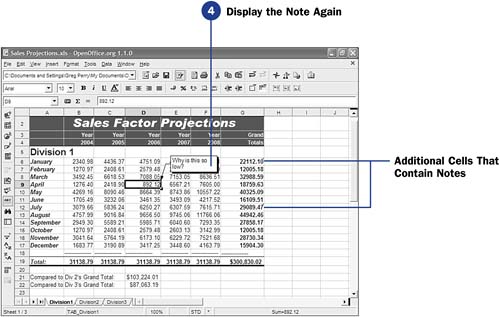
  4. Display the Note Again

    Once you enter the note, you go about working in your spreadsheet as usual. Calc indicates which cells contain notes by displaying a small red box in each cell's upper-right corner that contains a note. To see the note in any cell, hover your mouse pointer over that cell, and Calc displays the note.

    TIP

    graphics/tipbw_icon.gif

    To edit the note, right-click the cell, select Show Note , and edit the text that appears. Right-click and deselect Show Note to hide the note.

    When you print your spreadsheet, you must right-click and select Show Note on any and all cells with notes that you want printed with the spreadsheet.

 <  Day Day Up  >  
 <  Day Day Up  >  

63 Conditionally Format Data

Conditional formatting enables you to make your spreadsheets respond to the data they contain. When certain conditions arise, you can draw attention to particular cell entries by automatically making those cells display differently from the cells around those exceptions.

Before You Begin

59 Format Cells

61 Set Up Calc Page Formatting


Most often, users place conditional formats on cells that they want to watch (for example, for extraordinarily high or low conditions that might require special attention).

See Also

69 Protect Spreadsheet Data


The way you indicate if a condition is met is to specify a value and a condition that must become true before the format takes place. Here's a list of the available conditions:

  • Less than

  • Greater than

  • Equal to

  • Not equal to

  • Less than or equal to

  • Greater than or equal to

  • Between (requires two values for the condition)

  • Not between (requires two values for the condition)

KEY TERM

graphics/newtermbw_icon.gif

Conditional formatting ” The process of formatting cells automatically, based on the data they contain. When the data changes and triggers a predetermined condition, Calc automatically changes the cell's format.


  1. Request Conditional Formatting

    Click to select the cell or range on which you want to apply a conditional format. Select Conditional Formatting from the Format menu. The Conditional Formatting dialog box appears.

    graphics/08inf10.jpg

  2. Enter the Format Conditions

    You can apply up to three conditions for the cell you've selected to format conditionally. Most often, you'll probably only need to use a single conditional format.

    Click to select either Cell value is or Formula is to indicate how the conditional format is to apply. If the format depends on a value, as it usually will, select Cell value is . If the format depends on a formula, select Formula is and enter a cell reference for that formula to the right of the option.

    Select the Cell Style setting that you want Calc to use for the data's display if the condition is met by data within the cell. Any time the data changes to make the condition true, Calc applies the format style to the cell.

    NOTE

    graphics/notebw_icon.gif

    The available formats are Default, Heading, Heading1, Result , and Result2 . If you want to display a different format, you'll have to select one of these styles and change its format so it appears the way you prefer (see 64 About Calc Styles and Templates ).

    Select the condition, such as Less than . If the cell's value ever goes below the value you enter next to the condition, Calc changes the cell's format to match the style you select. Two of the conditions, Between and Not between , require two values for the condition to be matched. If you select either of these conditions, Calc provides two text boxes so you can enter both values that define the condition.

  3. View the Spreadsheet Again

    The Conditional Formatting dialog box consumes quite a bit of space, and while you're filling it in, you may need to see your data on the sheet beneath the dialog box. If so, click the Shrink button. Calc temporarily shrinks the Conditional Formatting dialog box to a thin line so you can view the spreadsheet once again.

    Click the Shrink button once again to return the Conditional Formatting dialog box to its original size so that you can complete the formatting. After setting up the conditional format, click OK to apply it.

    NOTE

    graphics/notebw_icon.gif

    Calc constantly monitors cell contents. Every time you enter a new value or the spreadsheet recalculates, Calc tests all the conditional formats and applies any of those formats if needed.

  4. Test the Format

    If the cell never matches the condition, the cell's format will remain unchanged. If, however, the cell does pass the condition, Calc applies the format so it becomes noticeable to anyone looking at the spreadsheet.

 <  Day Day Up  >